Motobu Town, Okinawa Prefecture
Bise Fukugi Tree-lined Lane Walk to the sea through a tunnel of fukugi trees that have sheltered village homes from the ocean wind
Step into the fukugi lane and the sounds outside seem to fall away. All I hear are leaves brushing overhead and my own footsteps. Whenever I visit Okinawa, I come back to walk this lane in Bise. Whether I came to take photos, draw, or feel how the trees block the wind, by the time I leave, I’m walking at about half my usual pace.
In summer, the dappled sunlight was so bright I kept looking down at my feet. On a cloudy winter day, I could see the trunks one by one, all the way to the end of the lane. The same trees show me completely different things when the light changes.

SpringMarch
I wanted to photograph the tunnel of leaves after the rain
Before bed, I checked the forecast again and again: the rain was supposed to stop overnight. By March, the air in Motobu was beginning to feel a little like spring. The last time I visited, the rows of trunks stood out beneath a cloudy sky. This time, I wanted to see the lane just after the rain, its wet leaves forming a tunnel overhead. I left my lodging first thing in the morning and drove to Bise in Motobu Town.
I parked in a car park near the lane and stepped onto it. At once, the smell of earth and wet leaves rose up around me. Why does the air after rain make me want to breathe so deeply? Light caught the leaves overhead, and as I walked, their sheen seemed to shift from one spot to another.
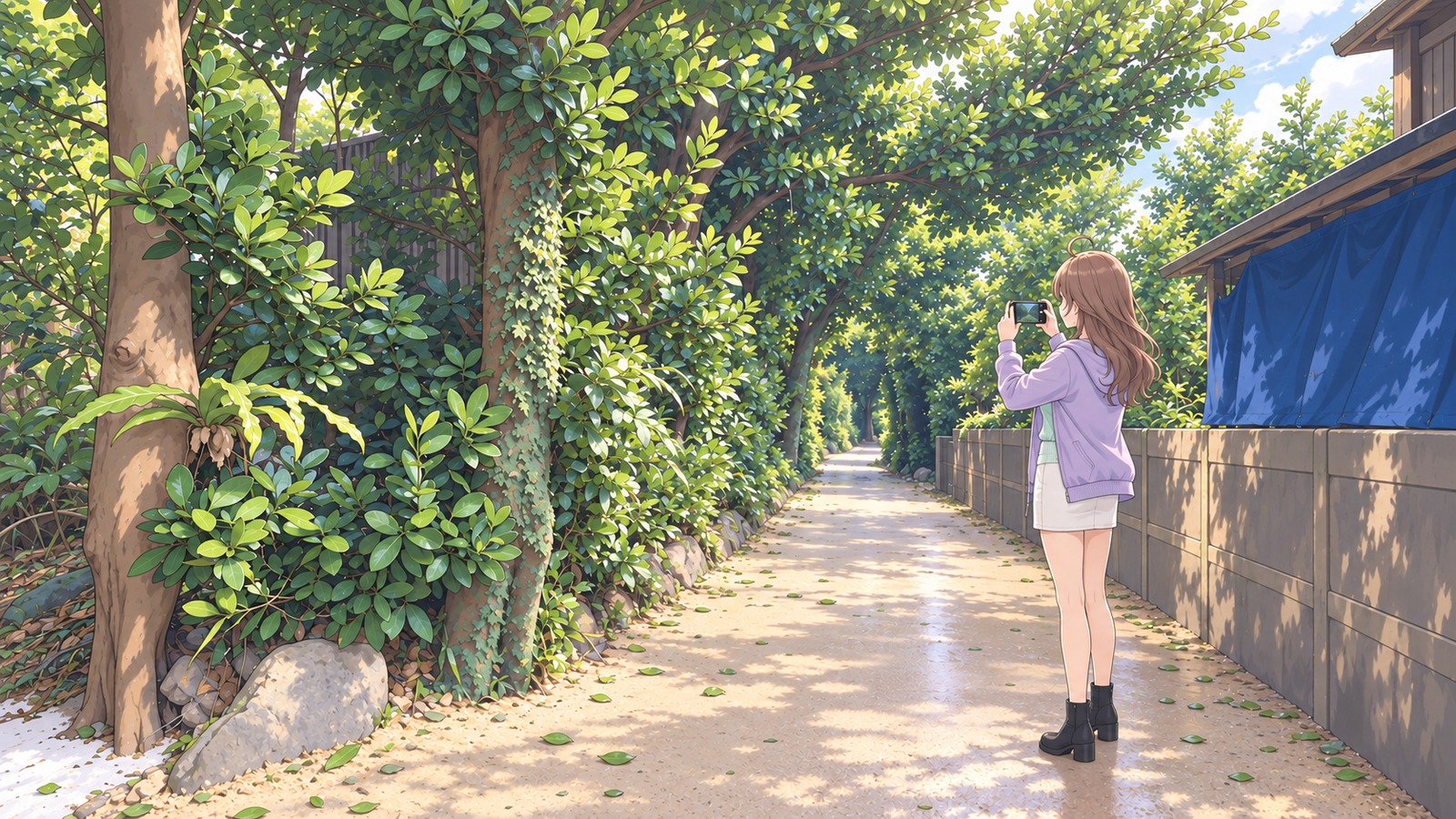
I turned my phone sideways, trying to fit the trunks and the lane into one shot. I wanted to include the trees on the left, the block wall and blue tarp on the right, and the narrow path stretching ahead. Tilt the phone just a little and everything in the frame changed. I froze, thinking, “Wait, what am I supposed to leave out?”
When I lowered my phone, I noticed branches that had been just outside the frame. The more I tried to capture everything, the less I seemed to see. I pushed my sleeves up a little and held the phone lower this time, taking a shot that drew the eye down the lane.
Puddles were scattered along the lane. When I leaned over, the overlapping leaves and blue sky appeared upside down in the water. I crouched for another shot, this time of the lane reflected in a puddle. The tunnel was overhead and in the puddles below—two tunnels at once.
Looking closely, I could see the leaves growing in opposite pairs, and the branches were dense with them. Maybe the tunnel looked so bright because light was bouncing off raindrops caught between the overlapping leaves. This must have been the light I wanted to photograph.
They say Bise is laid out on a grid. Every time I turned a corner, another straight lane of trees stretched ahead. It felt like a maze, but somehow I never got lost. The oldest fukugi is said to be around 300 years old, so I kept stopping whenever I spotted a thick trunk, thinking, “Could this be it?” After a while, every trunk started to look like the one, so I gave up searching.
Around one corner, rain-soaked flowers were blooming in a garden just beyond the wall. I’d been looking at nothing but the green of the lane, so the sudden burst of color made me catch my breath. Someone who lives here must have planted them. Taking a photo without asking felt wrong, so I quietly took them in instead.
I’d packed a Motobu acerola jelly drink in my bag, but I completely forgot about it while I was taking photos. The lane to Bisezaki Cape is about 1 km long. At last I put my phone away and walked slowly, from one trunk to the next. Back at the car park, I opened the jelly. Its sweet-tart taste was just right after my early start. I had the photos I wanted of the lane after the rain, so I decided to come back and photograph it on a sunny day before my stay was over.
SummerJuly–August
I opened my jelly and heard the leaves
National Route 449 runs north along the coast of the Motobu Peninsula. With the roof down, salt-scented sea air rushed straight into my car. Each time I came out of a bend, the water beyond the window looked a little brighter; even with my eyes on the road, the blue glimmered at the edge of my vision. I had the music up a little louder than usual when I spotted an onigiri-shaped “449” road marker and gave it a little nod. A route number on a trip feels like its own tiny souvenir.
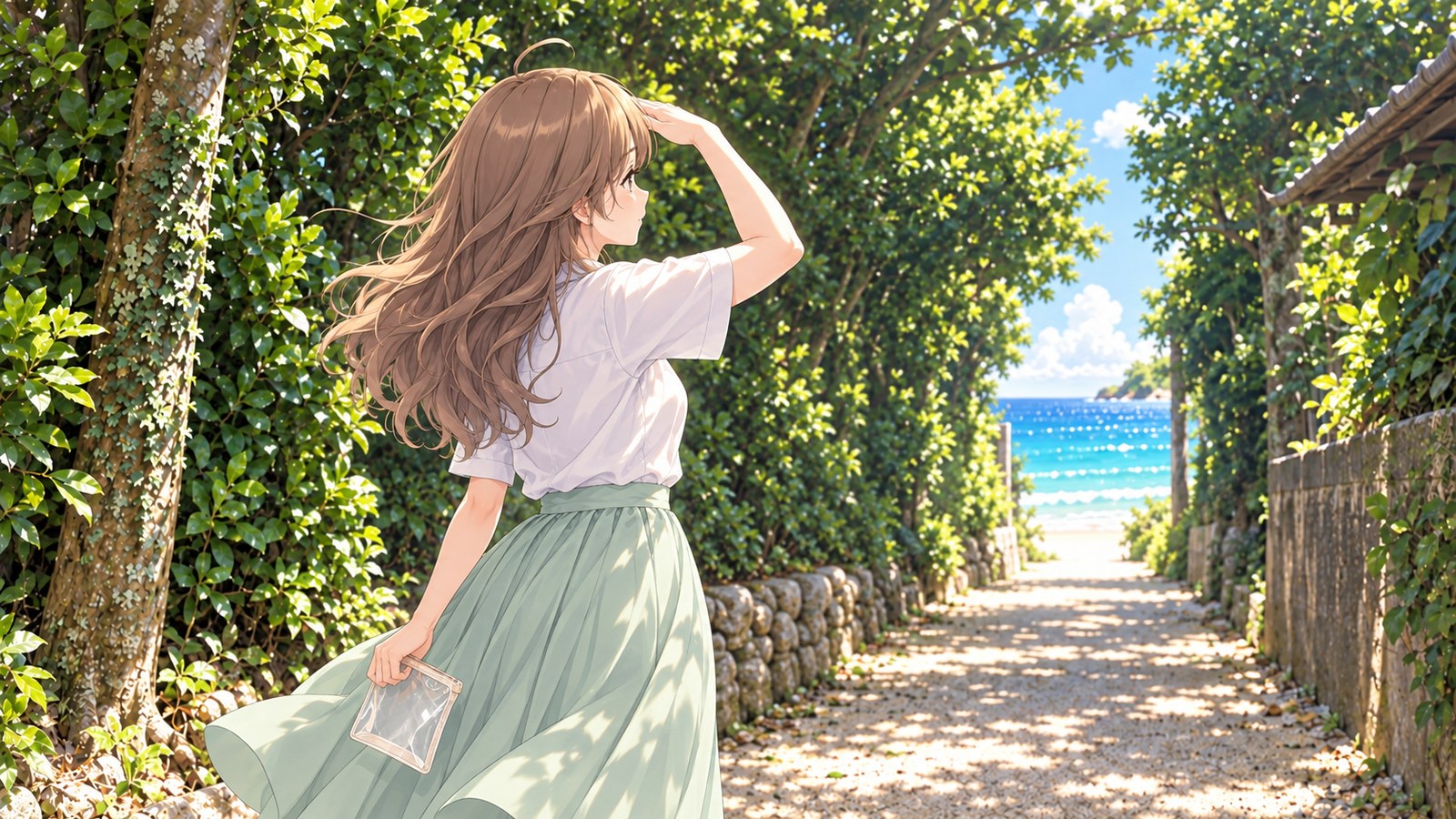
That summer, I drove south through Kyushu, then took the ferry from Kagoshima to Okinawa with my car. It was my first time driving my own car in Okinawa. I’d come to Bise to walk in the shade on a midsummer afternoon. I parked in a car park near the lane and stepped into the leafy tunnel. Leaves covered the sky above me. Even in the middle of a summer day, I could see all the way to the end without squinting. Trunks ran along the left; a block wall and blue tarp bordered the right. As I walked between them, the patches of light at my feet shifted shape one by one. The breeze in the shade felt so much better than the sunlight I’d been soaking up with the roof down. It lifted the hem of my mint skirt.
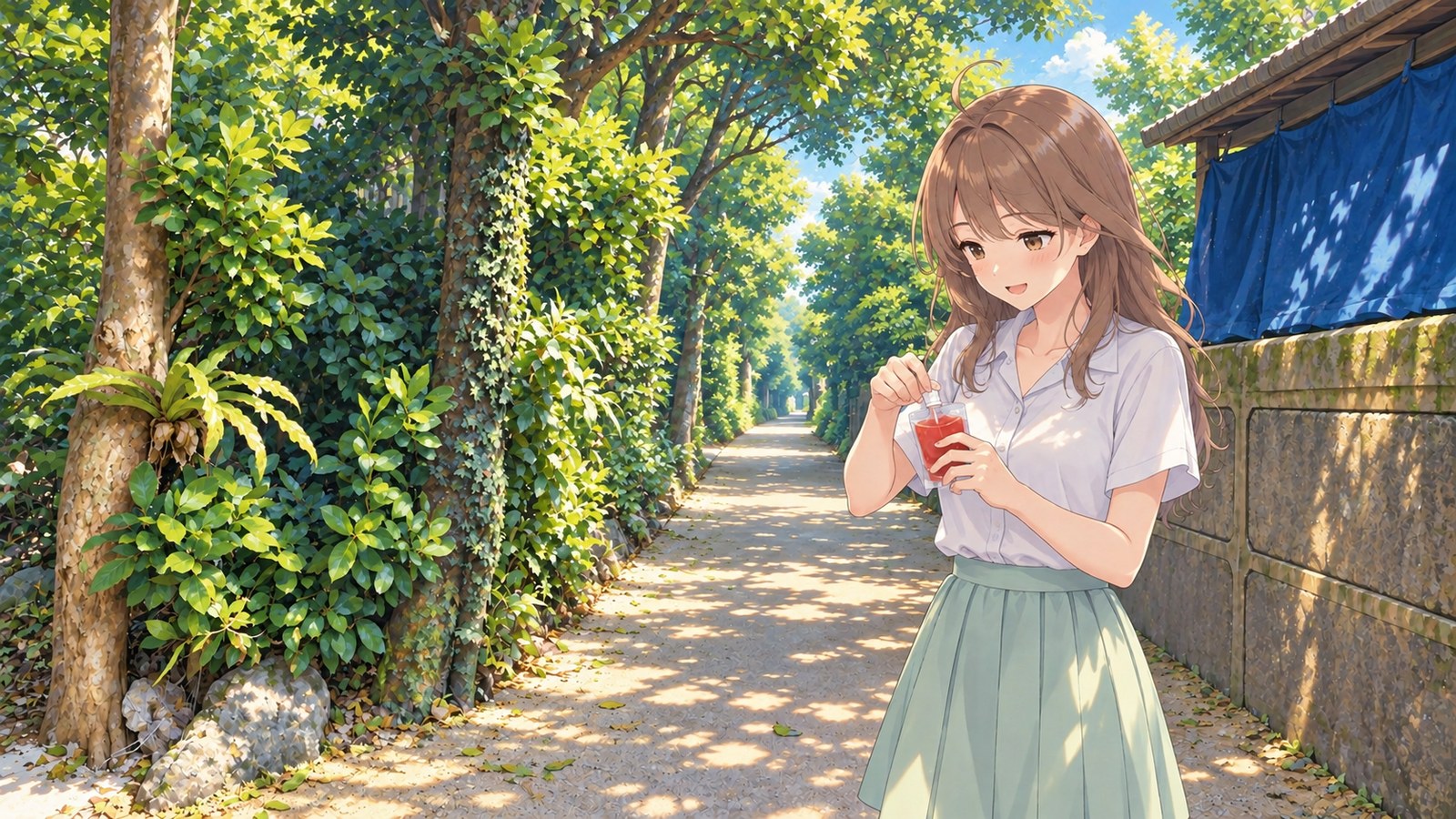
I stopped in the shade and took out an acerola jelly drink. I held the clear pouch in one hand and twisted the cap with the other. Then I heard leaves brushing together overhead. I’d been looking only at my hands, and it suddenly hit me how quiet the lane was.
I took a sip. First came the chill, then a sharp sweet-tart taste that made me smile. Motobu is known as the home of acerola. I loved being able to enjoy a local treat right there in the shade, so I held the pouch up to the light and took another sip. Sunlight filtered through the leaves, flickering only over my hands.
These fukugi trees were planted around homes as a windbreak. I’ve heard they grow slowly, with hard wood and the ability to tolerate salt. I’d come to see the beautiful tree-lined lane, but people still live just beyond those walls, and these trees have protected their homes from the sea wind for decades, even centuries. Thinking about that made me look up at the leaves with a little more care.
The lane to Bisezaki Cape is about 1 km long. Instead of hurrying, I wanted to take in each patch of sunlight, one at a time. Branch shadows made a netlike pattern across the path, so I tried stepping only on the bright spots. By my third step, there was nowhere left to put my foot, and I froze with one leg in the air.
The moment I left the lane, the view opened up. My eyes, used to the shade, had to adjust to the glare, and I instinctively raised a hand to my forehead. Blue water near Bisezaki Cape peeked out at the end of the path. Only once I was outside did I realize how much the leaves overhead had shielded me from the summer sun.
After standing in the sun for a little while with the sea breeze, I went back into the lane. The air changed as soon as I stepped in, and the heat trapped against the back of my blouse began to ease. I hadn’t expected such a difference between inside and outside.
Back at the car park, the seats of my open-top car were scorching. I laid down a towel before sitting and tucked the empty pouch into my bag. For the drive back, I put the roof up and turned the air conditioning all the way up. Barely had I set off before I was already missing the shade.

AutumnNovember
I wanted to keep looking more than I wanted to get it right
I wanted to draw a trunk with my own hands instead of taking a photo. So I brought a small sketchbook and pencil on my first trip to Okinawa. I flew to Naha and planned to explore by rental car. With a rental instead of my usual car, I kept my luggage light—but I made sure to leave just enough room for one sketchbook.
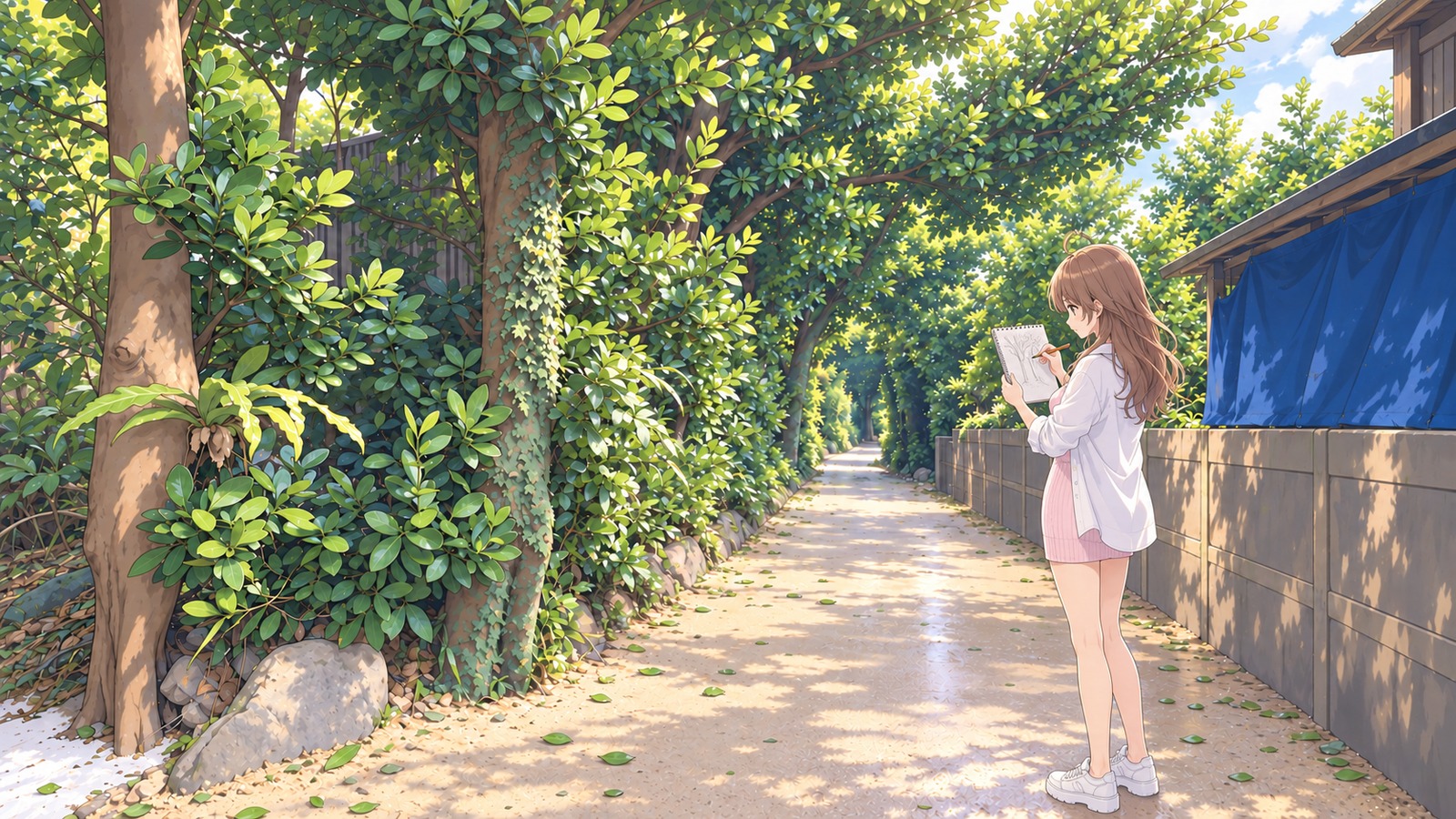
I parked the rental near the lane and started walking. The shadows of leaves on a block wall caught my eye. Even in November, the fukugi’s dense foliage still made a thick canopy overhead. I chose a spot in front of a thick trunk, then rolled up the sleeves of the white shirt I wore over my pink dress so I could draw more easily.
Before I started drawing, I studied the trunk’s surface. Fine vertical lines ran over its rough bark, and vines climbed along it. From a distance, all the trunks looked alike, but up close, every pattern was different.
I sat on a stone by the path and opened my sketchbook on my lap. I drew one trunk, then looked at the next: its width and curves were completely different. Had I made that first line too straight? I stopped, looking from the trunk to the page and back. If I erased it, I felt like I’d lose the energy in the line, so I drew a new one beside it.
My drawing barely progressed, but I kept finding more things I wanted to look at: vines climbing the trunks, the shapes of overlapping leaves. Each time I spotted something I would have walked right past, I felt like I’d found a little bonus. I sketched a few tiny leaf shapes on the edge of the page. The leaves grow in opposite pairs, and that pattern was surprisingly tricky to draw.
The afternoon light was softer than in summer, and the edges of leaf shadows on the wall were a little blurred. Every time the breeze stirred them, the light around the trunk I was drawing changed too. The lines on the page were still, but the lane in front of me never stopped moving. A photo would capture it in an instant, but when I was drawing, I could hardly tear myself away from that one trunk. I enjoyed it far more than I’d expected.
I’d heard that fukugi bark yields yellow dye used for Okinawan kimono. I couldn’t believe that color was hidden in the bark of the trunk I was drawing. Suddenly I was frustrated that all I could capture was gray pencil. I decided to bring colored pencils next time.
A few cyclists and people out for a walk passed by while I was drawing. They’d glance up at the trees, then keep going. For the people who live here, this is an everyday route; for me, it was a special view. Those two things meet on the same path. Thinking of that, I gave each person a little nod as we passed.
When I shifted my bag, I remembered the acerola jelly drink I’d packed as a snack for my walk. I’d save that sweet-tart Motobu treat for after my sketch. As I moved my pencil, the patch of light on top of the wall had grown narrower.
On the finished page, the trunks lean a little. I couldn’t quite capture how they looked in real life, but I remember exactly which trunk inspired each line. Back at the rental, I opened the jelly, then wrote the date and “Bise” in the corner of the page.
WinterJanuary
The wind changed where the lane opened up
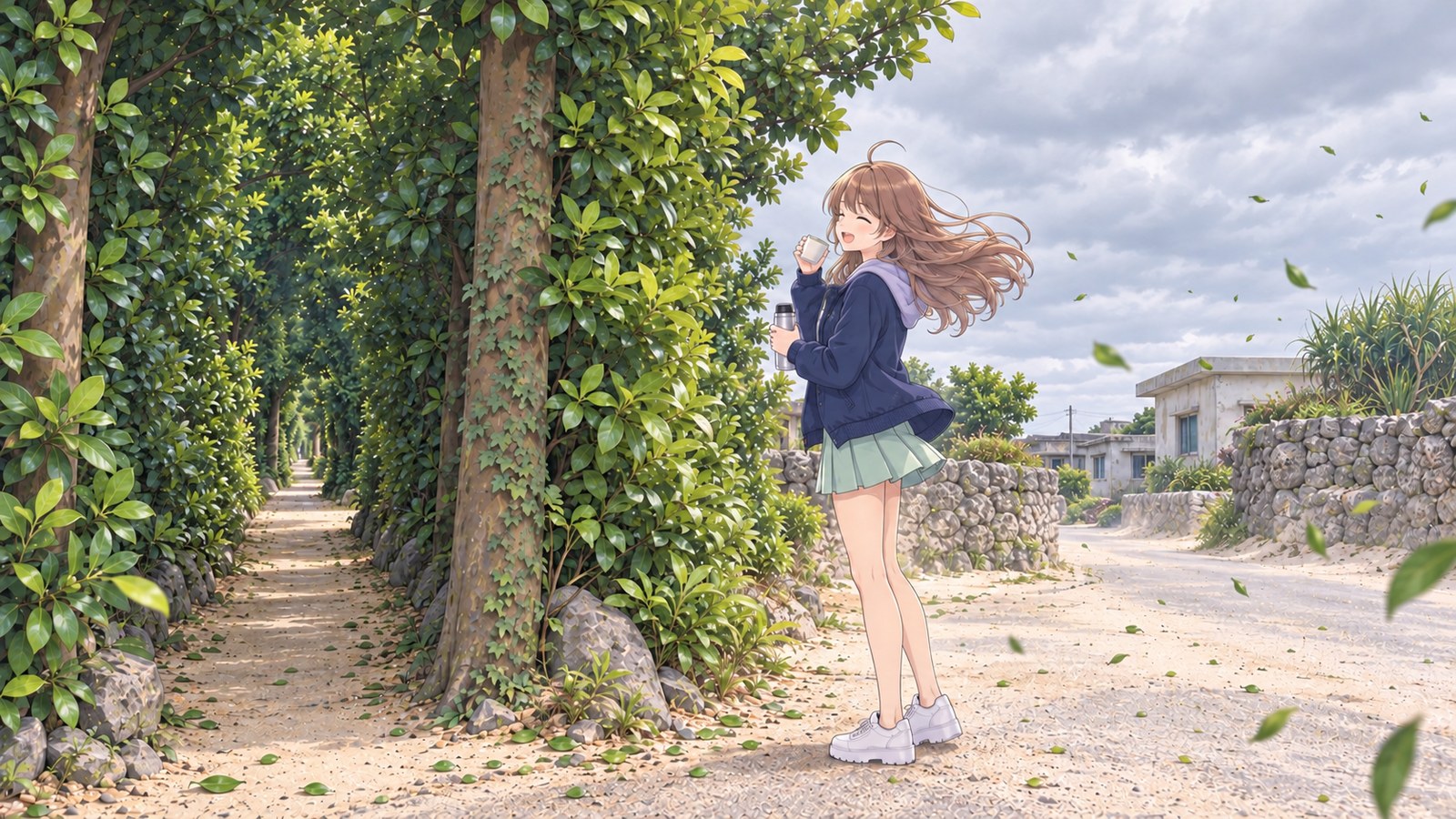
Outside the lane, the sea breeze hit my face head-on. Even in Okinawa in January, the north wind and sea breeze can make it feel colder than you’d expect. I zipped up my navy jacket and took one step into the lane. The wind suddenly eased. Wait, what just happened? I stopped right there.
The winter before, I’d driven through the snow in Hokkaido, so this winter I decided to spend the season farther south. I came to Bise on a cloudy day because I wanted to feel for myself how the fukugi, which keep their leaves through winter, shelter the lane from the wind.
I stopped at the side of the lane and poured a drink from my thermos into a cup. I brought the steaming cup to my lips and took a sip. Warmth spread through my mouth, taking the chill out of my cheeks.
I walked to an opening in the lane to see what would happen. The wind hit my cheeks again, and my jacket collar flapped. Two or three steps back, and it softened. I stepped out again, then back again. I started to enjoy the little experiment and went back and forth a few times until someone cycling by gave me a puzzled look. I hurriedly adjusted my grip on the cup. That’s when I could really feel how the fukugi planted around homes shelter daily life from the winter wind.
The branches overlapped above the wall, still thick with leaves. Without sunlight filtering through, I could hear the leaves and the distant waves more clearly. A tiny leaf that had fallen from above was stuck to my jacket sleeve.
One surprise: on a cloudy day, I could see farther down the lane. On my summer visit, the bright and shadowed patches had caught my eye, but today I could make out the trunks one by one. Even in my summer photos on my phone, only the bright center of the lane shows; the wall is almost impossible to make out. It’s the same path, but the weather can show you such a different side. I put my cup away and started walking along the line of trunks.
After a while, I came to a spot where the leaves were thinner and I could see the sky. Only there did the leaves above me make a sudden rustling sound and the wind pick up. As I walked, I started to figure out where the wind slipped through.
When the chill reached me, all I could think about was a hot bowl of noodles. I chose Okinawa soba in Motobu for lunch. I went into a restaurant in town, took off my jacket, and sat down with a steaming bowl. I lifted the thick noodles with my chopsticks, blew on them to cool them, and slurped. The broth’s aroma rose up to meet me, and warmth spread to even my fingertips, chilled from walking the lane. I polished off every last bite of pork belly and fish cake.
After leaving the restaurant, I opened my map and marked the spot where the wind changed at the opening in the lane. When spring comes, I plan to return and see how the wind feels there.

The story sections are fiction inspired by this location. For accurate information, please consult official tourism and information websites.
The sea near Motobu at night

Photos of this place10 images
-
Motobu Town, Okinawa Prefecture · Spring
-
Motobu Town, Okinawa Prefecture · Spring
-
Motobu Town, Okinawa Prefecture · Summer
-
Motobu Town, Okinawa Prefecture · Summer
-
Motobu Town, Okinawa Prefecture · Autumn
-
Motobu Town, Okinawa Prefecture · Autumn
-
Motobu Town, Okinawa Prefecture · Winter
-
Motobu Town, Okinawa Prefecture · Winter
-
Motobu Town, Okinawa Prefecture · The sea near Motobu at night (Summer)
-
Motobu Town, Okinawa Prefecture · Winter
Local treats to try on your trip
Acerola jelly drink
In Motobu, known as the home of acerola, you can also find acerola jelly drinks. I always tuck one into my bag when I visit Bise. A cold, sweet-tart sip feels just right after a walk through the lane.
Motobu Okinawa soba
The name “Motobu Soba Road” covers the whole town, and Izumi Highway along Prefectural Route 84 has long been known as a soba route. On Soba Day, October 17, 2010, the town declared itself “Motobu, the town of soba.” There are more than 60 places serving Okinawa soba in town, in addition to specialist soba shops, so I love looking at the map and choosing where to stop on my way back from the lane.
Highlights
A tree-lined lane about 1 km long, planted to shelter homes
Fukugi trees planted around homes as a windbreak now form a lane about 1 km long, stretching to Bisezaki Cape. They grow slowly, and they have hard wood and tolerate salty conditions. People still live in the homes beyond the walls, so I always tread a little more softly here.
Dappled sunlight and rustling leaves that change with the seasons
In summer, dappled sunlight paints a net across the path; on cloudy winter days, you can see the rows of trunks all the way into the distance. The soft rustle of leaves in the breeze was the same in every season.
Road and location details
Getting here from Tokyo
- From Tokyo
- Fly to Naha AirportFrom Naha Airport to the fukugi lane: about 1 hour 50 minutes by car on local roads
- If you’re bringing your car
- Kagoshima New Port to Naha PortAbout 25 hours by ferry. From Naha Port, it’s about 92 km and around 1.5 hours via the expressway.
- Nearest interchange
- Kyoda IC (Okinawa Expressway)About 30 km and 35–45 minutes to the fukugi lane
- Route to the lane
- National Route 449North along the coast of the Motobu Peninsula
Getting to and walking the Bise Fukugi Tree-lined Lane
- Lane to Bisezaki Cape
- About 1 km
- From Kyoda IC by car (local roads)
- About 45 minutes
From Kyoda IC, it’s about 45 minutes on local roads. Park near the lane, then explore on foot—that’s the best way. I bet you’ll stop more than once along the path to Bisezaki Cape.
Follow National Route 449 north along the coast of the Motobu Peninsula to reach Bise and its tree-lined lane. Bise is very close to Ocean Expo Park, so it’s easy to plan a side trip along with your walk.
More Spot Guides
If you enjoyed this story, you might like these places too. I've gone back to each of them in different seasons, again and again.
Maps & Sources
Official sources
- Motobu Town Tourism Association (Bise Fukugi Tree-lined Lane) (opens in a new tab)
- Okinawa Monogatari (Bise Fukugi Tree-lined Lane) (opens in a new tab)
- Motobu Town Tourism Association (Motobu Acerola Fresh) (opens in a new tab)
- Acerola Fresh (Acerola Jelly Drink) (opens in a new tab)
- Okinawa Prefectural Forest Resources Research Center (Fukugi) (opens in a new tab)
- Okinawa Monogatari (Travel to Okinawa in November) (opens in a new tab)
- Okinawa Monogatari (Travel to Okinawa in January) (opens in a new tab)
- Motobu Town Tourism Association (Motobu Soba Road) (opens in a new tab)