Shimonoseki, Yamaguchi Prefecture
Tsunoshima Ohashi Bridge The sea is a different color on either side of the bridge!
It started with a single photo: a bank of rapeseed flowers and a bridge curving around the island. I wanted to see it for myself, so I took the ferry from Tokyo with my car. In person, it was many times more beautiful than the picture, and before I knew it, I was coming back in one season after another. This is the story of what I saw, ate, and the little mistakes I made along the way on the small island beyond Tsunoshima Ohashi, the 1,780m bridge linking it to the mainland.
The bridge never changes, but each time I went, different flowers were waiting nearby. Every new flower name I learned gave me one more reason to cross again.
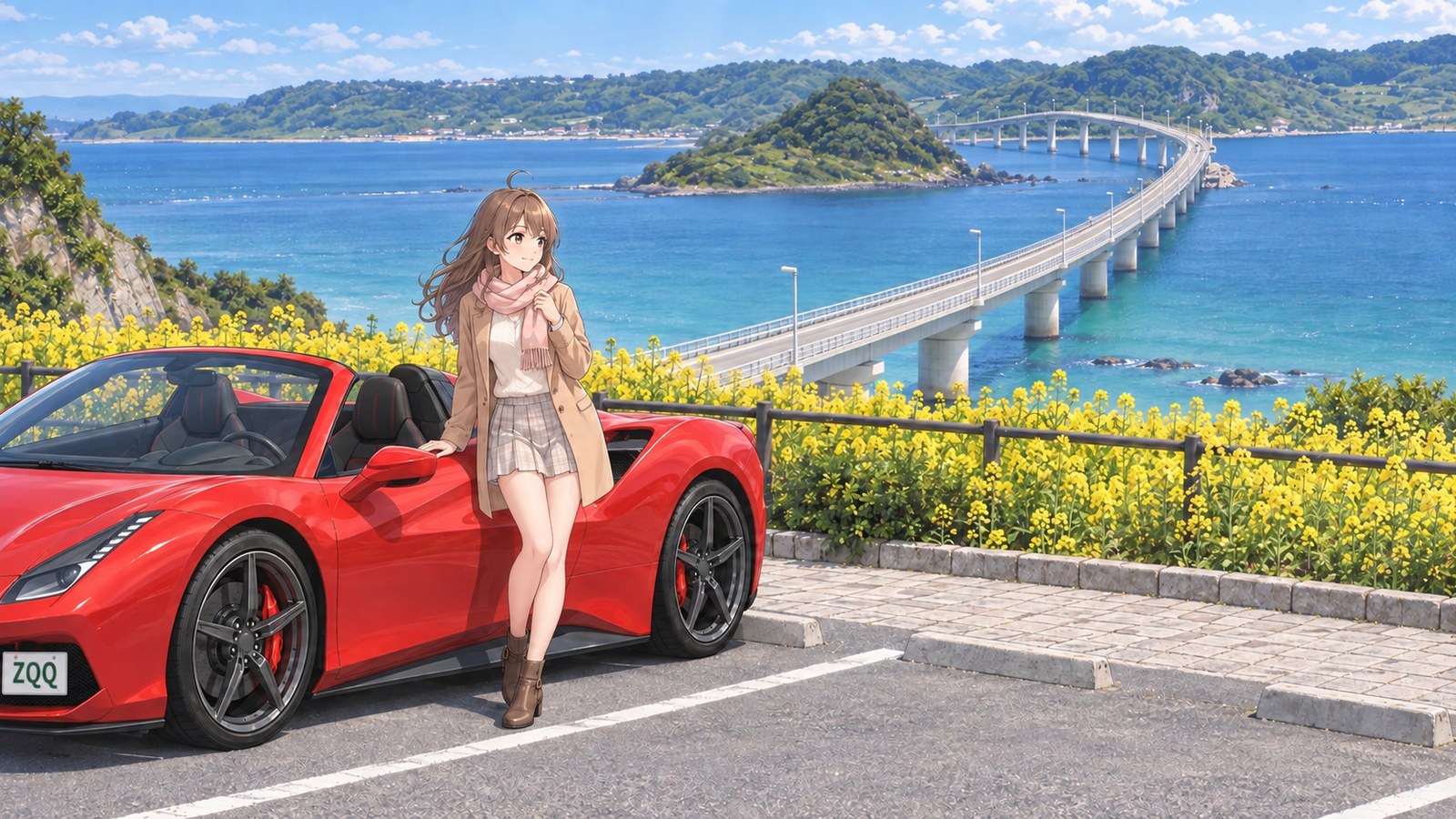
SpringWhen the rapeseed flowers bloom
A bridge reaching out to sea, and rapeseed flowers on the bank
Where does spring arrive first? All winter, I’d been poring over maps in my Tokyo apartment when I found a photo of rapeseed flowers and a bridge side by side on the Yamaguchi coast. I read that the flowers brighten Tsunoshima Ohashi for just a little while in early spring. The more I zoomed in on that photo, the more certain I was about where I wanted to go.
I drove my red convertible onto the ferry bound for Shin-Moji at the Tokyo Ferry Terminal in Ariake. After two nights aboard, I arrived in Kyushu on the morning of the third day. I crossed the Kanmon Bridge into Yamaguchi, then headed straight for Tsunoshima without any detours on day one of my five-day trip around the prefecture.
Once I joined National Route 191, the Sea of Japan began appearing and disappearing beyond the window. With the top down, the still-cold wind swept my hair back. The engine’s note and the changing glints of sea around each bend seemed to keep the same rhythm. I was enjoying it so much I almost wished the satnav would add a little time to the journey. Then a blue Route 191 sign appeared at the roadside. The first thing I met on this trip wasn’t the sea or the bridge. It was that sign.
I parked at Amagase Park on the mainland, and the moment I opened the door, a breeze carrying the scent of the sea rushed in. Beyond the bank full of rapeseed flowers, the sea stretched out, and the bridge reached across it toward the island. It was many times more beautiful than in the photo. I leaned against the car and simply watched the sea, letting the wind tug at my pink scarf.
Apparently the famous straight-on view is from a road higher up on the mountain side, above the prefectural road. There’s nowhere to park there, so I left the car at the park and walked up the hill. I caught my breath at the top, then turned around: the bridge curved gently across the sea, bending around Hato Island. It would have been shorter to go straight, but the bridge takes a gentle curve around the island. Looking at that lovely shape, I felt like thanking the people who designed it.
I was so busy taking pictures that I didn’t notice until the third shot: my thumb had crept into the corner of the frame. When I looked back, there it was in the first and second pictures, too—rapeseed flowers, the bridge, and my thumb. I’d been so focused on the flowers and the bridge that I hadn’t even noticed where my finger was. Still, I couldn’t bring myself to delete them. They were proof of how completely I’d been swept up in the moment.
Back at the park, I crossed the bridge with the top still down. The cold wind crept from my neck into my coat, and I couldn’t help hunching my shoulders. I still didn’t put the top up. I wanted to feel that wind over the sea for as long as I could. I didn’t speed up; I wanted to savor all 1,780m. The sea glimmered at the edge of my vision, and as the island came closer, I tightened my grip on the wheel.
After crossing the bridge, I stopped for a break at Shiokaze no Sato Tsunoshima, in the middle of the island. I warmed my hands around a hot drink and thought about the length of the bridge I’d just crossed. I couldn’t stop smiling.
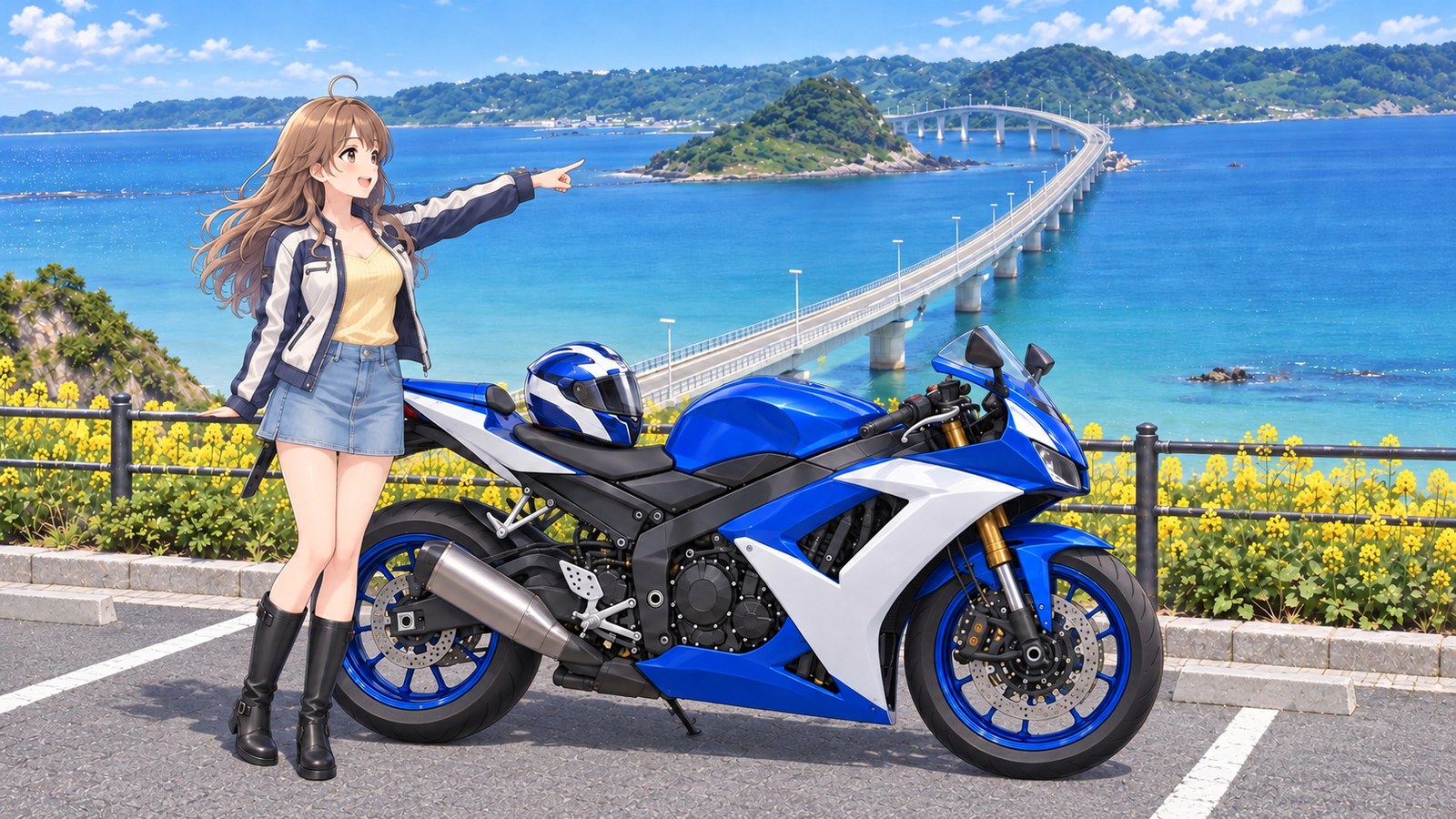
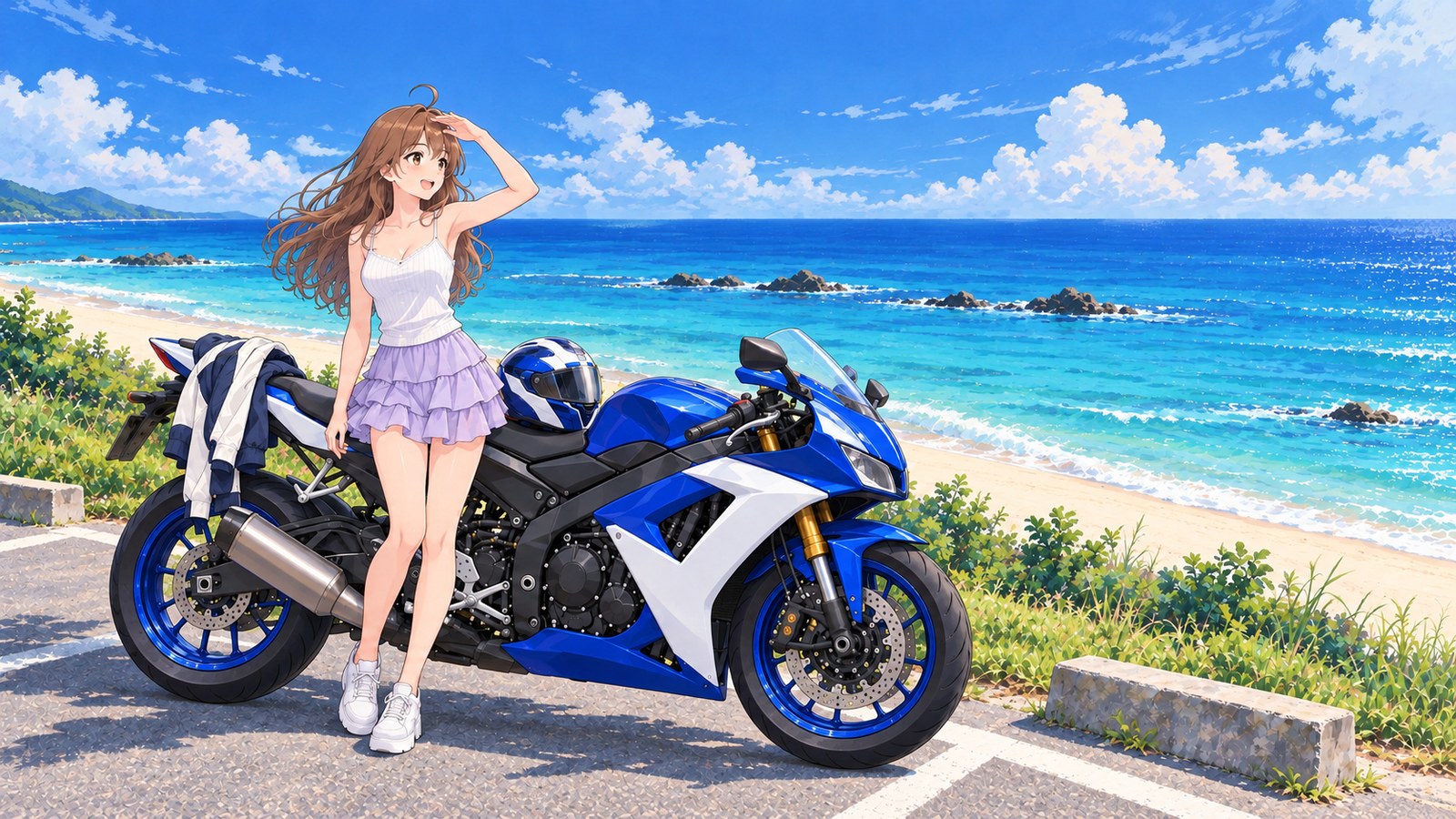
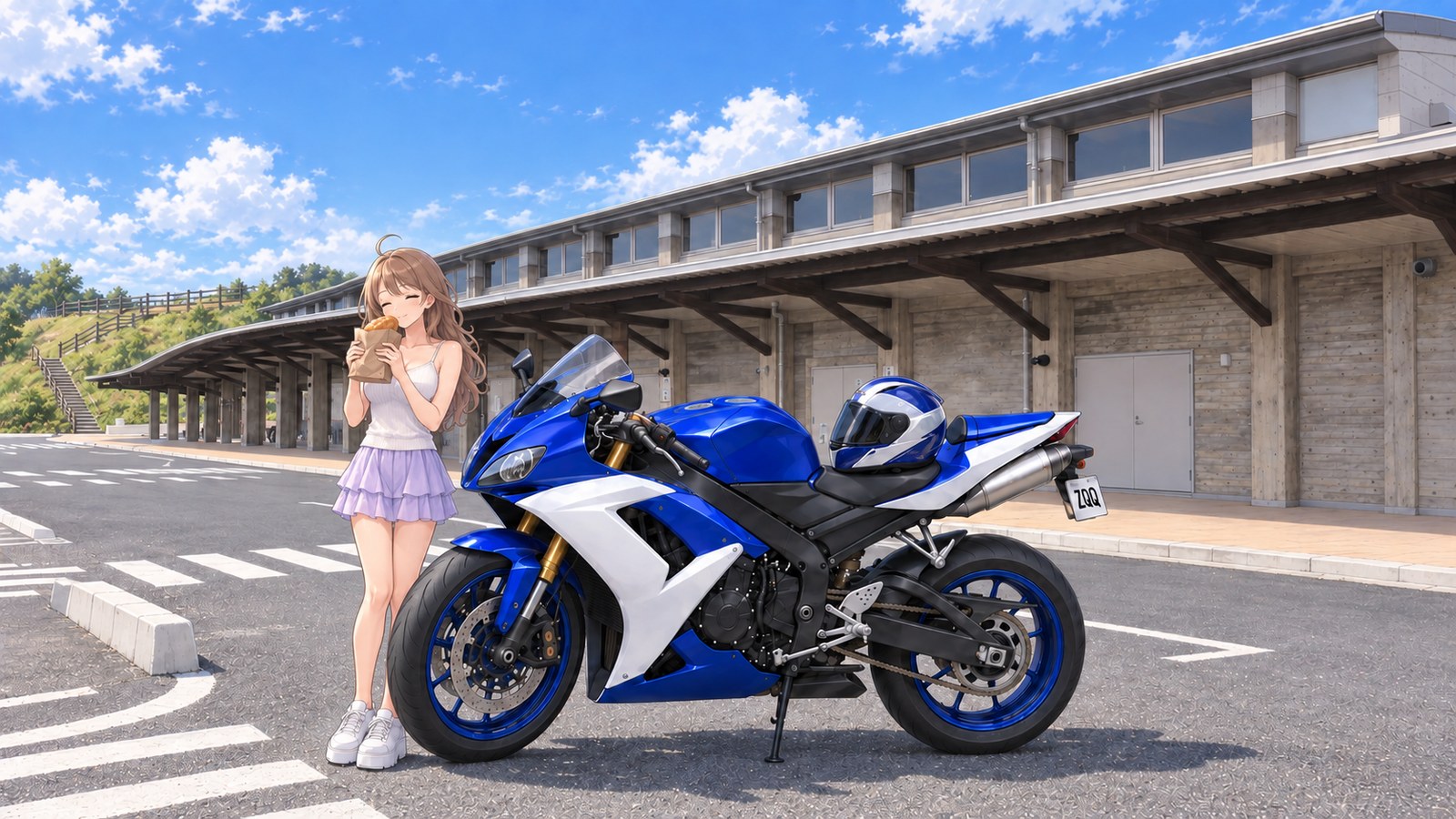
Before the rapeseed flowers were gone, I wanted to see the same view from a motorbike, too. So I loaded my blue-and-white bike onto the ferry and crossed again on a separate trip. When I reached Amagase Park, the flowers seemed taller than they had that day. The breeze off the sea felt a little softer, too. I set my helmet on the seat and pointed toward the bridge beyond the flowers. I wasn’t pointing it out to anyone, but I still found myself pointing. The sea was so bright with reflected light that day.
SummerJuly–August
Two shades of sea, and beach lilies by the lighthouse
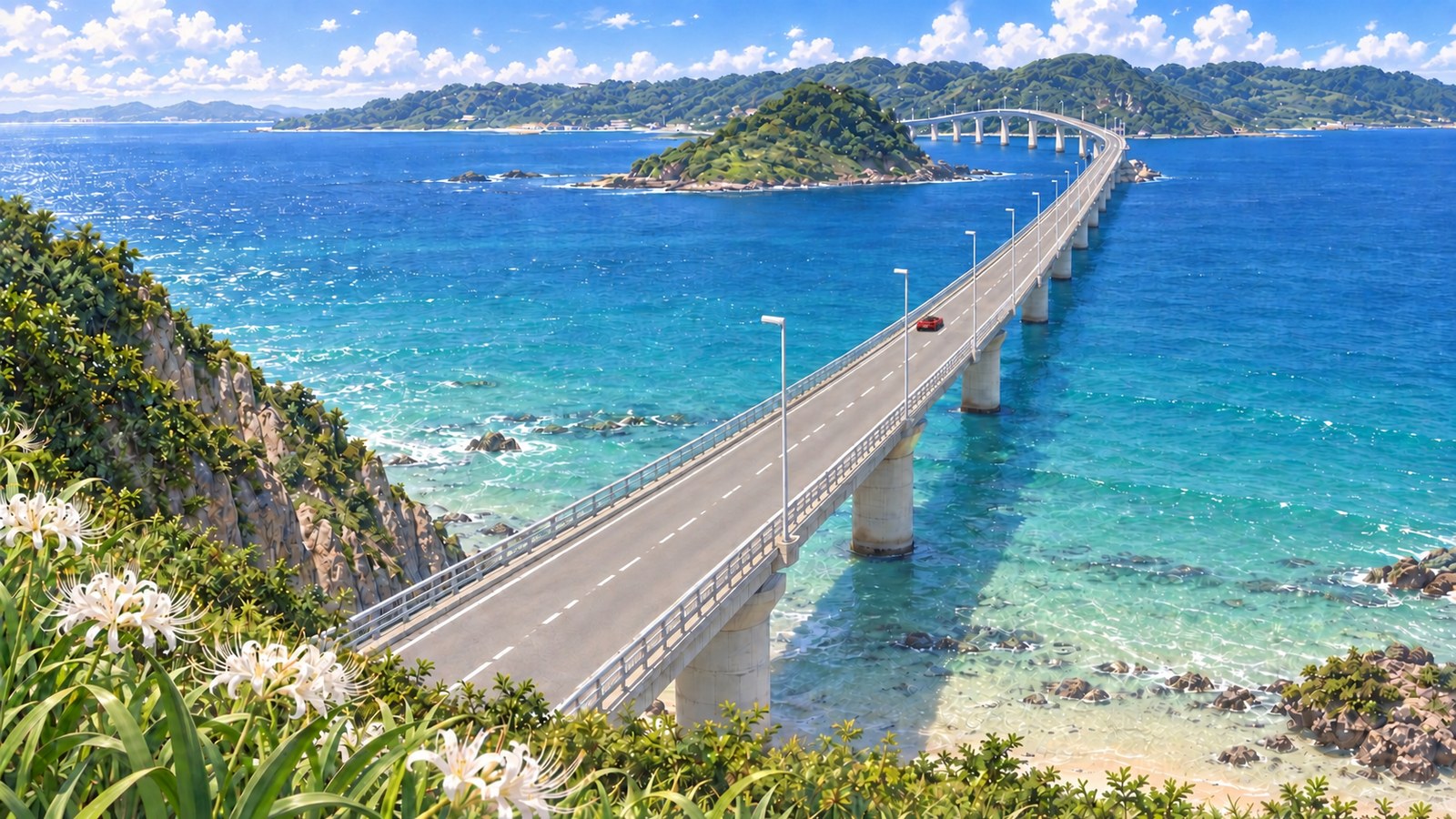
In mid-July, I took the ferry to Yamaguchi again, red convertible and all. I was on day two of a four-day trip when I headed for Tsunoshima. As soon as I reached the bottom of the slope on the mainland side, the view opened up in front of me. One bridge curved gently across the sea toward the island. It was 1,780m long, one of the longest bridges in Japan that you can cross for free, I’d read. I drove straight out over the sea with the convertible top down.
I’d barely set off when I did a double take. The sea was a completely different color on either side of the bridge. One side was bright emerald, the other deep cobalt. I wanted so badly to know whether it was a trick of the light or if the water really was different. But I was driving, so I saved that for the way back. I kept my eyes on the road and tightened my grip on the wheel.
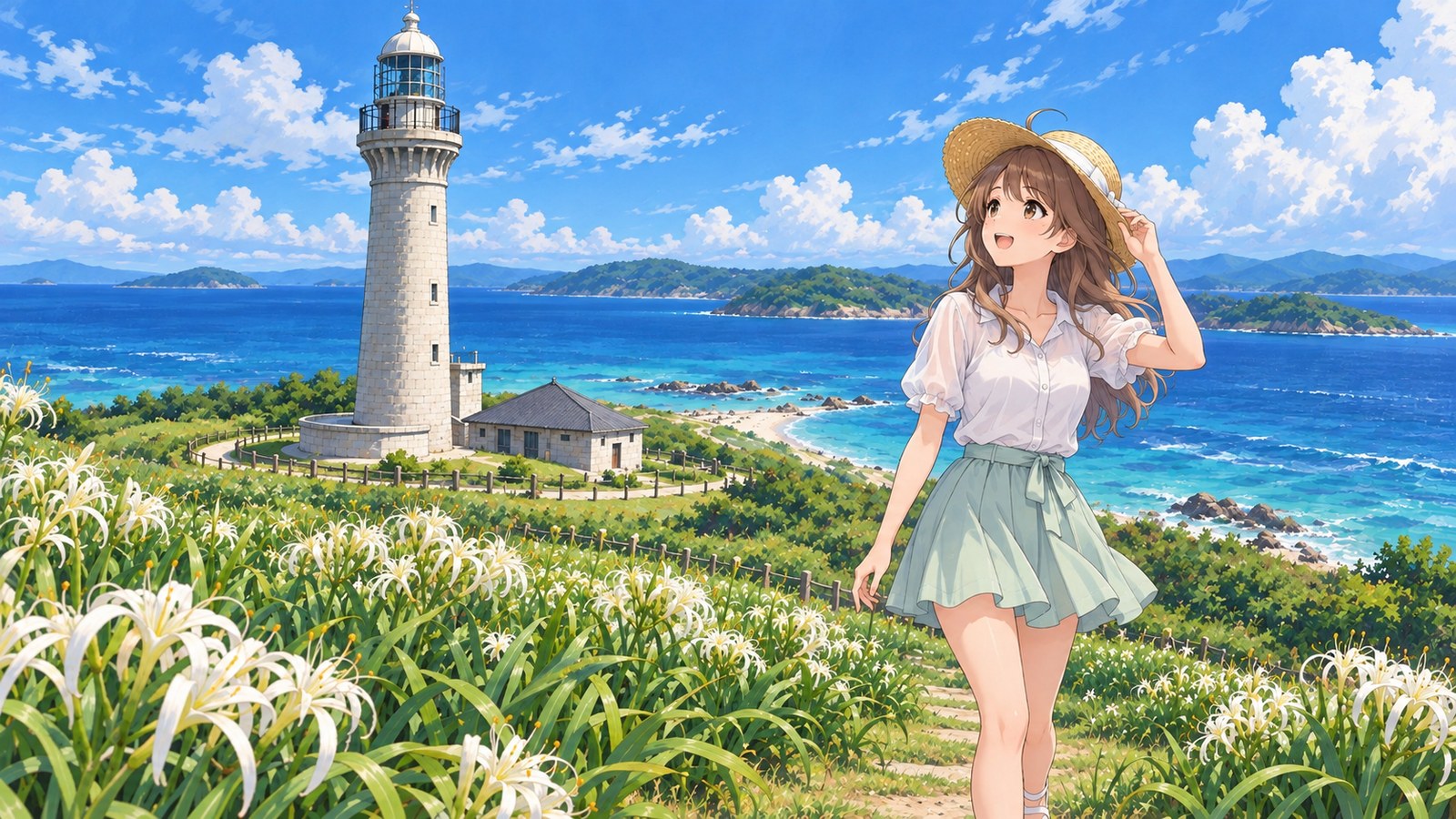
Tsunoshima is a small island, about a ten-minute drive from end to end. At its far end stands Tsunoshima Lighthouse, first lit in 1876, the 9th year of the Meiji era. Built of granite, it’s still in service, and you can climb inside. The spiral staircase has 105 steps. By the time I was partway up, I was out of breath and my legs were aching. Still, I wanted that view from the top, so I climbed every last step.
The moment I stepped out at the top, the sea stretched in every direction. The wind whipped my hair around, and I grabbed the railing in a hurry. Below, beach lilies bloomed in clusters in the grass around the lighthouse. Their slender petals curled back like tiny fireworks from a distance. After coming back down, I held on to my straw hat and wandered slowly along the little path between the flowers.
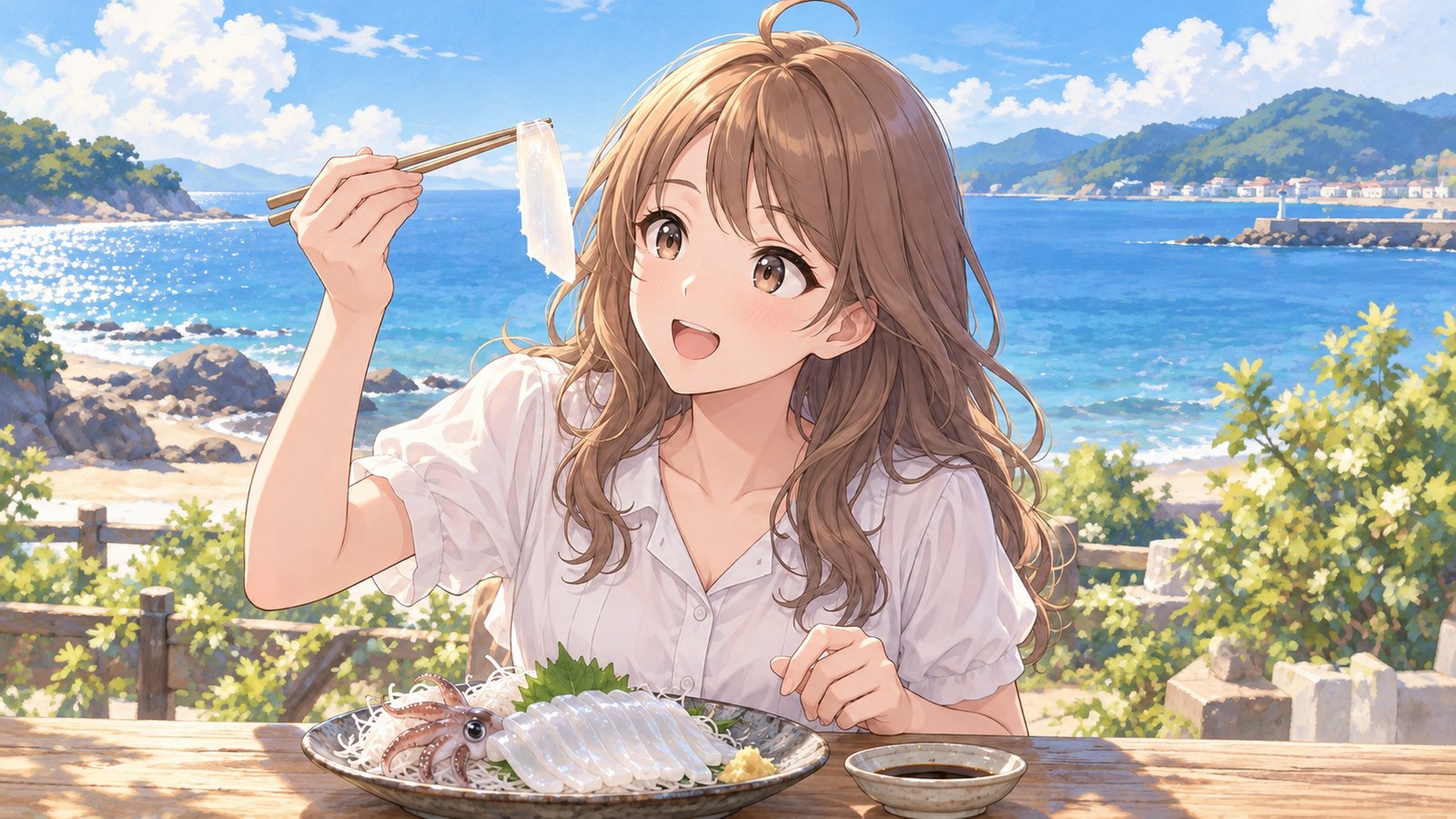
For lunch, I had the local specialty: spear-squid sashimi. The flesh was so translucent that it looked as if I might see the scenery through it. I held a piece up to the light and kept changing the angle before taking a bite. The sweetness spread across my tongue, and the squid was so tender it almost melted. I had no idea squid could taste this sweet. The Kottoi squid from this area is rated A, the highest grade. I didn’t bother holding the last piece up to the light. I popped it straight into my mouth.
On the way back, I crossed the bridge, parked at Amagase Park, and checked the colors of the sea that had caught my eye on the way over. Sure enough, it looked like two different colors on either side of the bridge. With the water this clear, differences in depth and on the sea floor show through as differences in color. I was so relieved to know I hadn’t imagined it that I gave a little clap beside the car.
In August, I came back to Tsunoshima on my blue-and-white bike, on a separate trip from the one by car. This time I had my eye on Tsunoshima Ohama Beach. I parked the bike in the car park above the beach. The dazzling white sand had formed over many years as countless shells broke down. I held a hand up to shade my eyes and looked out at water so clear I could almost count the grains of sand at the water’s edge.
That day, I’d brought a takeaway Tsunoshima pudding. I’d heard that puddings made with carefully selected ingredients from Yamaguchi Prefecture changed every day, and I’d been seriously torn over which one to choose. In the end, the deciding factor was: “It was the first one to catch my eye.” In the shade cast by the bike seat, I opened the lid and dug in with my spoon. It was cool and silky smooth; even my sun-warmed cheeks relaxed along with me. The pudding tasted completely different from how it would have at home as I ate it looking down over the white beach.
AutumnLate October
Daruma asters on the rocks, and sunset over the horizon
Daruma-giku. When I came across the name of the flower that blooms on Tsunoshima’s rocky shores in autumn, something about it caught my attention. So I decided to make Tsunoshima the first stop on my motorbike trip, staying in Yamaguchi and Kitakyushu for about 2 weeks from the end of October. I loaded my blue-and-white bike onto the ferry to Shin-Moji, crossed the Kanmon Bridge, and headed into Yamaguchi.
When I reached the coastal road, the autumn wind slipped in through my cuffs. On a motorbike, you really feel yourself ease off a little before a bend and lean with the road. Even when a crosswind came in from the sea, I kept my grip relaxed and held the tank with my knees, letting the wind pass. Each time the salt in the air grew stronger, I knew the island was getting closer.
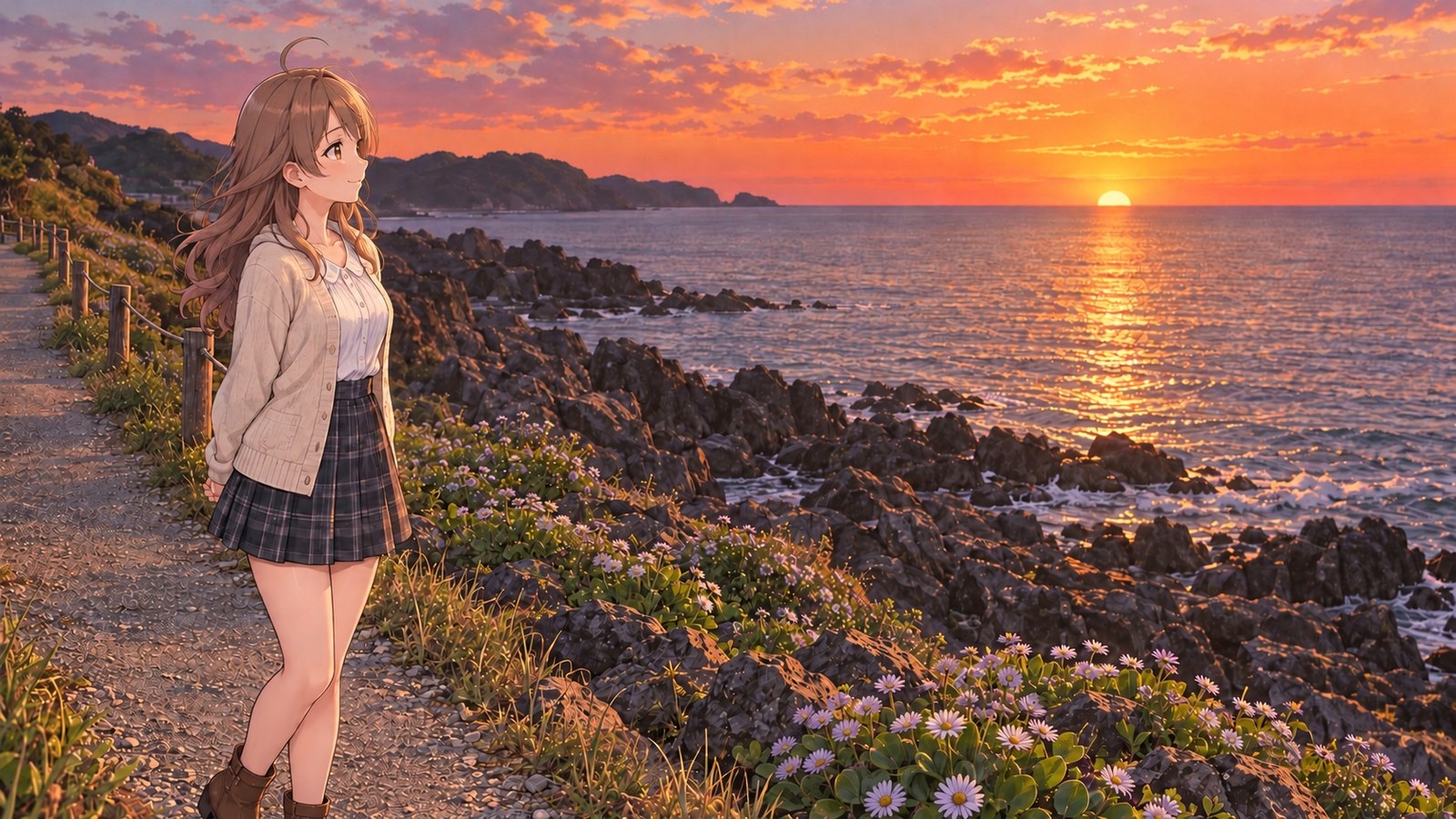
Makizaki Wind Park was a short walk beyond the free car park where I left my bike. I left my riding jacket on the bike and climbed onto the rocks in my cardigan. I checked my footing with the soles of my boots as I went. Beyond the jagged rocks, the horizon stretched in a straight line. In the cracks at my feet, little asters bloomed close together. They stayed low and kept blooming, even in the strong sea breeze. They seemed much better at handling the wind than I was, trying to hold down my hair before it blew away.
With a name like Daruma-giku, I’d imagined a rounder flower, one that looked as if it could get knocked over and pop right back up. But the real flowers were far more delicate than I’d pictured. I said sorry to the flower in my head for imagining it wrong. Then I crouched to get down to its level: white and pale purple petals seemed to float softly in that little space between the hard rocks.
While I waited for sunset, I stopped by Tsunoshima Lighthouse. I remembered the view after climbing its 105 steps in summer, so today I decided to admire it from below. The old staff quarters next door are open as a museum. As I walked through the exhibits, the lighthouse’s long history of lighting the sea, stretching back to the Meiji era, began to feel a little more real. By the time I stepped outside, the sun was already starting to dip, so I hurried toward the path. The sound of my boots carried clearly along the quiet evening trail.
The next thing I wanted to see after the Daruma-giku was the sun sinking into the horizon. I waited on the path, and the moment the sun touched the sea, a straight path of light appeared across the water. With my hands clasped behind me, I watched its width change. As the sun sank, the path narrowed little by little. Even after it had disappeared, a little light lingered at the edge of the sky. I leaned against the rail and watched until it was gone.
The following week, I wanted so badly to see the bridge and sunset together that I rode back to Tsunoshima from where I was staying. I parked my bike at Amagase Park on the mainland and took off my helmet. The wind had messed up my hair, and I kept tucking it behind my ears. The bridge slowly took on the sunset’s glow. In daylight it had looked white; now it was turning orange. A sunset seen alone always makes me want to tell someone about it. That day, I wanted to take it all in and hold on to the memory. With only a little of my stay left, I stood there with my hands clasped in front of me until the bridge lights came on.

WinterLate January
Daffodils by the lighthouse, and sea foam in the wind
I wanted to see what the Sea of Japan was really like in winter, at least once. I wondered what the bright summer sea would look like in winter. In late January, on a three-day trip around Yamaguchi, I took the ferry with my car again. I came to Tsunoshima the day after getting off the boat. The sky was thick with gray clouds, and the sea was far rougher than it had been in summer. The winter wind off the Sea of Japan was so cold that I had to work up a little courage before opening the car door. I’d made the trip anyway because wild daffodils bloom around the lighthouse only in winter.
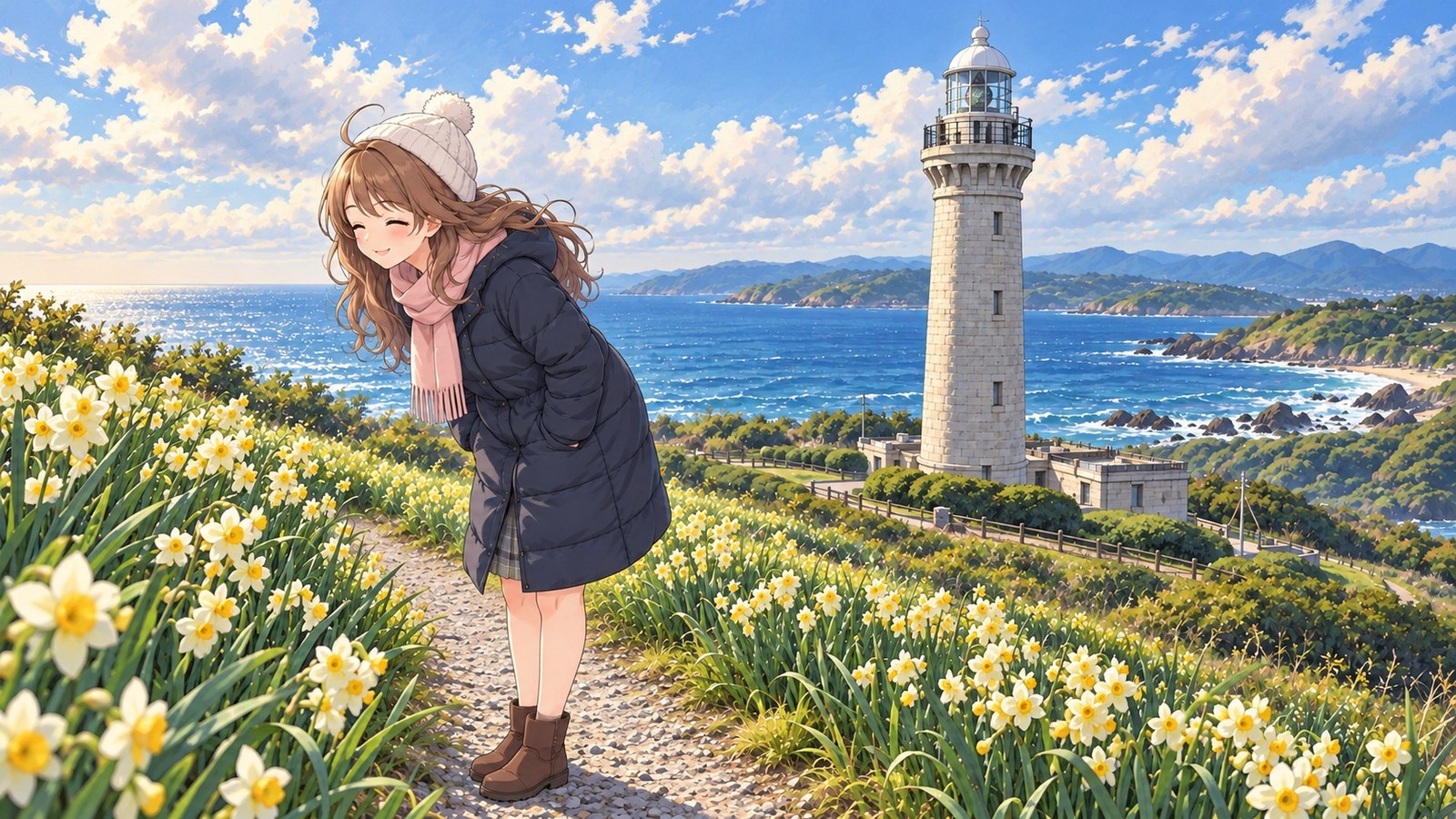
I parked at the paid car park near the lighthouse and set off on foot. A sweet scent caught me on the wind. Daffodils dotted the slope at Tsunoshima Lighthouse Park, gathering in little clusters here and there. Their leaves all streamed in the same direction with the wind. I kept my hands in my pockets, leaned toward the flowers, and closed my eyes. My cheeks, stiff from the cold, slowly relaxed.
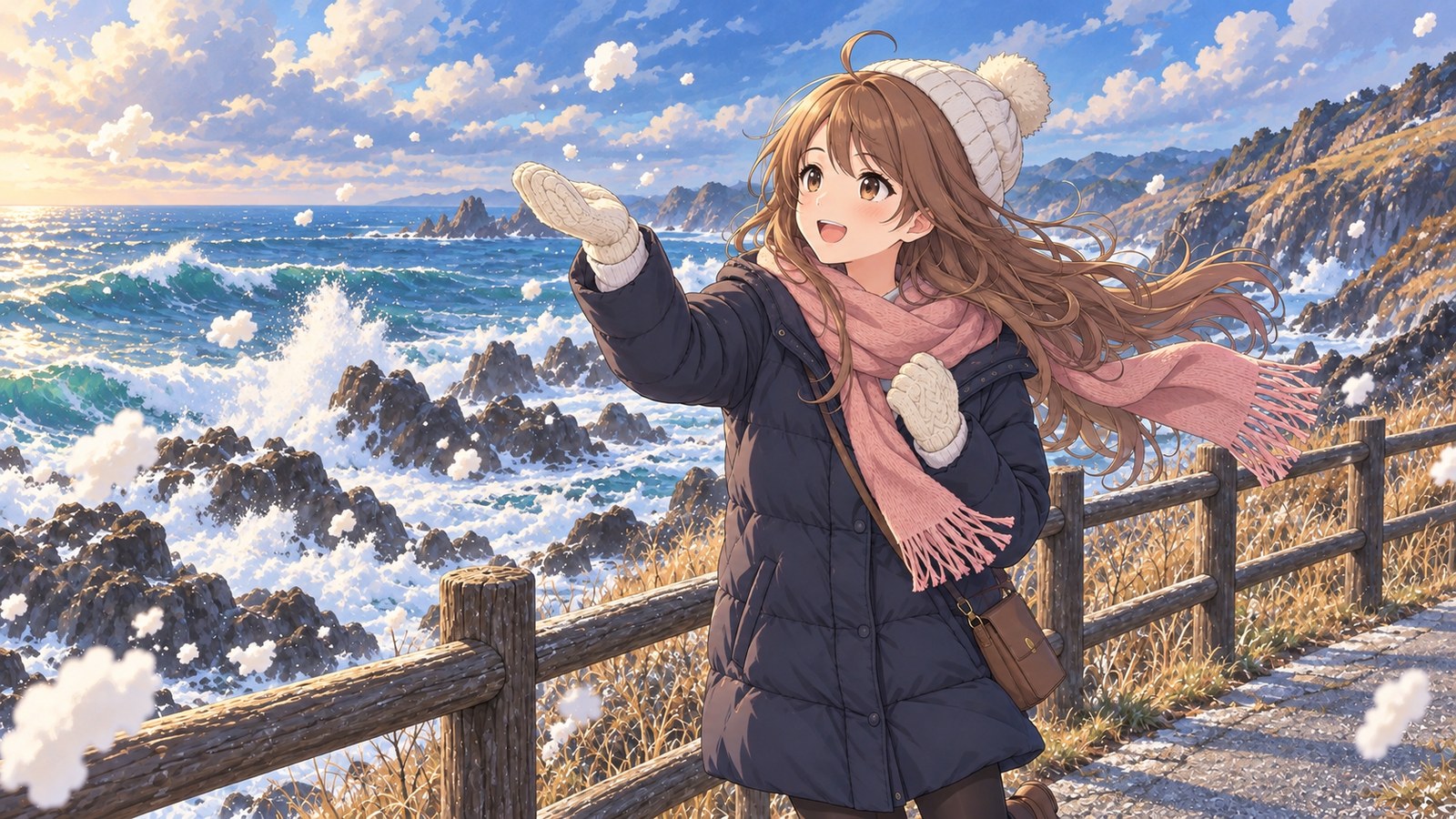
As I walked toward the sea, the waves sounded much lower and heavier than they had in summer. Something white blew over and caught on my scarf. I thought it was snow, but it was foam. When waves foam up on a cold day and the wind carries it into the air, that’s sea foam. I’d read all about it before coming, but flying right at me, it looked just like snow. I reached through the railing to catch a bit. It vanished almost at once on my mitten. I thought I’d caught it, but it was already gone. Frustrated, I reached out again, but the next bit disappeared just as fast. By the third one, I gave up and laughed.
I climbed the lighthouse while it was still light. Winter visits end at 16:30, so I had to go before the sun started to dip. This time I climbed the 105 steps that had left me exhausted in summer, gripping the railing with my mittens on. Inside, the wind was blocked, and it was so quiet I could hardly believe how loud the wind had been moments before. At the top, a cold gust hit my cheeks, and I squinted. Ahead, the slope of Lighthouse Park and the rough winter sea stretched out.
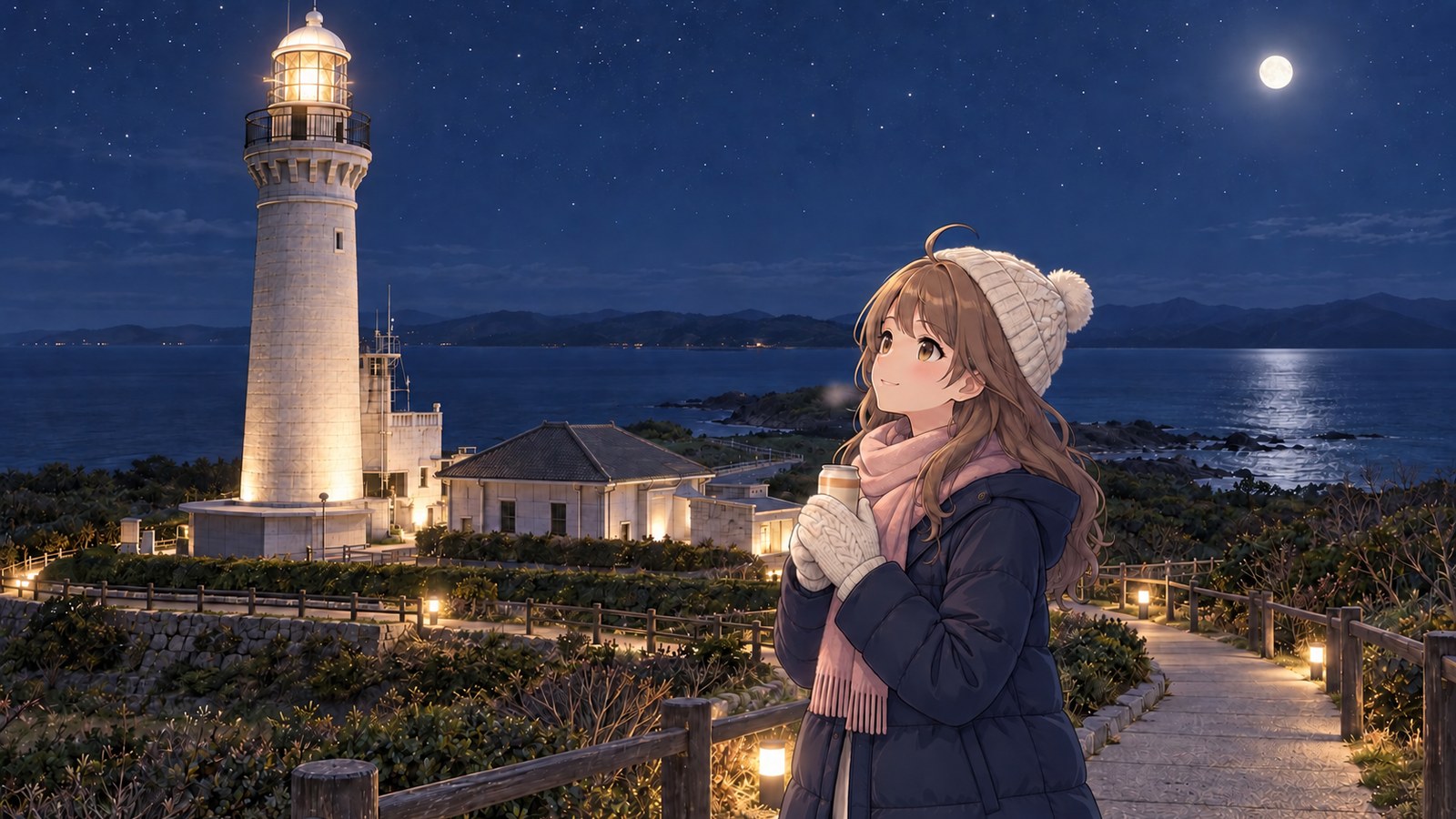
I decided to wait until sunset. Sitting on a bench at Lighthouse Park, I cupped a warm can of milk tea in my cold hands. Then the lighthouse light came on, and the tower itself was softly lit from below. The sea I’d looked down on from the top in summer was now lit by the lighthouse.
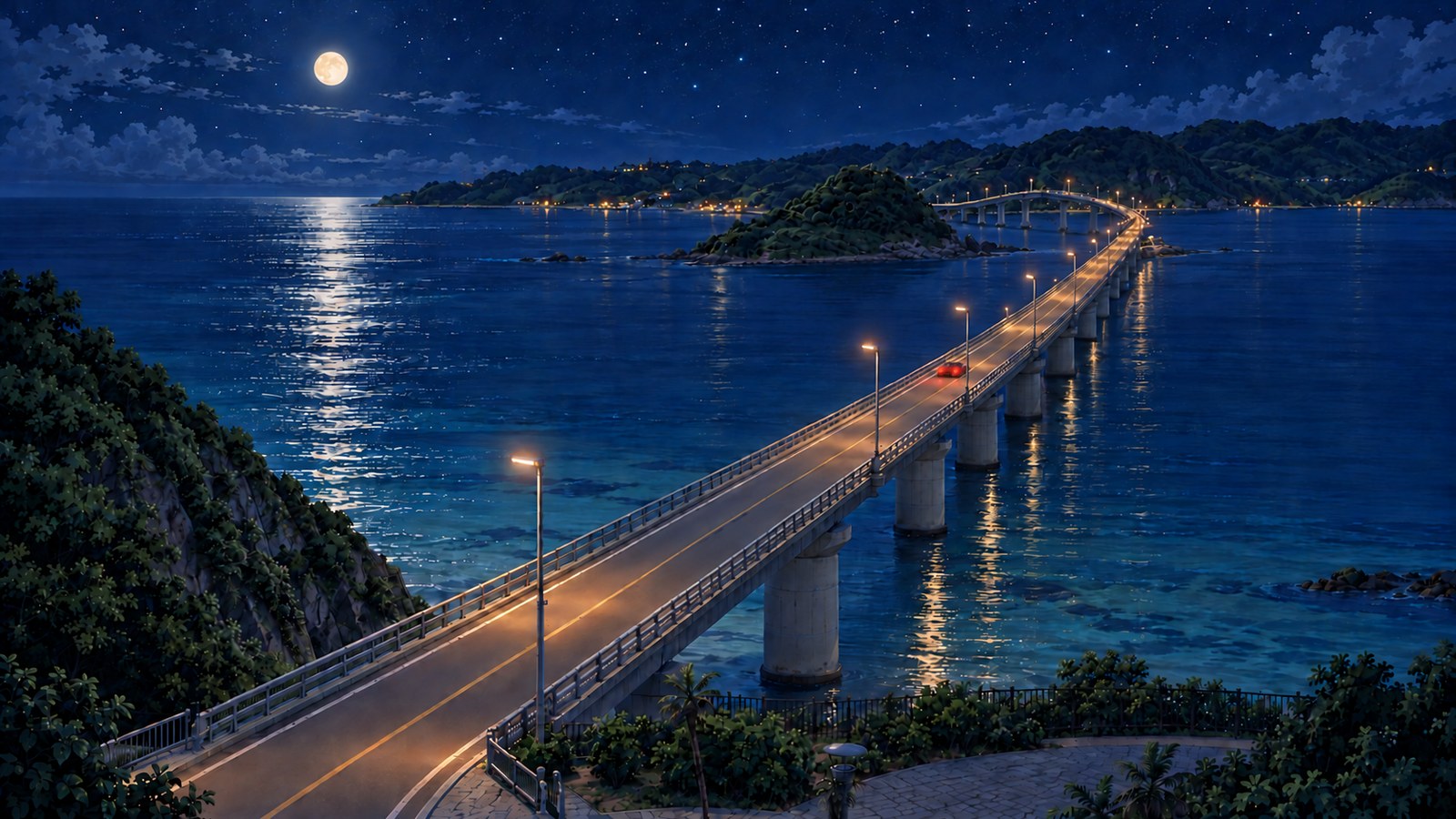
The lighthouse was first lit in 1876, the 9th year of the Meiji era, and it still shines over the sea today. Thinking of how its watch over the water had carried on from the Meiji era right into the Reiwa era, I took a little longer to get up from the bench. I finished my milk tea and noticed my fingertips had gone completely cold, so I headed back to the car park. On the way home, I crossed the bridge, parked at Amagase Park on the mainland, and turned around for one last look. The streetlights on Tsunoshima Ohashi were evenly spaced, turning the bridge I’d crossed in summer into a dotted line of light over the night sea. The seasons had come full circle, starting with the rapeseed flowers of spring. The bridge hadn’t changed at all, but with every crossing, I knew a little more about the island. Next time, I think I could show someone around.
The story sections are fiction inspired by this location. For accurate information, please consult official tourism and information websites.
Tsunoshima Ohashi Bridge at Night
Photos of this place12 images
-
Shimonoseki, Yamaguchi Prefecture · Spring
-
Shimonoseki, Yamaguchi Prefecture · Spring
-
Shimonoseki, Yamaguchi Prefecture · Summer
-
Shimonoseki, Yamaguchi Prefecture · Summer
-
Shimonoseki, Yamaguchi Prefecture · Summer
-
Shimonoseki, Yamaguchi Prefecture · Summer
-
Shimonoseki, Yamaguchi Prefecture · Autumn
-
Shimonoseki, Yamaguchi Prefecture · Autumn
-
Shimonoseki, Yamaguchi Prefecture · Winter
-
Shimonoseki, Yamaguchi Prefecture · Winter
-
Shimonoseki, Yamaguchi Prefecture · Winter
-
Shimonoseki, Yamaguchi Prefecture · Tsunoshima Ohashi Bridge at Night (Summer)
Local specialties
Shimonoseki Kitaura Kottoi Squid
Spear squid is a Tsunoshima specialty. The “Shimonoseki Kitaura Kottoi Squid” in particular is rated A, the highest grade, and is known for its sweetness and tender texture. I had it as sashimi one summer lunchtime. The sweetness deepened with every bite, and my chopsticks darted toward the next piece so quickly I almost laughed at myself. If you visit Tsunoshima, be sure to try it.
Seafood from Tsunoshima
Besides spear squid, Tsunoshima is known for sea urchin, horse mackerel, whitebait, wakame seaweed, and akamoku seaweed. I’ve only tried the squid so far, so next time I plan to work my way through the island’s seafood one by one.
Tsunoshima Pudding
There’s a takeout-only pudding shop around Tsunoshima. They put out different puddings each day, all made with ingredients carefully selected from Yamaguchi Prefecture. I picked one up on a summer motorbike trip and took it to the car park above the beach. It was cool and smooth, and even my cheeks, warm from the sun, relaxed as I ate.
Kawara Soba
I’ve heard you can order Yamaguchi’s famous kawara soba at scenic restaurants around Tsunoshima, too. On my winter trip, I got so caught up in the scent of daffodils and sea foam that I completely forgot about it. It only came back to me on the ferry home.
Highlights
A 1,780m bridge curving around Hato Island
Tsunoshima Ohashi Bridge links the mainland and Tsunoshima, is 1,780m long, and opened in 2000. Its route curves around Hato Island, and it is one of the longest toll-free bridges in Japan. When it was completed, it was said to be the longest bridge to an outlying island on a public road in Japan. From behind the wheel, you can feel the curve gradually bringing the island around to face you as you cross. I don’t think you’d get that same feeling on a straight bridge.
A lighthouse you can climb, one of only 5 in Japan with a first-order lens
Tsunoshima Lighthouse is a 29.62m-tall Western-style lighthouse built of granite. It was first lit in 1876, the 9th year of the Meiji era. It is one of only 16 lighthouses in Japan that visitors can climb, and its narrow, steep spiral staircase has 105 steps. Just 5 active lighthouses in Japan use a first-order lens, and Tsunoshima Lighthouse is one of them. In 2020, it became the first active lighthouse to be designated an Important Cultural Property. It was one of the lighthouses built under the direction of British engineer R. H. Brunton, and the first Western-style lighthouse on the Sea of Japan coast. It was said to have been the tallest stone lighthouse when it was built. When I climbed all 105 steps and found myself surrounded by sea in every direction, I forgot how tired my legs were.
White sand made from shells
The white sand at Tsunoshima Ohama Beach formed over a long time from countless broken shells. It’s a little romantic to think that the sand beneath your feet began as shells. In summer, the beach draws plenty of swimmers, and Tsunoshima Ohama Campground opens for the season.
Road Details
Getting Here from Tokyo
- From Tokyo
- Ferry to Shin-Moji PortFrom Ariake via Tokushima; about 35 hours
- From Shin-Moji Port
- About 73kmVia Kanmon Bridge and the Chugoku Expressway; about 1 hour 20 minutes by car
- Expressway Interchanges
- Ozuki IC / Mine IC (Chugoku Expressway)Both are about 60 minutes by car from Tsunoshima Ohashi Bridge
- Parking Before the Bridge
- Amagase ParkTake Prefectural Route 275 from National Route 191. The car park is free and open 24 hours a day.
Tsunoshima Ohashi Bridge
- Length
- 1,780m
- Boat Clearance
- 18m
From Amagase Park on the mainland, cross to Tsunoshima, passing close to Hato Island.
The bridge is 6.5m wide. One section provides an opening 18m high and 70m wide for boats to pass underneath. Every time I cross the highest point, I can’t help picturing a boat slipping through below.
Nearby Driving Spots

Nearby Roadside Stations
More Spot Guides
If you enjoyed this story, you might like these places too. I've gone back to each of them in different seasons, again and again.
Maps & Sources
Official Sources Consulted
- Yamaguchi Prefecture Infrastructure Management (Tsunoshima Ohashi Bridge) (opens in a new tab)
- Visit Yamaguchi (The Complete Guide to Your First Visit to Tsunoshima) (opens in a new tab)
- Visit Yamaguchi (Tsunoshima) (opens in a new tab)
- Visit Yamaguchi (More Than Just Tsunoshima Ohashi: A Blog About the Island) (opens in a new tab)
- Cultural Heritage Online (Tsunoshima Lighthouse) (opens in a new tab)
- Yamaguchi Prefecture Road Construction Division (A Bridge to See at Least Once: Tsunoshima Ohashi) (opens in a new tab)
- Visit Yamaguchi (Tsunoshima Ohashi) (opens in a new tab)
- Tōkōkai (Tsunoshima Lighthouse) (opens in a new tab)
- Ocean Tokyu Ferry (Sailing Schedule) (opens in a new tab)