Aso City, Kumamoto Prefecture
Aso Burning grasslands, frozen ponds—it was all still Aso.
As I drive along Milk Road, the land suddenly falls away on one side, and the towns and fields on the caldera floor burst into view. No matter how many times I drive it, I still catch my breath a little. I stop in Aso whenever I travel through Kyushu. The grasslands ablaze, horses wandering through the grass, towns sunk beneath the clouds, the pond frozen white—it is all the same Aso. On the way home, I'm already wondering which season I'll come back in.
From flames moving across a distant slope to frost on a twig at my feet, the things that caught my eye in Aso were at very different distances in each season.
SpringEarly March
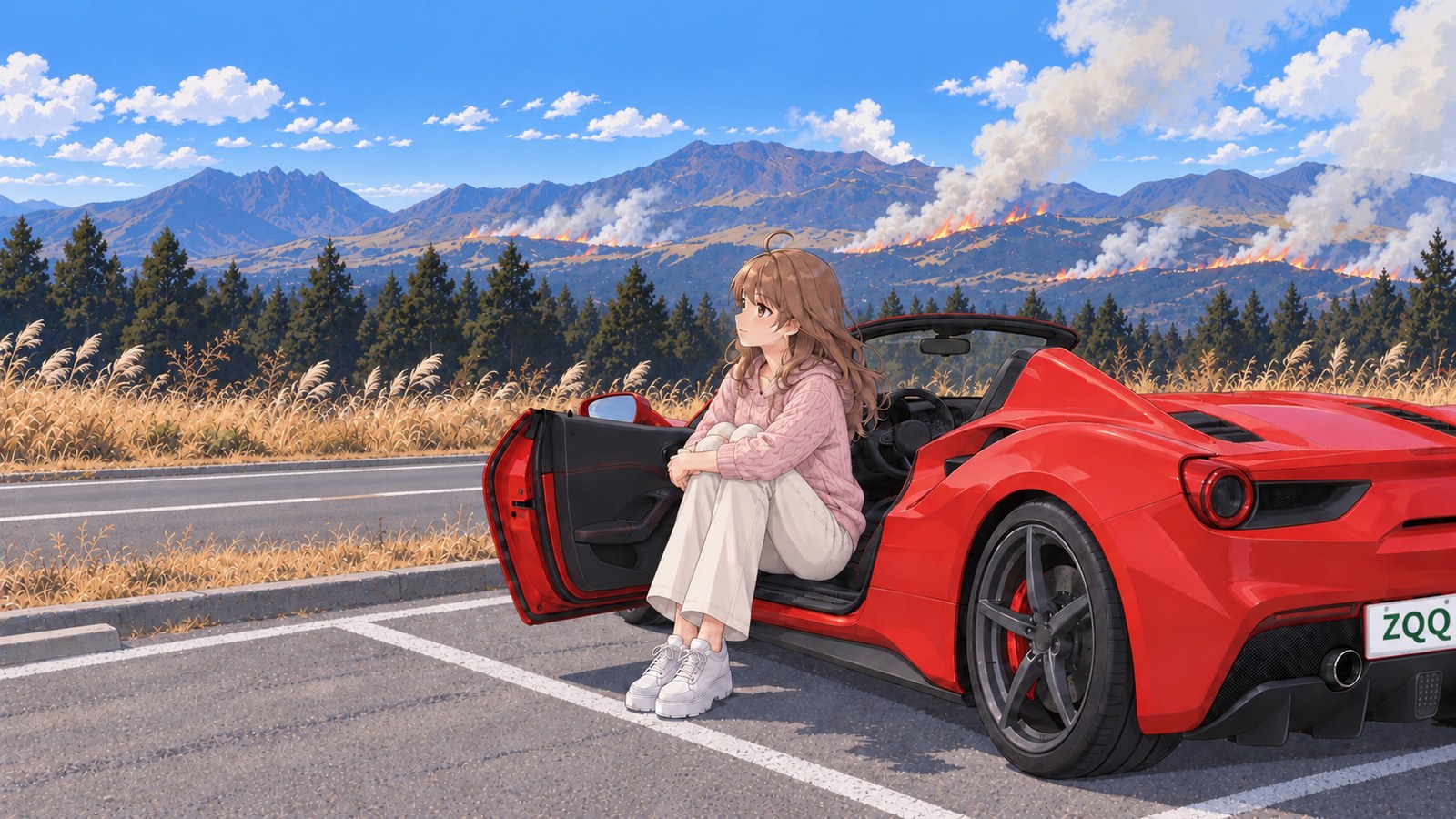
I watched the distant flames with my car door open
As soon as I climbed onto Milk Road, the air inside the car changed. In early March, the grasslands high on the outer rim still looked wintry, stretching on and on along both sides of the road. I turned the heater up a little and pulled my jumper collar higher. The curves here are broad and gentle, so I only had to nudge the wheel slightly, then ease it back. Even with my eyes on the road, the grassland kept streaming into the edge of my vision. That alone made me glad I'd come.
I stopped in Aso on my way back north through Kyushu after spending the winter in Okinawa. More than anything, I wanted to see the controlled grassland burns, held sometime between February and around April, with my own eyes. I'd heard the schedule could shift with the weather, so I'd been watching the sky all evening the night before.
As I neared Kabutoiwa Viewpoint, I spotted a thin trail of white smoke rising from the foot of a hillside across the caldera. I wanted to turn and look right away, but held back and signalled first, pulling into the souvenir shop car park. Only after parking and opening the door could I finally turn around. A line of flames was moving slowly across the distant slope. I'd meant to get out, but instead I drew my knees up and sat there, unable to move.
The flames were far away, but against the vast grassland, their line was much longer than I'd expected, almost as if an entire mountainside were moving slowly. I couldn't hear the fire or feel its heat from where I was, yet my palms had started to sweat.
There must be people near those flames. During the burn, people carrying fire beaters follow behind the burn crew, checking each section to make sure the flames are out. I couldn't see any of them from where I was. But the smoke rose in calm, steady plumes because someone was surely there keeping watch. Thinking of that, I felt like bowing my head to the distant slope.
People keep Aso's grasslands open by working them. Where controlled burns, haymaking and grazing stop, the grassland gradually turns into forest. The burns also help reduce pests and disease, and this way of managing the land has been recognised as a Globally Important Agricultural Heritage System. The grassland stretching beyond the road today is here because people have kept up this spring work year after year. I'd read about it in books, but seeing the smoke right in front of me gave that knowledge a whole different weight.
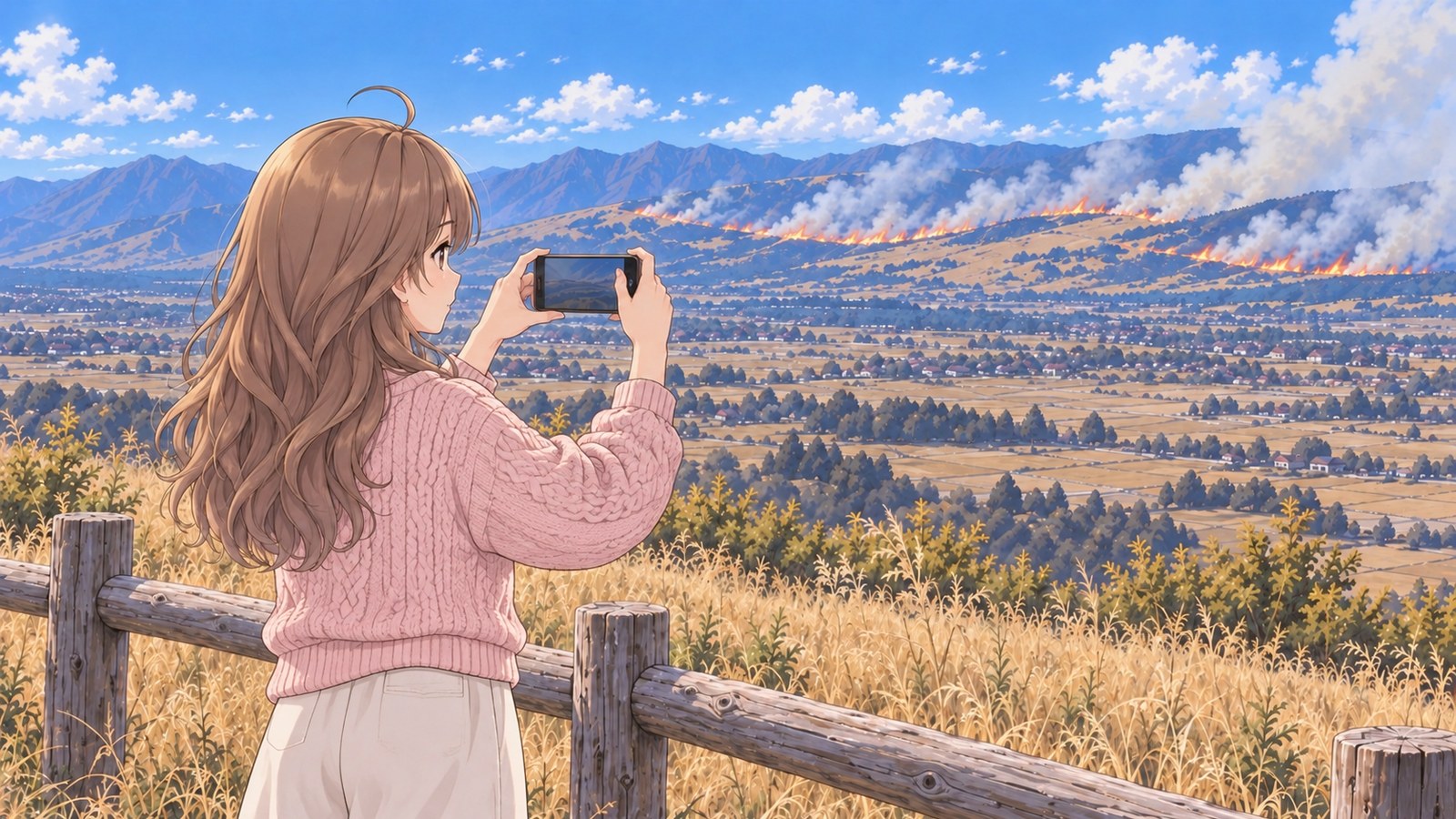
Each time the wind shifted, the smoke changed direction. The plume that had risen straight into the sky was now trailing sideways along the ridge. As I compared the smoke with the line of flames, I began to make out, even from a distance, the boundary between the slope already burned black and the grass that still looked wintry. That boundary shifted sideways little by little, but steadily.
At last I unfolded my legs, crossed the road and walked to the timber railing at the viewpoint. I turned my phone sideways. Instead of zooming in on the flames, I framed the whole grassland too, so that when I looked back later, I'd remember that thin line set in all that space. I marked the one of the three shots where the smoke streamed furthest sideways.
Back in the car, before closing the door, I looked over my shoulder at the slope. As spring moves on, new grass grows over the burned land and it turns green again. I thought of the green grasslands I'd seen from horseback in summer and realised they were the result of people tending the land year after year. The black slope began to look like a place waiting for the next season. I started the engine and headed back along Milk Road.
SummerAugust
Still clutching the saddle, I finally looked up—and Kusasenri stretched out before me
“Next, left. Oh—no, straight on.” My driving friend in the passenger seat seemed convinced she was navigating as she studied the map. She'd flown in the day before to meet me and had been in my passenger seat ever since. When she isn't driving her own yellow car, she has a lot more to say. We'd driven up to Kusasenri together for the guided horseback ride she'd been urging me to try.
With the top down, we climbed the mountain road, and where the trees fell away, a green grassland opened up all at once. My friend pointed and said, “There!” “I can see it,” I said, keeping my eyes on the road. That's the big difference between the driver and the passenger: I can't sit there taking in the view. I parked and walked to the horse-riding area. Kusasenri is pastureland managed for grazing, and the guided ride is a short one, about 5 minutes, with a guide leading the horse by the reins. I'd heard it was fine for first-timers, which was a relief. My friend, who'd been the one insisting I try it, said, “I'll watch.” After checking with the guide, she decided to walk alongside the horse instead.
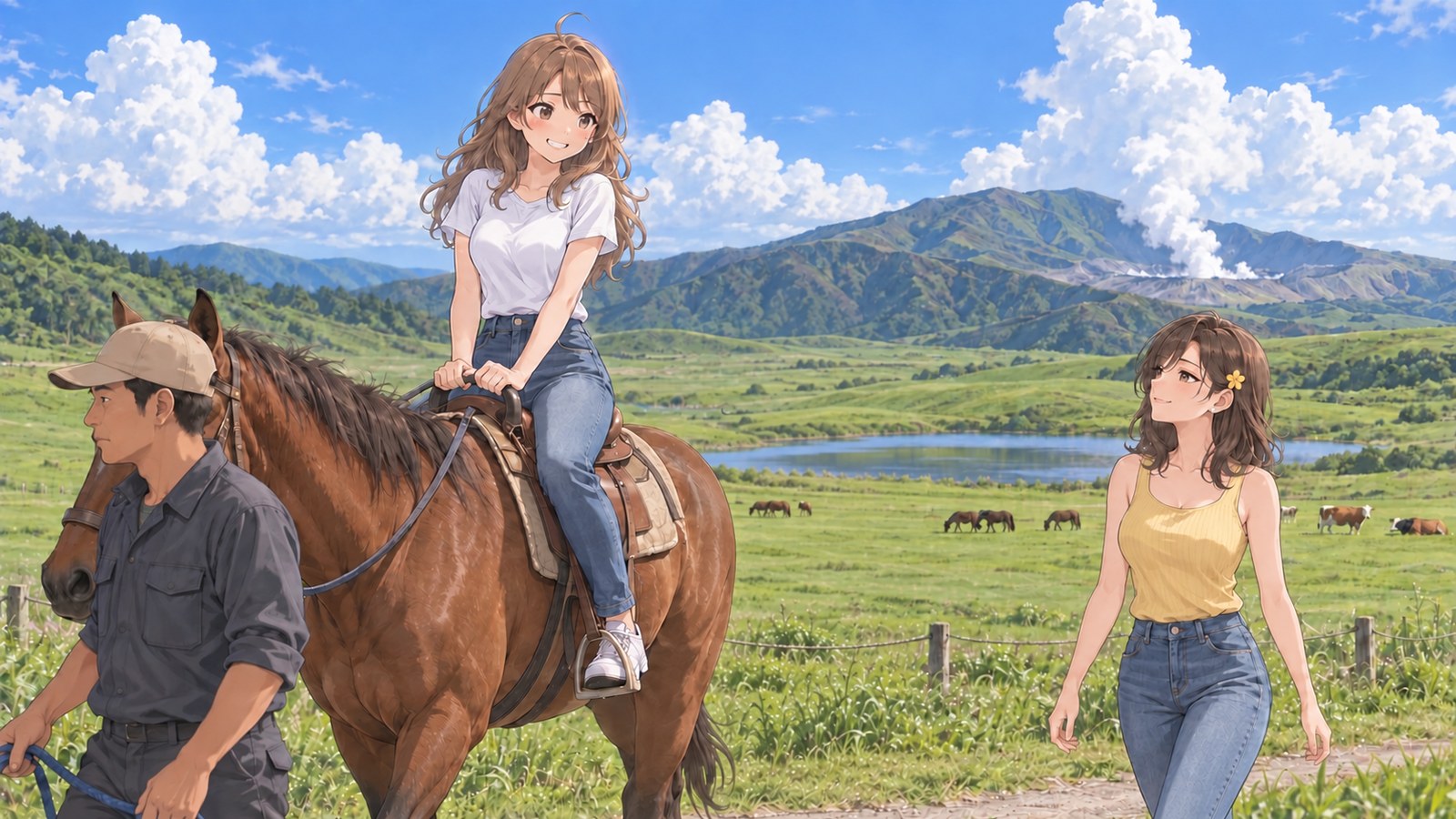
Once I was in the saddle, the horse felt much taller than it had looked from the ground. The guide adjusted the reins and told me, “This one's gentle, you'll be fine,” but both my hands stayed clamped around the saddle. The horse's body felt warm through it, and I could feel the broad muscles in its back shifting with every step. In a car, I know exactly how much pressure to use and where; on horseback, I had no idea what to do with any of it. In my head, I gave the horse a very proper, “Please take good care of me.”
The horse started walking, and I swayed back and forth. At first, all I could think about was the movement; I kept looking down at the saddle and tightening my grip. My friend walking beside us leaned in to peer at my face and laughed. “You look so serious.” I was about to say, “I'm always serious,” when I heard myself and cracked up first.
Once I laughed, the tension in my back eased and I finally lifted my head. The grassland stretched on and on beyond my friend. Cattle and horses grazed lazily; beyond them were the pond and Mount Nakadake, sending up a plume of white smoke. When I came in winter, I'd spent all my time crouched down looking at frost underfoot. This was the first time I'd really looked out across Kusasenri. From horseback, the grassland seemed to go much further than it did from the driver's seat.
At a horse's walking pace, the scenery changed only a little at a time. The pond, the herd of cattle, the direction of the plume. Even with my hands still on the saddle, it was fun to spot one thing and look for the next, and before I knew it, I'd loosened my grip. My friend said I looked like I was enjoying myself more than at the start, and I couldn't deny it.
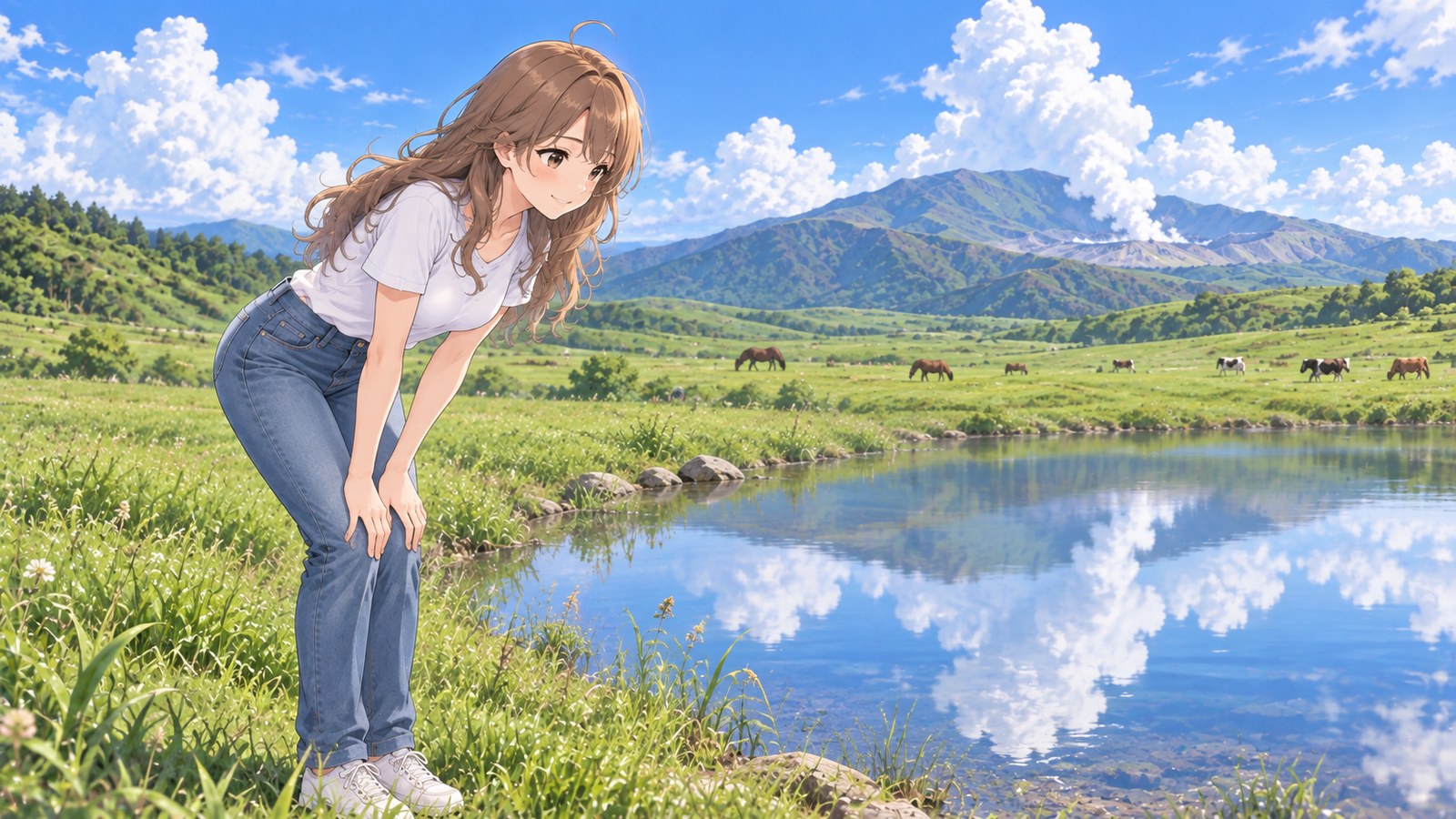
Once I got off, the ground felt lower than usual and I wobbled a little. Then we walked together to the pond at the edge of the grassland. It's said to have formed from rainwater collecting there. I leaned over with my hands on my knees, and the summer clouds and blue sky were reflected across the surface. Now I could walk over and see up close the pond I'd spotted from horseback. My friend was still saying she should've taken a photo of how serious I looked.
I'd already decided I was having Aso Akaushi for lunch. We were heading to Yoka Yoka-tei's Sakanashi Main Branch, which serves beef raised on its own ranch. Back at the car park, my friend opened the map again and announced, “Leave the directions to me!” I took the wheel with the same hands that had clutched the saddle and drove back down the mountain. When the Akaushi arrived, I thought of the cattle we'd seen grazing in the grassland and took a moment to say a more heartfelt “thank you” before eating. The more I chewed, the more flavour came through, and with every bite, the tension from the horseback ride melted away.
AutumnOctober–November
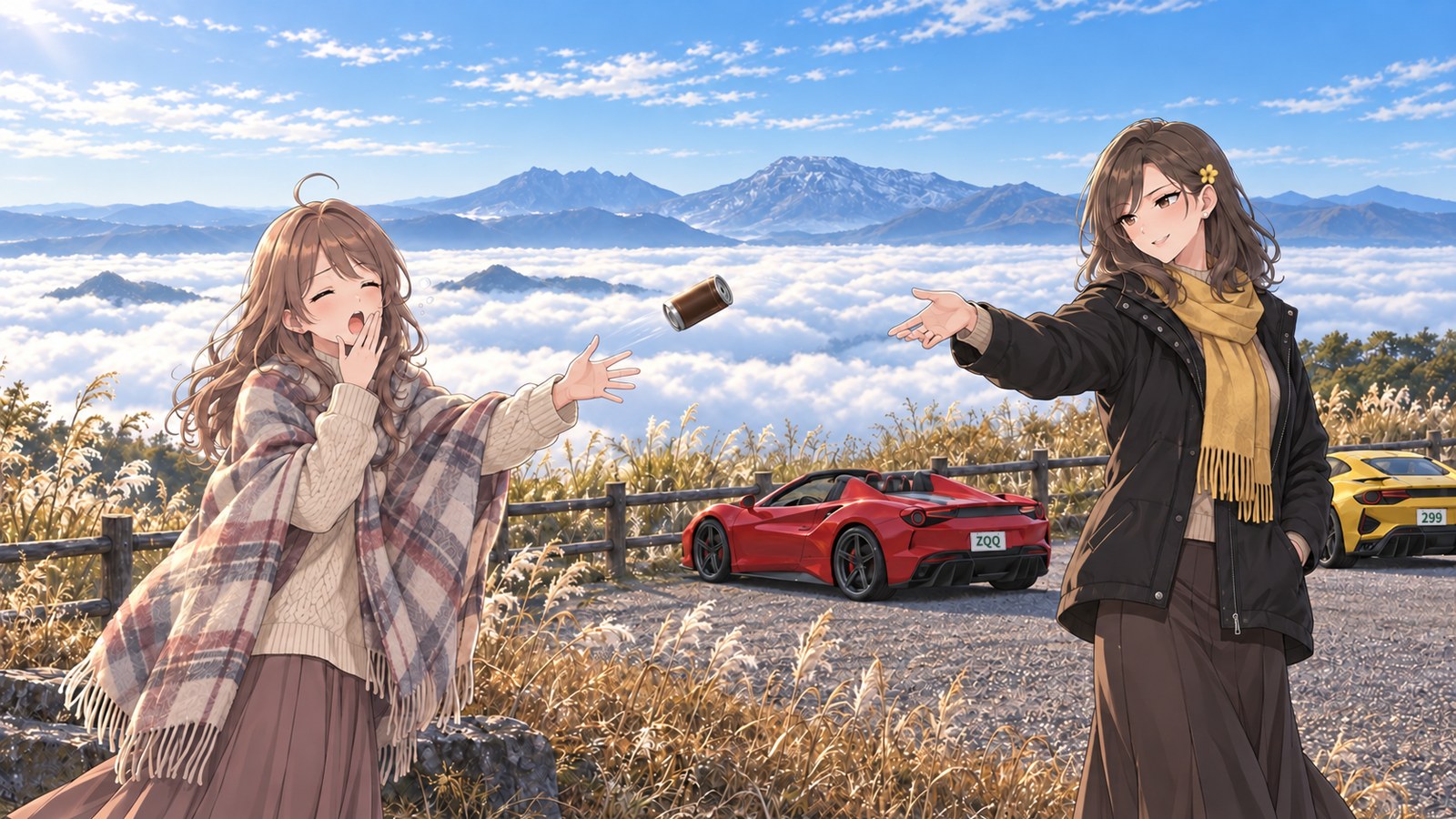
A canned coffee came flying while I was mid-yawn
I left our lodging early and followed my driving friend's yellow car. This autumn, my friend had brought her own car too, so we could drive through Aso in two cars. Daikanbo is about a 30-minute drive from Roadside Station Aso, and we planned to arrive when the car park opened at 8. When the yellow car ahead slowed for a bend, I slowed at the same spot. Even our steering began to match. We weren't connected by radio or phone, but it felt as if the two cars were drawing one long line. It made me quietly happy, even so early in the morning.
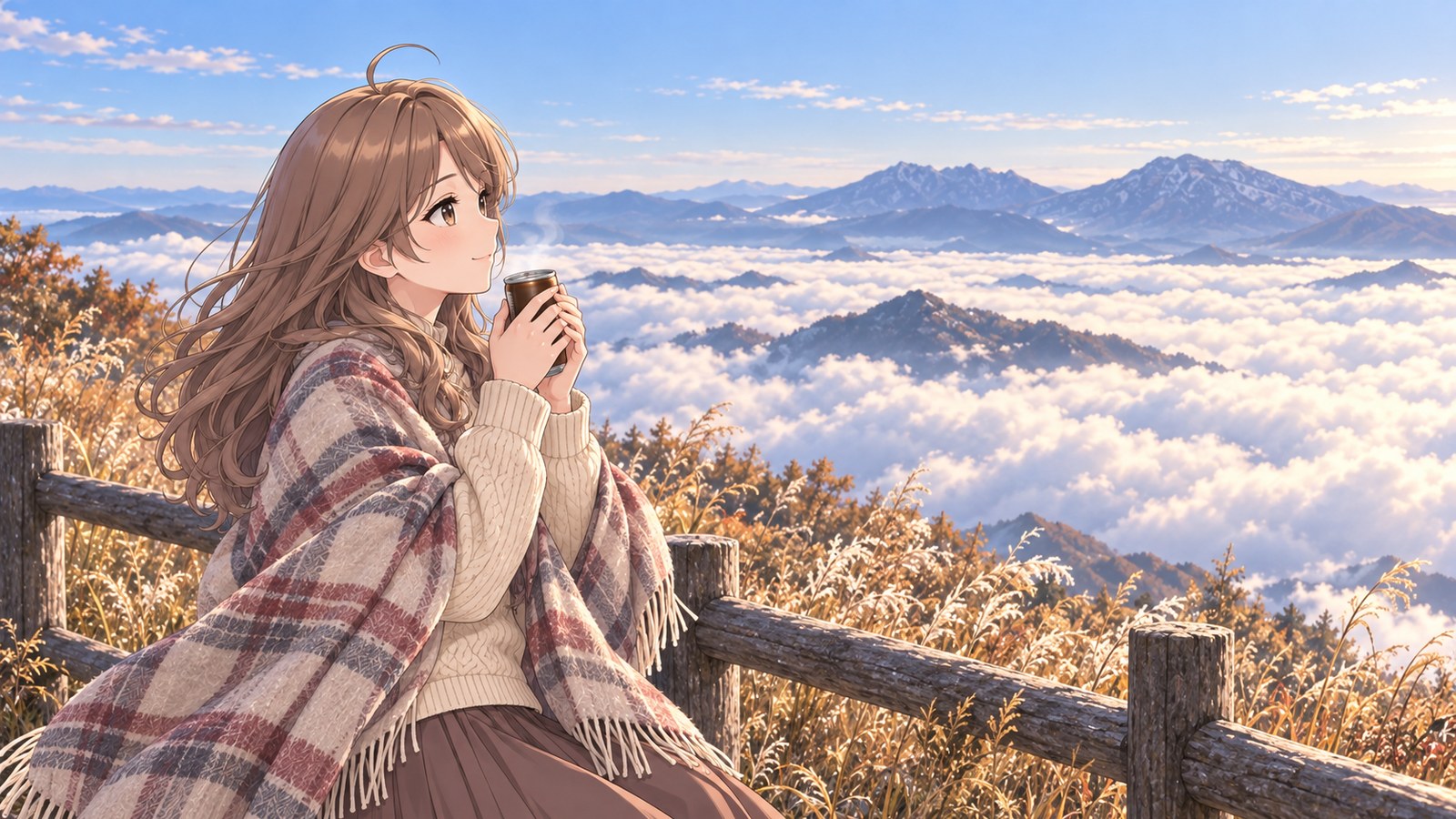
When I got out, the air was crisp and cold. Good call, yesterday-me: I'd packed a blanket in the car. At the lookout area at the end of the path, I pulled it up over my shoulders. Clouds filled the caldera, with only the mountain outlines floating above. I should've been sleepy, but I was wide awake.
The Aso Five Peaks poking above the clouds are said to look like the Buddha lying down. I started at one end, trying to work out which peak was the Buddha's head, then realised I was wrapped in a blanket with only my head sticking out, probably in the same pose. I had a little laugh inside the blanket.
A sea of clouds is more likely after rain the previous day, when there's a large difference between daytime and nighttime temperatures and the morning is clear and calm. The previous evening, we watched the clearing sky and said, “Maybe we'll get clouds tomorrow.” And we did. You can apparently see the town of Aso and the Five Peaks, and even as far as the Kuju Range, from Daikanbo. I was pointing at the mountains lined up above the clouds and guessing their names when my friend said, “You just pointed at that one.”
Just then, I let out a huge yawn. My friend, standing a little way off, looked over, laughed and tossed me a canned coffee. I was still halfway through the yawn, but my hand shot out in time and caught it. All those years of driving must have sharpened my reflexes for moments like this too.
The can warmed my palms just right. “Awake now?” she asked. “I'm taking in the view, honestly,” I said. At the fence, I cupped the can in both hands and took a sip. As I swallowed, its faintly sweet warmth settled deep in my chilled belly.
As the sun rose higher, the tops of the clouds began to glow white and the sea of clouds slowly stirred. My friend was off photographing another direction; I was looking for a break in the clouds. We were quiet, each watching our own view. We had come together, but the morning felt as still as if I'd come alone, and I found it surprisingly soothing.
We waited for the tea shop to open, then had takana rice. I was ravenous after the early start, and the fragrant, salty takana rice really hit the spot. I wrapped my hands around my rice bowl, the same way I'd held the coffee. When I went back to the lookout after eating, the sea of clouds had broken apart and the town below was beginning to emerge. Down there, an ordinary morning had started a long time ago.
I was folding up the blanket at the car park when my friend lowered the window of her yellow car and called, “I got a photo of you yawning too!” I asked her to delete it, but she just smiled and rolled the window back up without answering. I still haven't found out what happened to that photo.
WinterEarly February
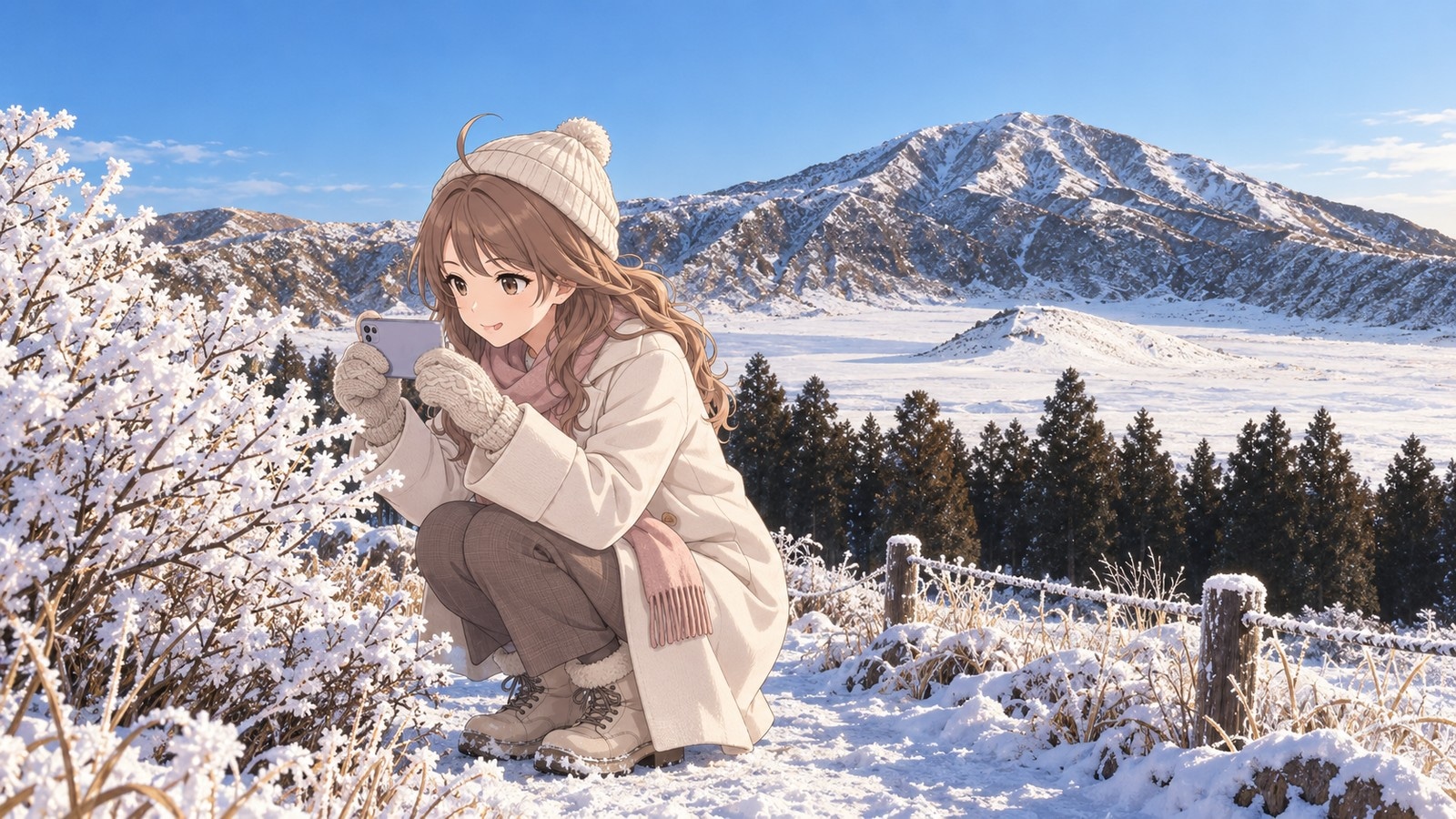
I crouched to photograph a frosted branch and stayed there
On the climb from the foothills to Kusasenri, the snow piled up along the roadside as we got higher. That day I was driving a red four-wheel-drive sedan. Listening to the winter tyres crunch over the snow, I braked and turned earlier and more gently than usual. There was no rush, but I love—and feel a little proud of—taking my time and keeping steady on a road like that.
I came to Aso to see the rime. I'd learned that, weather permitting, rime often lasts at Kusasenri into mid-February, so I made the climb in early February. I checked the road conditions that morning before setting out, but the air at Kusasenri was completely different from the foothills.
I parked and had barely started across the snowy grassland when a branch covered in frost caught my eye. I'd planned to photograph the distant mountains, but my attention had already drifted to a slender branch nearby. Gathering the hem of my cream coat so it wouldn't brush the snow, I crouched and leaned in.
Frost had spread all the way to the tips of the slender branches. When I raised my phone, I saw several places I wanted to bring into focus. I photographed the nearest branch first, then the ones behind it. Even a small turn of my head changed how the branches overlapped, so I kept adjusting my position.
I kept holding my breath each time I pressed the shutter. After checking the screen to see if I'd got the shot, I'd let it out with a sigh. I was so worried my breath might melt the frost that I actually turned my face away to exhale. Maybe I was being a little too careful.
A gust shook the branches and frost fell in a delicate shower. It caught the light for an instant, then disappeared into the snow. By the time I pointed my phone at it, the branches were still again. So I waited in front of them with my phone up, ready for the next gust. My cheeks had gone cold while I waited; when the wind finally came, no frost fell this time.
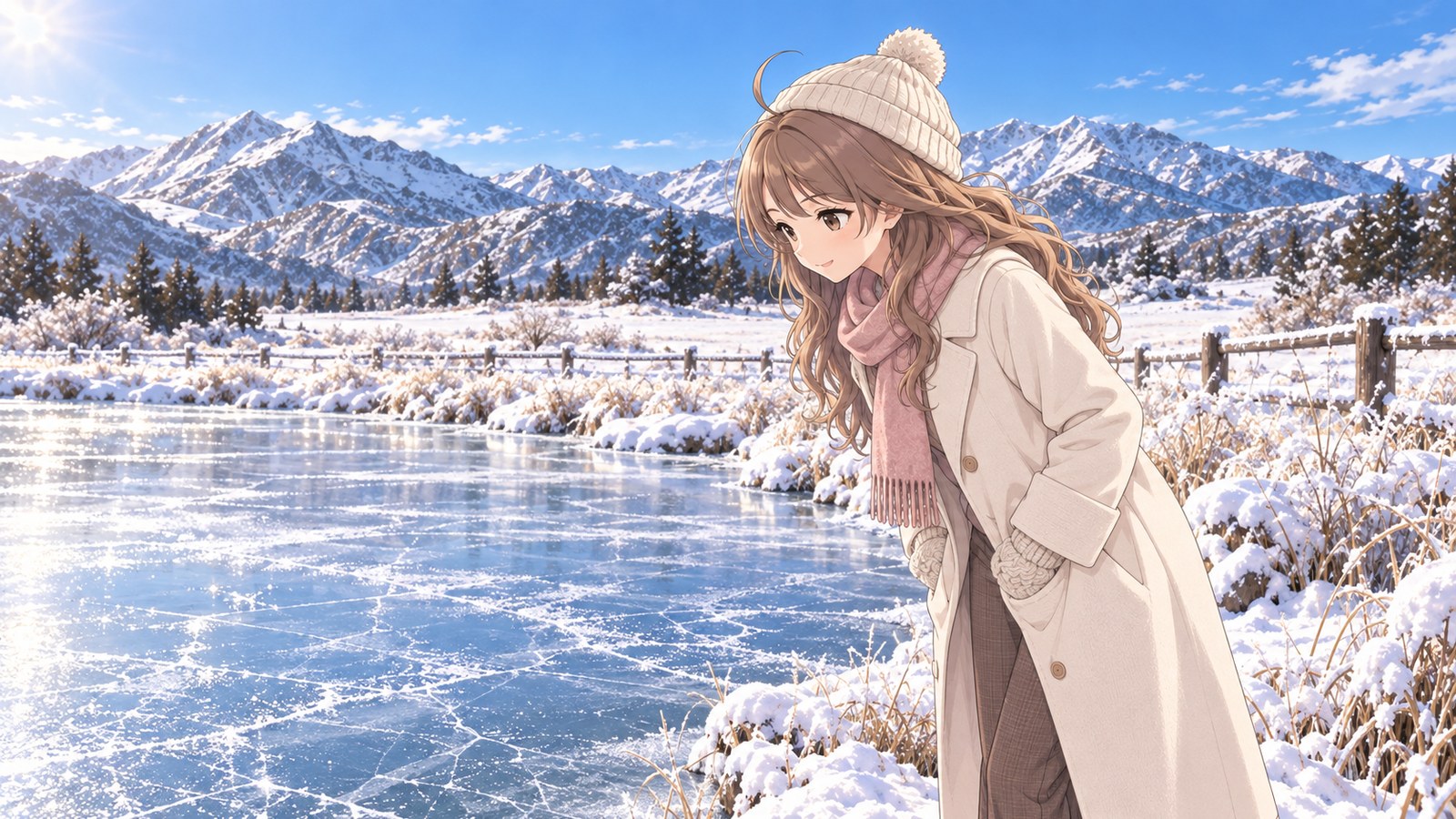
I gave up, stood and walked to the edge of the frozen pond. White lines ran across the ice. Like the frost on the branches, they became more interesting the closer I looked, so I leaned over the pond with my gloved hands still tucked into my pockets. The snow underfoot gave a soft squeak. When the cold wind came, I buried my face in my scarf.
When I looked up, the grassland was white as far as I could see. Cattle and horses would normally be grazing here in summer, but today nothing moved; all I could hear was the wind. I'd come to such a vast place, yet the thing I'd spent the longest looking at was frost on a tiny twig. Even I thought that was a little funny.
Back in the car, I turned on the heater and my frozen fingertips slowly began to thaw. As I scrolled through the photos, I found one near the beginning with a flake of frost just starting to break free from a branch. I hadn't managed to catch it while I was waiting for the wind—yet somehow I'd photographed it before I even started waiting. Beyond the windscreen, the trees in the grassland swayed again, and this time the frost really did scatter.
The story sections are fiction inspired by this location. For accurate information, please consult official tourism and information websites.
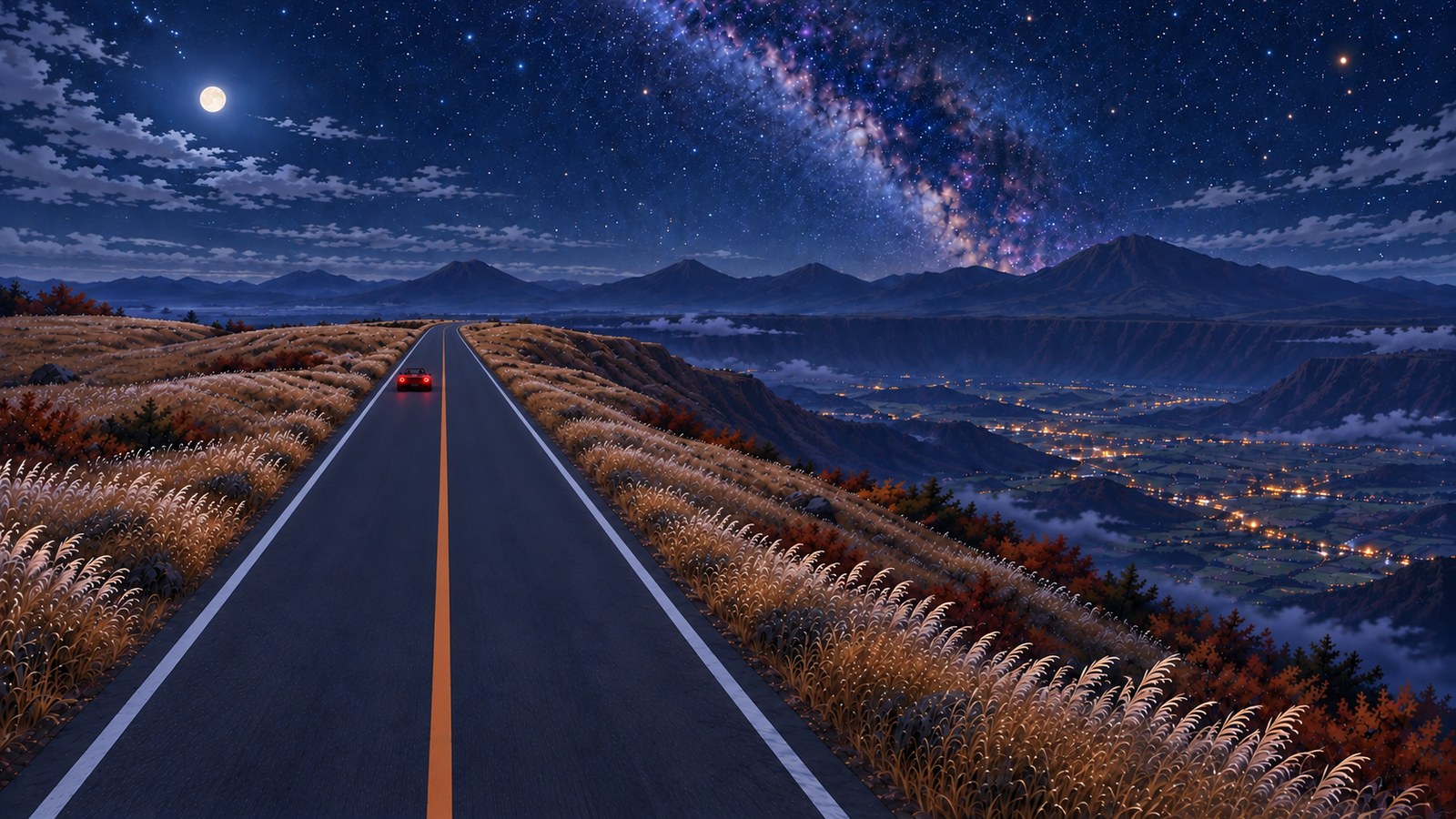
Aso at Night
Photos of this place9 images
-
Aso City, Kumamoto Prefecture · Spring
-
Aso City, Kumamoto Prefecture · Spring
-
Aso City, Kumamoto Prefecture · Summer
-
Aso City, Kumamoto Prefecture · Summer
-
Aso City, Kumamoto Prefecture · Autumn
-
Aso City, Kumamoto Prefecture · Autumn
-
Aso City, Kumamoto Prefecture · Winter
-
Aso City, Kumamoto Prefecture · Winter
-
Aso City, Kumamoto Prefecture · Aso at Night (Autumn)
Local specialties
Akaushi Beef Bowl
A bowl of rice topped with a medium-rare steak of Akaushi, a Japanese breed of beef cattle raised in Aso's natural surroundings. The beef is so good that I'm always trying to pace myself so I don't run out of rice.
Takana Rice
Aso's takana greens are long and slender, and are said to be ideal for pickling. Takana rice, made with the pickled greens, is a local speciality. The greens have a crisp bite, and even without any other side dishes, I empty my rice bowl in no time.
Dago-jiru (Dumpling Soup)
Dago-jiru is a traditional Kumamoto soup made with soft, chewy dumplings called dago. They're made by kneading wheat flour, then simmered with burdock, daikon and carrot and seasoned with miso or soy sauce. A single bowl, packed with chewy dumplings and root vegetables, warms you from the inside out.
Highlights
A Thousand Years of Spring Work to Protect the Grasslands
People have maintained Aso's grasslands for about 1,000 years through controlled burns, haymaking and grazing. Areas where the burns stop gradually turn into forest. From February to around April, dry grass is burned to carry the grasslands into the next season, and this way of managing the land is recognised as a Globally Important Agricultural Heritage System. The green grasslands of summer owe their colour to this work, repeated every year.
Kusasenri's Pond and Mount Nakadake's Plume
Kusasenri-ga-hama is a vast grassland covering 785,000 square metres. In one sweep, you can take in a pond said to have formed from rainwater, and Mount Nakadake sending up a plume of volcanic smoke. With grazing cattle and horses in summer and the pond frozen over in winter, the same place can look completely different.
Looking for the Sleeping Buddha Above the Clouds at Daikanbo
Daikanbo is said to have been named by Tokutomi Soho. The Aso Five Peaks seen from here are called the “Reclining Buddha” because they look like the Buddha lying down, and you can apparently see as far as the Kuju Range.
Road trip stops
Getting here from Tokyo
- From Tokyo
- Ferry to Shinmoji PortThe ferry departs from Ariake, calls at Tokushima, and takes about 35 hours
- From Shinmoji Port
- About 210 kmAbout 3 hours by car via the Kyushu Expressway and other routes
- Expressway interchange
- Kumamoto Interchange (Kyushu Expressway)About 45 km; around 1 hour by car to the Kusasenri car park
- To Daikanbo
- About 12 km from Roadside Station AsoAbout 30 minutes by car. The car park just before the viewpoint is open from 8 am to 5 pm.
Spring: Kabutoiwa Viewpoint on Milk Road
- Places to visit
- Along Prefectural Route 339 (Milk Road)
- Scenery
- Panoramic views of the Aso Five Peaks and the outer rim
Drive along Milk Road, which runs over the outer rim. From the shop's car park, a paved footpath leads to the viewpoint.
Summer and winter: Kusasenri-ga-hama
- Places to visit
- Kusasenri-ga-hama, Aso Summit Area
- Scenery
- Grassland area: 785,000 square metres
In Aso's summit area, Kusasenri's highlights are guided horseback rides in summer and rime-covered trees and a frozen pond in winter. From Kumamoto Interchange, it's about 45 km and around 1 hour to the Kusasenri car park.
Autumn: Take a break at Daikanbo
- Places to visit
- Yamada, Aso City, Kumamoto Prefecture
- Scenery
- Views across the caldera and the Aso Five Peaks
Daikanbo is a popular viewpoint where drivers also stop for a break. The car park just before it is open from 8 am to 5 pm, so for a morning sea of clouds, it's best to time your climb to the opening.
In spring, head for Kabutoiwa Viewpoint on Milk Road; in summer and winter, Kusasenri-ga-hama; and in autumn, Daikanbo. The views change dramatically from one part of Aso to another, so it's fun to choose a different destination each season.
More Spot Guides
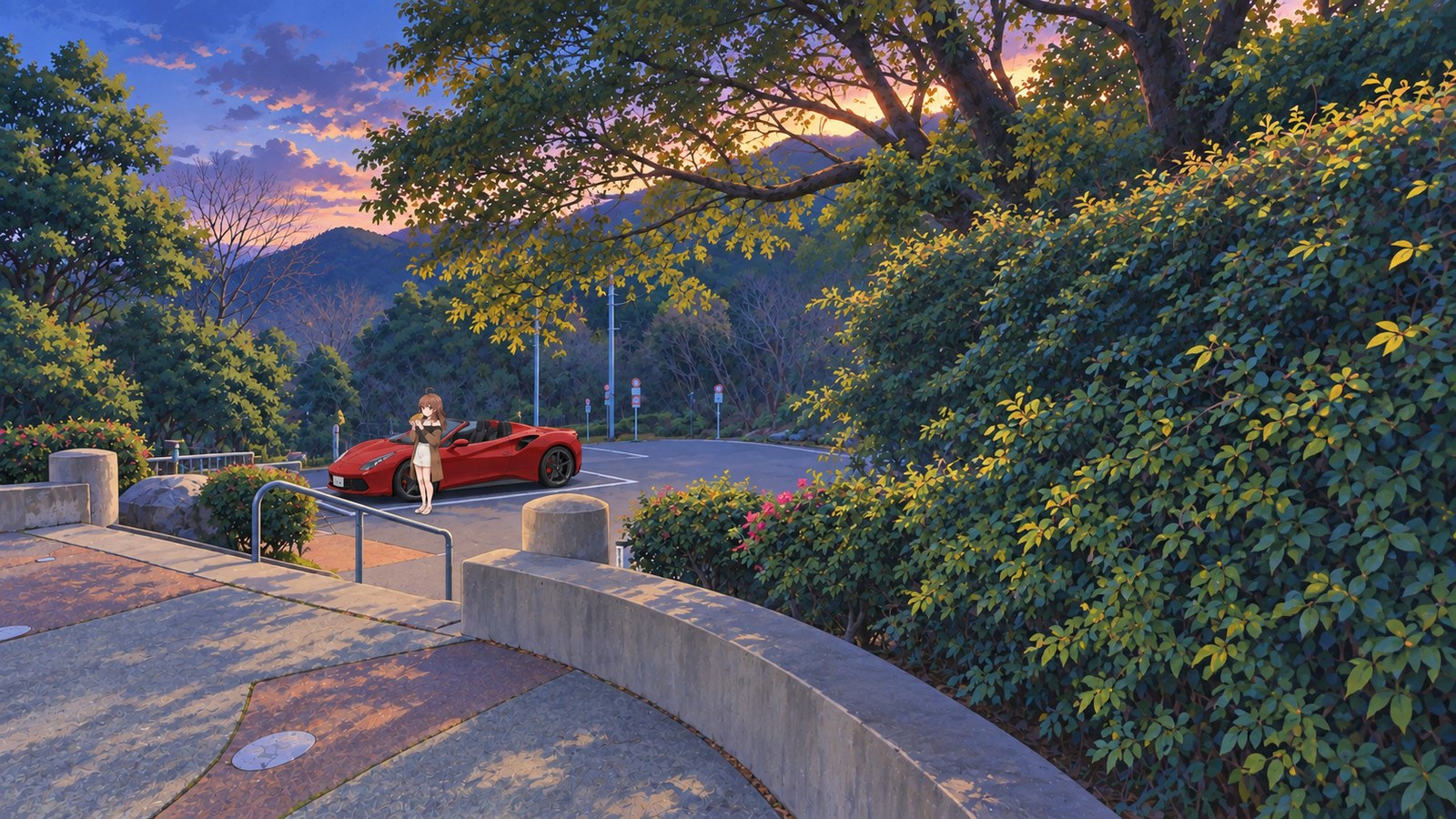
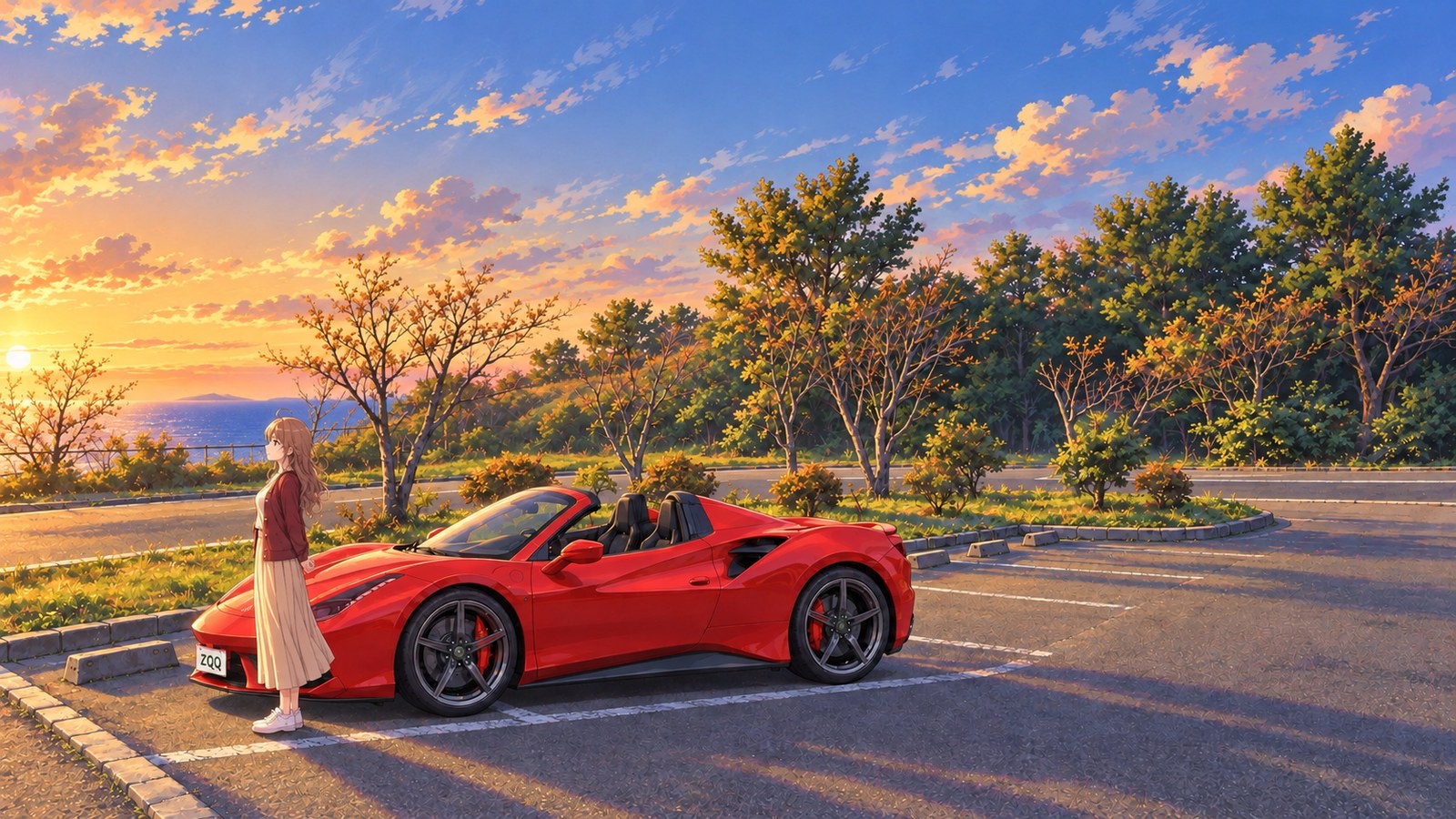
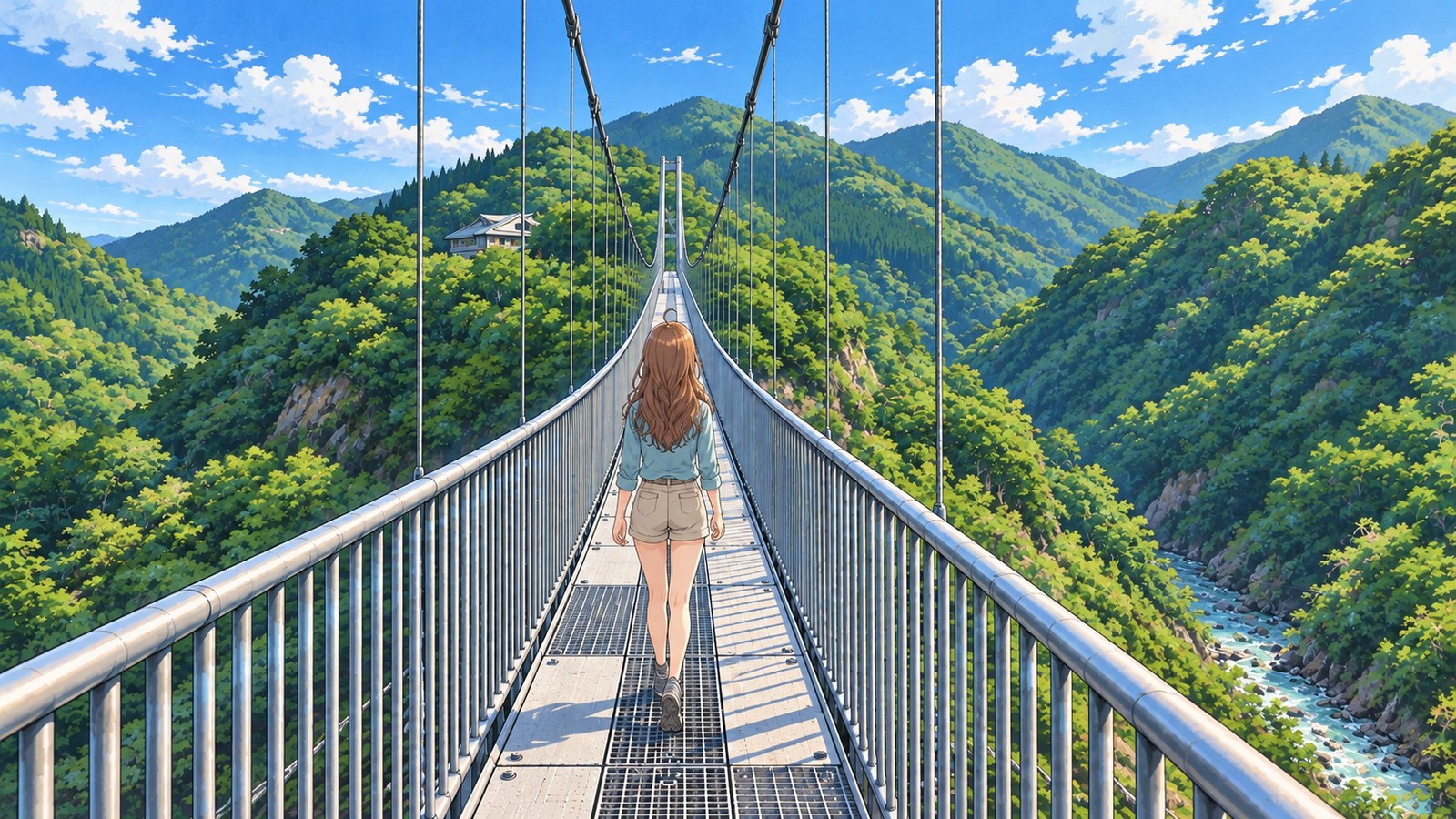
If you enjoyed this story, you might like these places too. I've gone back to each of them in different seasons, again and again.
Maps & Sources
Official sources
- Kumamoto Prefecture Tourism Site (Aso Grasslands) (opens in a new tab)
- Aso City Tourism Association (Controlled Burns) (opens in a new tab)
- Aso City Tourism Association (Kusasenri-ga-hama) (opens in a new tab)
- Aso City Tourism Association (Daikanbo) (opens in a new tab)
- Kumamoto Prefecture Tourism Site (Rime at Kusasenri) (opens in a new tab)
- Kumamoto Prefecture Tourism Site (Akaushi Beef Bowl) (opens in a new tab)
- Aso City Tourism Association (Daikanbo Tea House) (opens in a new tab)
- Kyushu Torupa (Daikanbo Chaya Car Park) (opens in a new tab)
- Ministry of Agriculture, Forestry and Fisheries: Our Local Cuisine (Kumamoto Prefecture) (opens in a new tab)
- Ocean Tokyu Ferry (Sailing Schedule) (opens in a new tab)