Minami-Osumi, Kagoshima
A drive to Cape Sata A summer evening walk to a view from the southernmost tip of mainland Japan
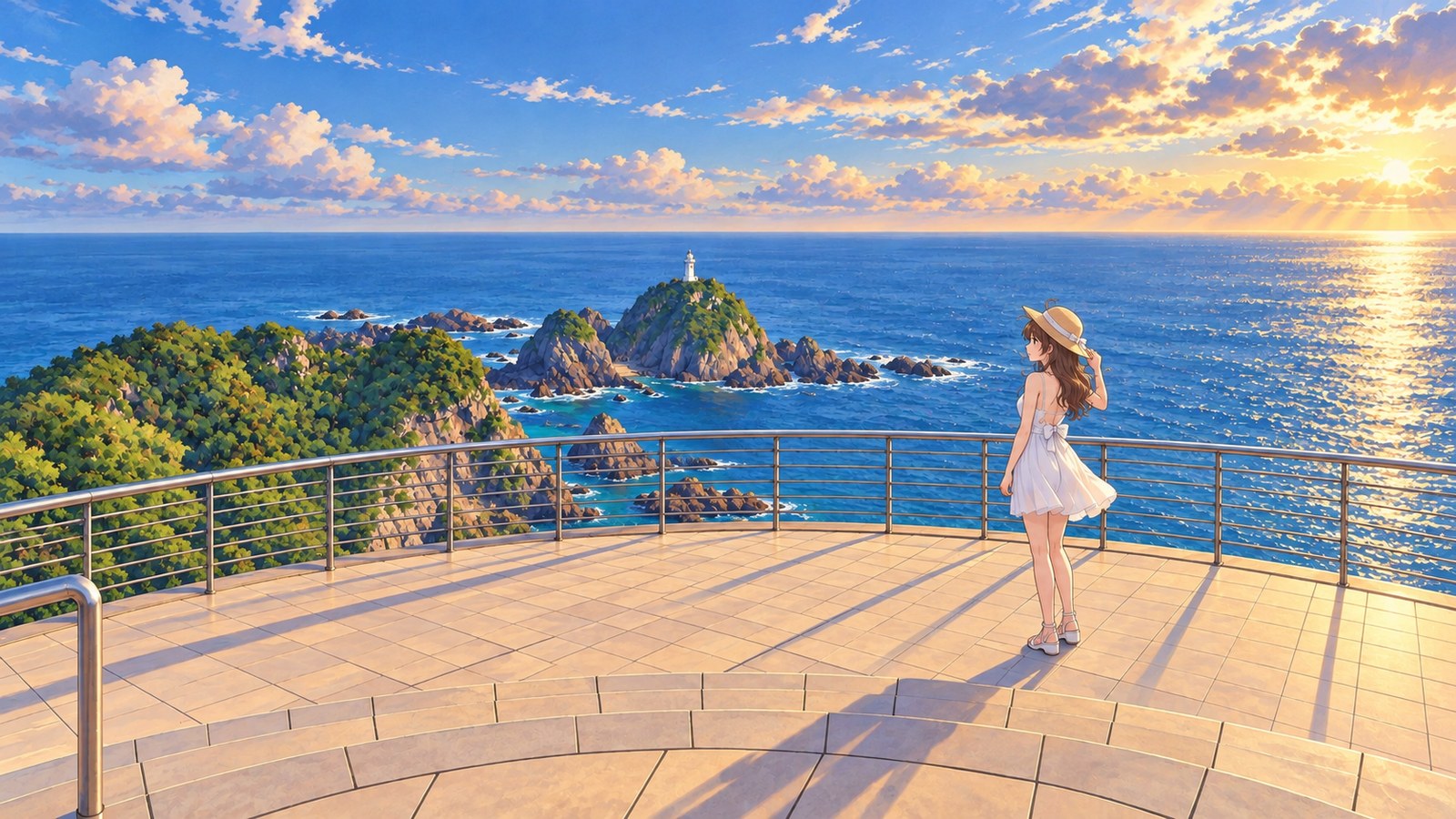
After taking in the wide-open sea, spotting the little lighthouse made the journey all the way here feel real. With one hand on my hat brim, I watched it alongside my friend. I loved that evening.
Summer brings an evening by the sea under my straw hat; spring, a trail through sago palms; autumn, a lighthouse offshore; and winter, whitecaps. Open whichever season catches your eye, and savour the walk to the lookout along with it.
SummerA summer evening
I took in the wide sea, then spotted the lighthouse
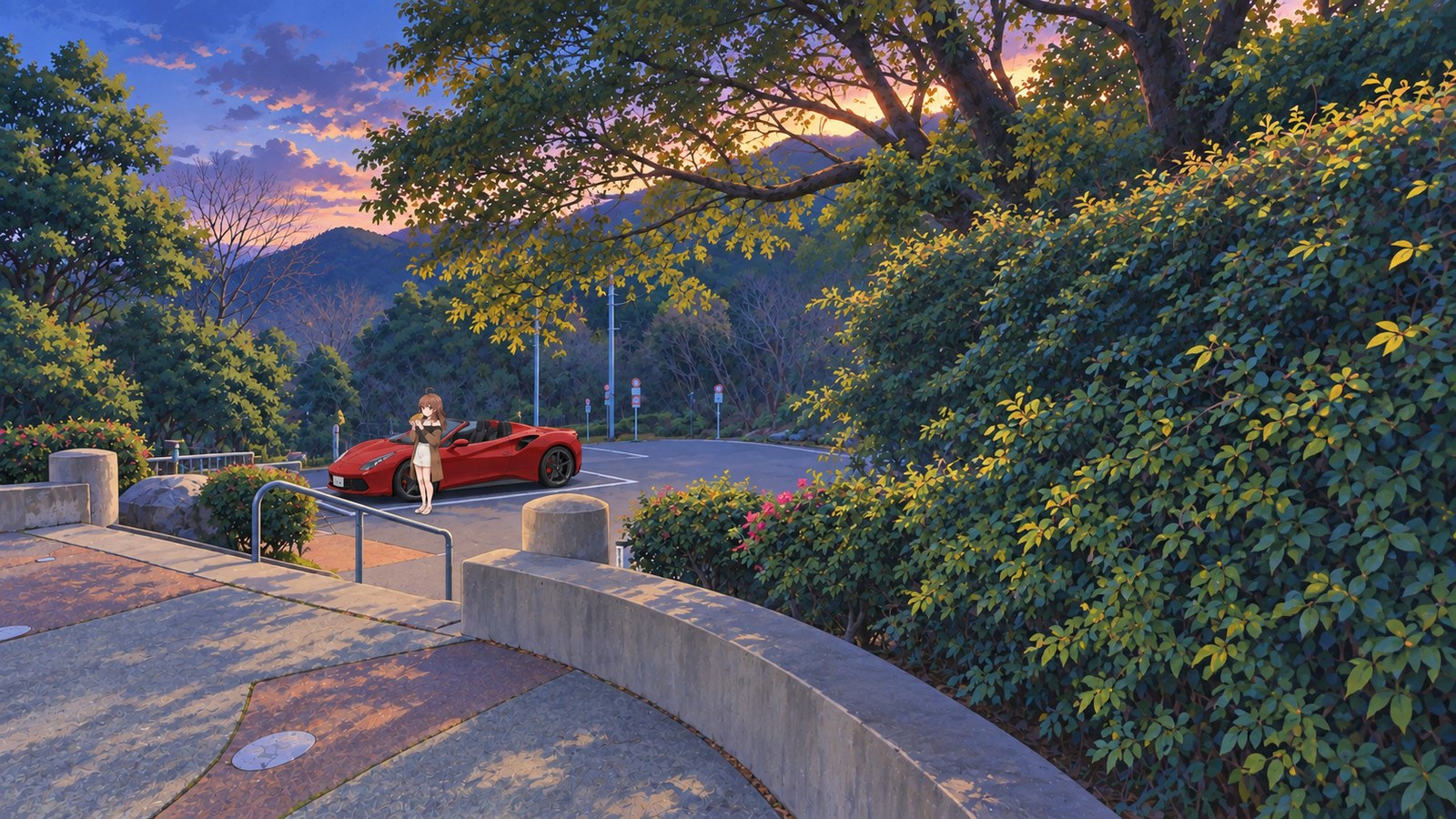
There was about a week left of my summer trip around Kyushu. I’d brought my red convertible over on the ferry from Ariake. My driving friend, who’d joined me along the way, was in the passenger seat, checking the map. Since getting off the ferry at Shinmoji, we’d been working our way south, and that day we finally reached the southern tip of Kagoshima. I wanted to see the sea at dusk from the southernmost cape on mainland Japan.
At lunch, we went to Tokimi, a restaurant near Izashiki Port, where I’d reserved a Tokimi-don. The rice bowl came topped with sashimi made with seafood from nearby waters. The sea came through in every bite, and my friend and I kept looking at each other and nodding. Once we’d eaten, we headed for the cape in the late afternoon.
There’s a car park at Cape Sata with space for about 70 cars. From there, I headed on foot to the lookout. The entrance plaza has a tourist information centre and a rest area, so we took a breather before setting off. The tunnel at the start was cool, and the sweat on my skin soon started to dry. As soon as we came out onto the trail, the salty sea air felt much closer.
I followed the trail past Misaki Shrine toward the lookout. The shrine is known for matchmaking, and I’d heard there were heart-shaped markers along the path. My friend and I searched as we walked, pointing at each one as soon as we spotted it. The view along the trail, with its sago palms and banyan trees, was completely different from the one from the road.
When we reached a place with a wide view of the sea, the late-afternoon light was already stretching across the water. I steadied my straw hat with one hand and looked out to the horizon. The hem of my white dress fluttered in the breeze, and I stood there without saying a word.
Apparently, the Pacific lay to my left, the East China Sea to my right, and Kinko Bay just behind me, off to the right. I turned in a circle—whichever way I faced, there was more sea. It felt as though my body understood I’d reached mainland Japan’s southernmost point before my mind caught up. My friend and I took turns photographing each other by the “Southernmost Point on Mainland Japan” sign at the observation plaza.
Then I looked from the sea to the island, and there it was: a small white lighthouse. “There’s Cape Sata Lighthouse,” I said to my friend. I loved spotting that little lighthouse out across such a vast stretch of sea.
As the sun sank lower, its reflection stretched farther across the water. A faint sunset glow touched the lighthouse walls, too. Every time the wind lifted my hat brim, I pressed it back down and followed the long trail of light with my eyes.
Before sunset, we started back along the trail. As we passed a heart-shaped marker we’d found on the way in, my friend laughed. “Shall we look for some more on the way back?” I answered seriously that there might still be one we hadn’t found. In the end, we both walked along scanning the path.
By the time we got back to the car park, only the sky above the sea was still bright. As soon as we got into the car, my friend started searching on her phone for somewhere to eat lunch the next day. “Something spicy next time,” she said. I could still taste the Tokimi-don and laughed. “Already talking about our next meal?”
SpringDaytime, April–May
The trail to the sea made me want to stop and look around
I was in the third week of my spring trip around Kyushu, after getting off the ferry at Shinmoji, and had made it down to the southern tip of Kagoshima. I drove to the Cape Sata car park in the red convertible I’d brought over from Ariake. I’d read that Minami-Osumi’s official guide recommends spring and autumn for walking, so at this cape I wanted to explore the trail before I even looked out to sea.
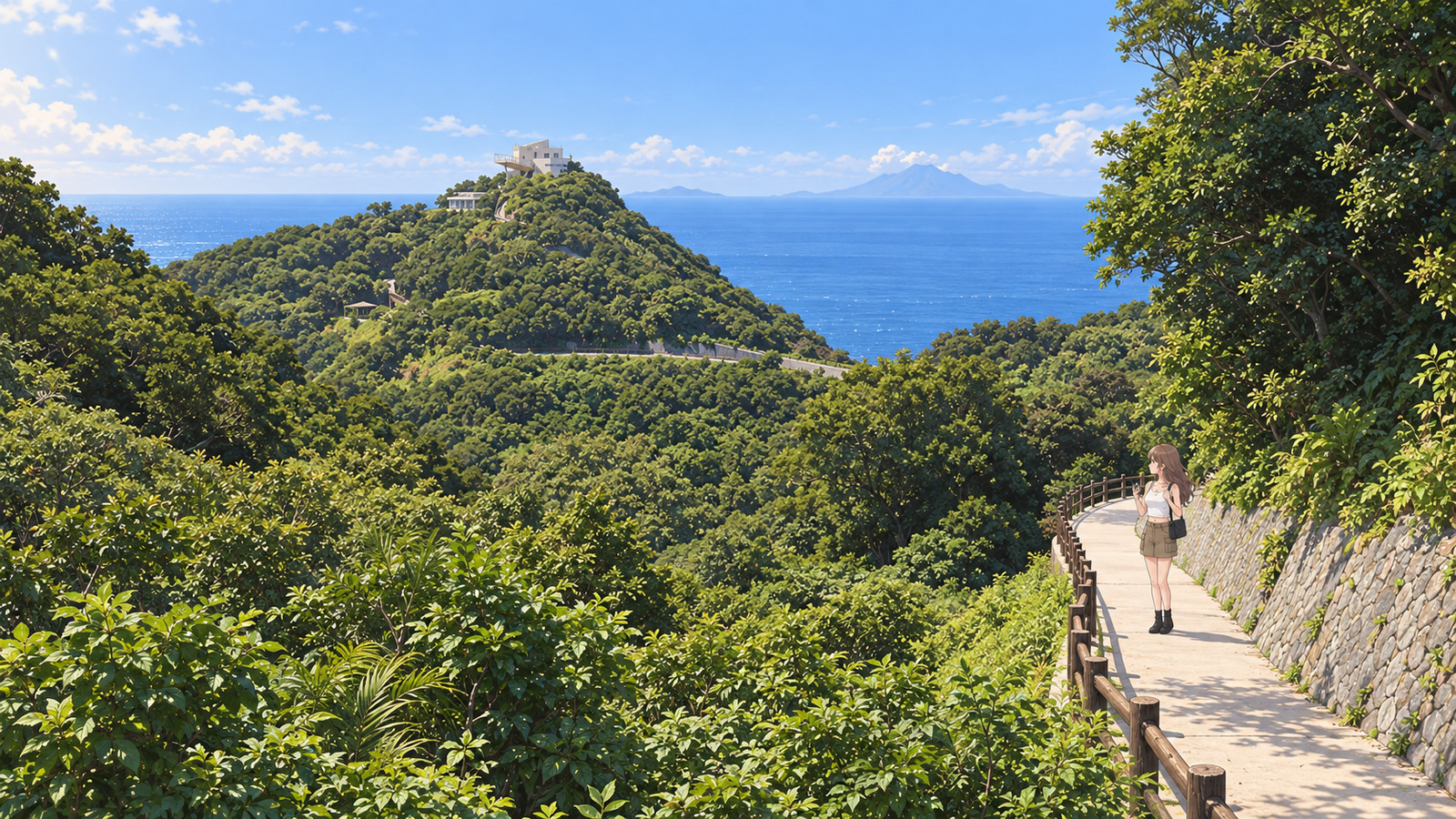
Cape Sata is the southernmost cape on mainland Japan, and you reach the lookout on foot. Once I stepped out of the car and into the entrance tunnel, the journey began to slow down to walking pace. It was cool inside, and it took me a moment to adjust to the brightness outside. From the plaza at the far end, I could see the lookout across a valley, with the southern sea beyond it. I hitched my bag strap onto my shoulder, thinking, “So I have to walk all the way over there.”
From the exit, the path slopes down to Misaki Shrine, then climbs and ramps up toward the rest area and lookout. Sago palms and banyan trees line the trail, and I kept catching myself looking up at them, then ahead to the next bend. If I’d only been focused on the distant sea, I wouldn’t have stopped so often along the way.
I’d read that this grove of sago palms is designated a Special Natural Monument of Japan under the name “Natural Habitat of Sago Palms in Kagoshima Prefecture.” Looking up at their huge fronds layered over one another made me feel that I really was in southern Japan. It would’ve been a shame to walk past them thinking they were just trees beside the trail.
At the foot of the slope, I stopped at Misaki Shrine and put my hands together. I offered thanks for getting this far safely and asked for the rest of my trip to bring more good drives. When I looked up, the spring light filtering between the trees seemed brighter than before.
The climb beyond the shrine felt longer than I’d expected. Once I was a little out of breath, I looked back from midway up the slope and spotted the path I’d descended, threading through the trees. The roof of the observation complex was getting closer, so I took a photo of it and the forest trail together on my phone.
The trail is about 800 m one way. On paper, that distance had just been a number; after walking the bends and stopping along the way, I found myself looking forward to the return, too. When the sea opened up from the lookout, its brightness felt even more intense after walking through the forest.
I’d just been looking up at the sago palms; now the sea was spread out in front of me. I wanted to remember not just one or the other, but the order of the walk that brought me here. On the way back downhill, I took another look at each clump of sago palms I’d admired on the way in.
On the way back, I stopped at Nejime Roadside Station and looked around the local products shop for specialties from Minami-Osumi. I was planning to look for Dede Cola made with Hetsuka daidai, too.
After that, I stopped by the monument marking the 31st parallel north. I parked in a small parking area and stood in front of it, amused to find myself right on a line I’d only ever seen on a map. I pretended to step over the invisible line: one step north, then one south. After checking no one was watching, I made one more round trip.
AutumnAfternoon, October–November
I looked for a distant lighthouse at the end of the trail
I’d taken the ferry from Ariake and got off at Shinmoji. Now I was travelling around Kyushu. In the second week of the trip, I drove the red convertible down to Kagoshima’s southern tip after reading that Minami-Osumi’s official guide recommends autumn for a walk. My plan was to find the lighthouse on an island offshore once I got to the end of the trail.
The autumn breeze brushed my cheek as soon as I came through the entrance tunnel. Sunlight was softer than in summer, and the big fronds of the sago palms swayed gently. It really was perfect walking weather. I rolled up my cardigan sleeves a little and followed the path past Misaki Shrine. The afternoon sun felt just warm enough through my cardigan.
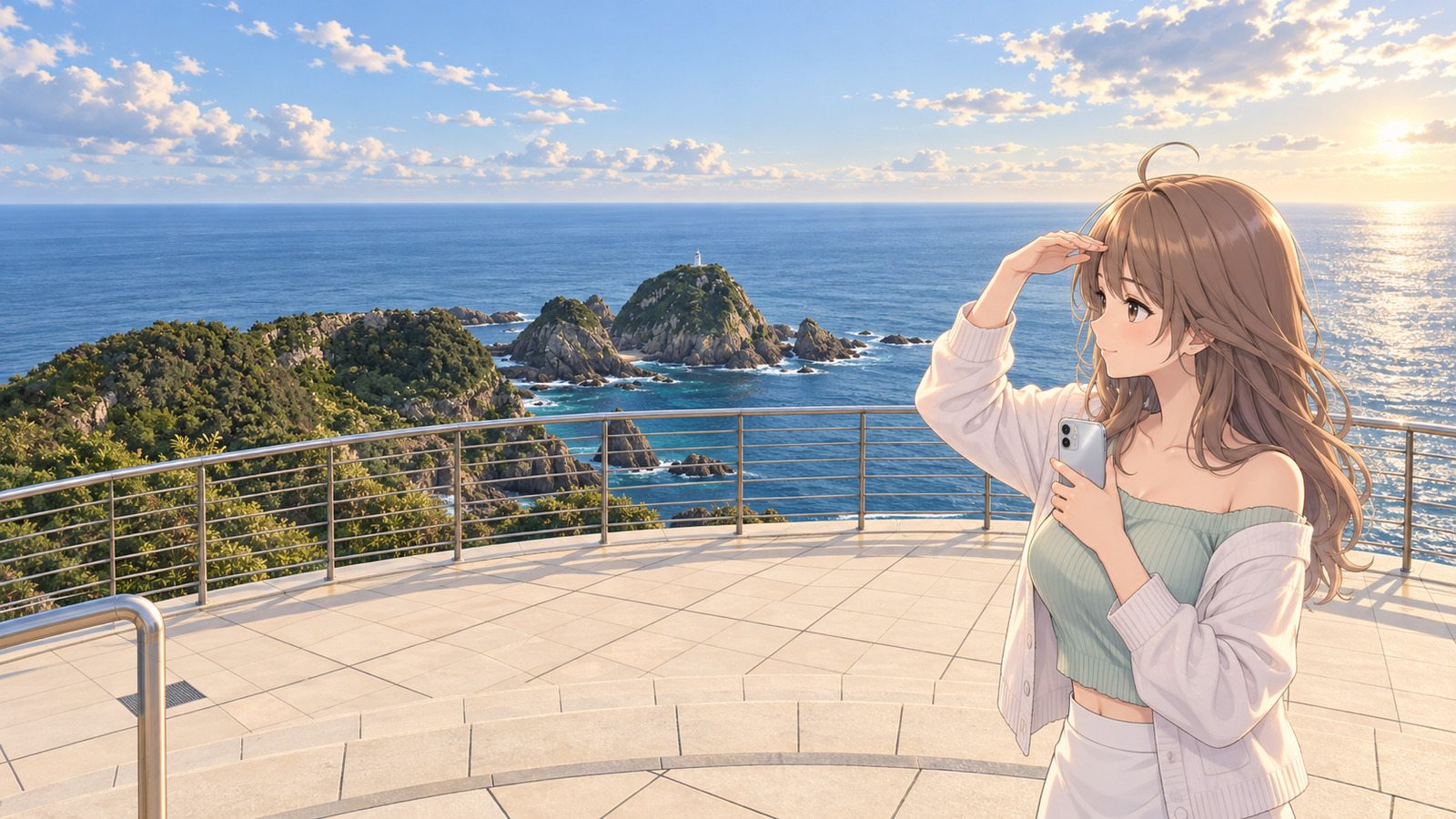
Walking among sago palms and banyan trees gave me a different sense of distance from what I’d had in the driver’s seat. From the lookout, the trail I’d followed gave way to a wide sweep of sea. I took a photo, lowered my phone, and looked around properly. The view I thought I’d captured on screen stretched much farther once I looked up.
The afternoon sun was dazzling, so I shaded my eyes with one hand, squinting through the gaps between my fingers. In the shade of my hand, the glare on the water softened, and I could make out the shape of a distant island more clearly. My phone, with the photo I’d just taken, was in my other hand.
Out on the water, I spotted the little Cape Sata Lighthouse. It stands on Ōwajima, an island about 50 m off the cliffs at the southern tip. Once I shifted my gaze from the cape in front to the island, I could see exactly where the lighthouse stood. The time I’d spent simply gazing into the distance became the moment I found what I was looking for.
Designed by a Brit, it’s described as one of Japan’s oldest lighthouses. It was completed in 1871 (Meiji 4), burned down in 1945 (Shōwa 20), then restored in 1950 (Shōwa 25). It was hard to imagine that a lighthouse that looked so small had such a long history. I typed the dates from the information board into my phone before I could forget them, then added the island’s name: “Ōwajima.”
I decided to walk on to Lighthouse Keepers’ Plaza. Apparently it’s on the former site of the staff quarters where lighthouse keepers used to live. Once I imagined the keepers watching the light from here, the little lighthouse I’d been looking at felt connected to the lives people had lived there. I could also see Birojima, east-northeast of the lighthouse.
As the afternoon light began to fade, I started back along the trail. On the way in, I’d kept my eyes ahead; on the way back, I peered toward the sea at every bend to see if the lighthouse on Ōwajima would appear between the trees.
I’d walked right past Misaki Shrine on the way in, so I stopped in front of it and put my hands together. There was still more than half of my autumn trip left, and I prayed for good drives to come. When I looked up, the sago palm fronds beside the shrine rustled in the afternoon breeze.
WinterDaytime, January–February
Small whitecaps appeared around the lighthouse
This winter trip around Kyushu would take me through snowy Aso, so I’d brought a red four-wheel-drive sedan over on the ferry from Ariake. I’d been travelling north to south for about 10 days since disembarking at Shinmoji. I’d made the detour to Cape Sata after a winter photo feature on Minami-Osumi’s official website showed someone watching the waves in the wind. That scene had stayed with me.
It was a winter morning when I parked at Cape Sata. Minami-Osumi is warm, but I’d read that the sea breeze can make it feel much colder. I buttoned my coat and tightened my scarf before setting off.
From the entrance tunnel, the trail runs about 800 m one way past Misaki Shrine and through sago palms and banyan trees. As soon as I came out of the tunnel, the wind grew much louder. Between the trees, I caught glimpses of waves breaking into white foam. The sea looked nothing like the calm water I’d seen in summer. My scarf kept flapping in the gusts, and I laughed as I held it down.
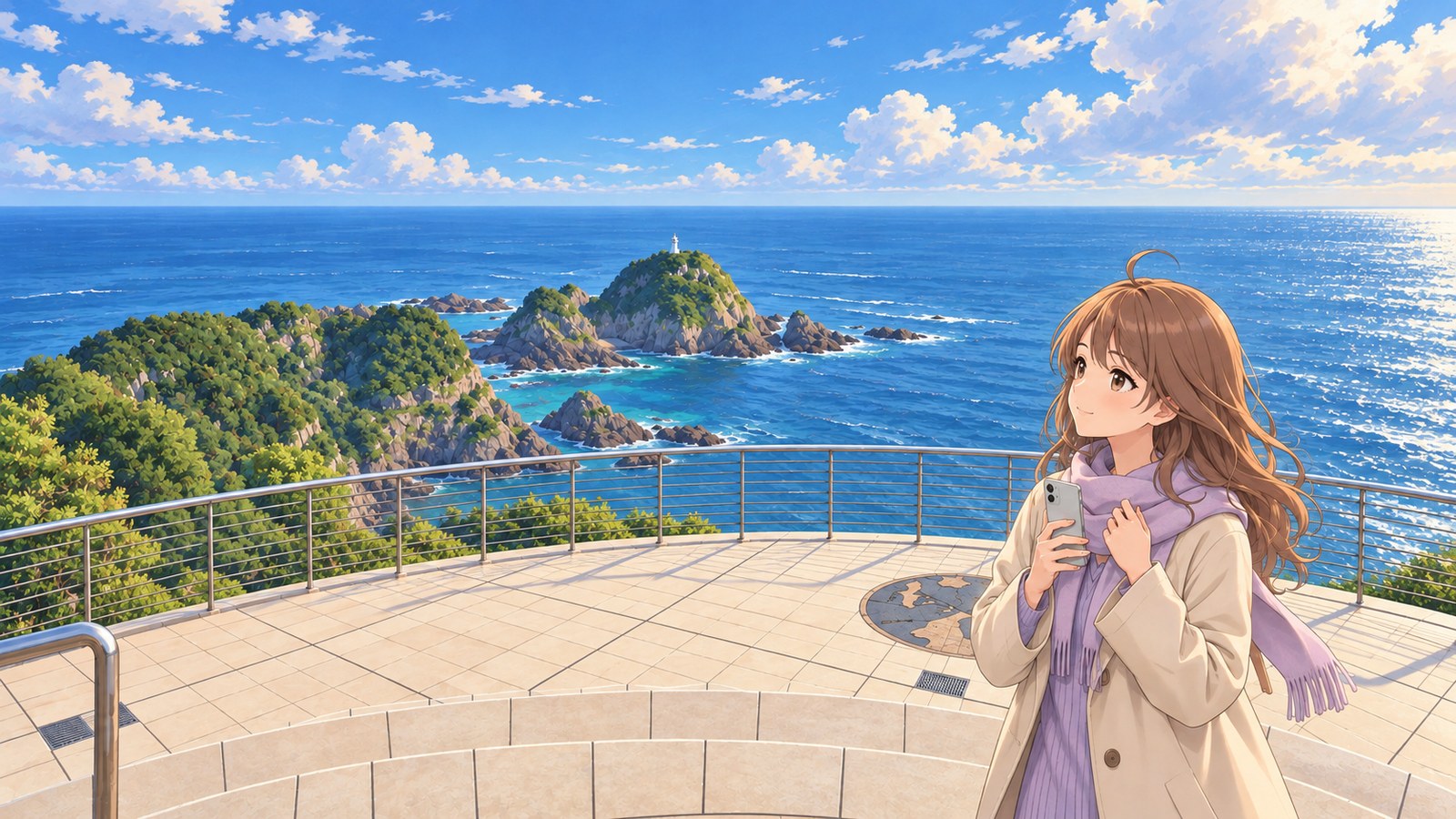
At the lookout, I held my coat closed at the collar with one hand and lifted my face toward the sea, still holding my phone to my chest. The wind moved my hair, and I used one hand to keep my scarf in place. I wanted to look at the sea first instead of rushing to take a photo. I was glad my cheeks were cold; it felt like a real winter trip.
The sea was flecked with small whitecaps, and I followed their movement with my eyes. Each time a wave broke around the island, white foam traced the foot of the lighthouse. Beyond them, the little Cape Sata Lighthouse stood on Ōwajima. I kept shifting my gaze between the moving sea and the lighthouse, fixed in place.
Timing the shutter for the moment a wave broke was harder than I thought. I tried a few times and finally caught one shot of a wave breaking into white foam beneath the lighthouse. Zooming in, I could even see the water spreading along the rocky edge of the island. Since there was no one to show it to, I gave myself a tiny fist pump.
On my summer evening visit, I’d been focused on the light. The sea at midday in winter was completely different, in sound and motion. A faint smell of salt hung in the cold air. It was the same lookout, but everything I noticed had changed.
On the trail back, the sago palms’ huge fronds flapped and rustled in the wind. The moment I stepped into the entrance tunnel, the wind and the rustling stopped, leaving only the sound of my footsteps. The contrast with the sound of the sea made me smile. I stopped just before the exit, listening to the wind outside and comparing it with the sudden hush in the tunnel.
For lunch, I went to MARINA, the restaurant at Nejime Roadside Station. I ordered Dede Cola, made with Hetsuka daidai, a local citrus fruit. Its fresh, clean scent seemed to wake me up after the cold sea wind. It wasn’t too sweet, and the fragrance lifted with every sip. My face still felt chilled from the wind, but I was holding a cold glass in both hands; the mismatch made me smile.
The story sections are fiction inspired by this location. For accurate information, please consult official tourism and information websites.
Photos of this place4 images
-
Minami-Osumi, Kagoshima · A summer evening and a lighthouse
-
Minami-Osumi, Kagoshima · Walking the spring trail
-
Minami-Osumi, Kagoshima · An autumn walk and sea views
-
Minami-Osumi, Kagoshima · Watching the winter sea
Local specialty
Tokimi-don
At Tokimi, a restaurant near Izashiki Port, you can enjoy a rice bowl topped with sashimi made from fish from nearby waters. I reserved one for lunch on my summer trip. With every bite, the scent of the sea came through, and my friend and I kept exchanging looks and nodding before heading to Cape Sata.
Highlights
Look out over the sea from mainland Japan’s southernmost cape
This is the lookout at Cape Sata, with sea in every direction. I like looking out at the horizon first, then searching for the lighthouse; it makes the journey all the way here feel worth it.
A trail that leads to the view
It’s about an 800 m walk from the entrance tunnel to the lookout. The trail passes Misaki Shrine on its way to the sea, and I like taking my time on the path.
Trail and walking details
Cape Sata Lookout Trail
- One-way trail distance
- About 800 m
- Estimated one-way walking time
- About 20 minutes
From the entrance, the trail passes Misaki Shrine on its way to the lookout. After parking, I like taking my time on the walk to the sea view.
The trail is about 800 m each way and takes about 20 minutes to walk.
More Spot Guides
If you enjoyed this story, you might like these places too. I've gone back to each of them in different seasons, again and again.

Maps & Sources
Official sources
- Kagoshima Prefecture Tourism Website | Cape Sata Park (opens in a new tab)
- Minami-Osumi Official Tourism Website | Cape Sata (opens in a new tab)
- Kagoshima Prefecture Tourism Website | Tokimi Restaurant (opens in a new tab)
- Minami-Osumi Guide for First-Time Visitors (opens in a new tab)
- Minami-Osumi Official Tourism Website | Winter Photo Trip (opens in a new tab)