Minoh City, Osaka Prefecture
A bite of maple-leaf tempura at Minoh Falls in autumn An autumn break after walking the waterfall trail
Park near Minoh Station and follow the riverside waterfall trail to Minoh Falls, where the water drops 33m. In spring, I photographed the falls framed by fresh greenery from Takimi Bridge; in summer, I cooled off in the spray; in autumn, I nibbled maple-leaf tempura in front of the falls; and in winter, I sipped tea beneath snowy branches. Each season changes how I spend time at the falls.
In spring, I framed the falls with fresh greenery; in summer, I listened to the water from the shade; in autumn, I enjoyed the foliage and tried maple-leaf tempura. At midday on a snowy winter day, I watched the snow-covered branches and the flowing falls. Choose whichever seasonal trip interests you.
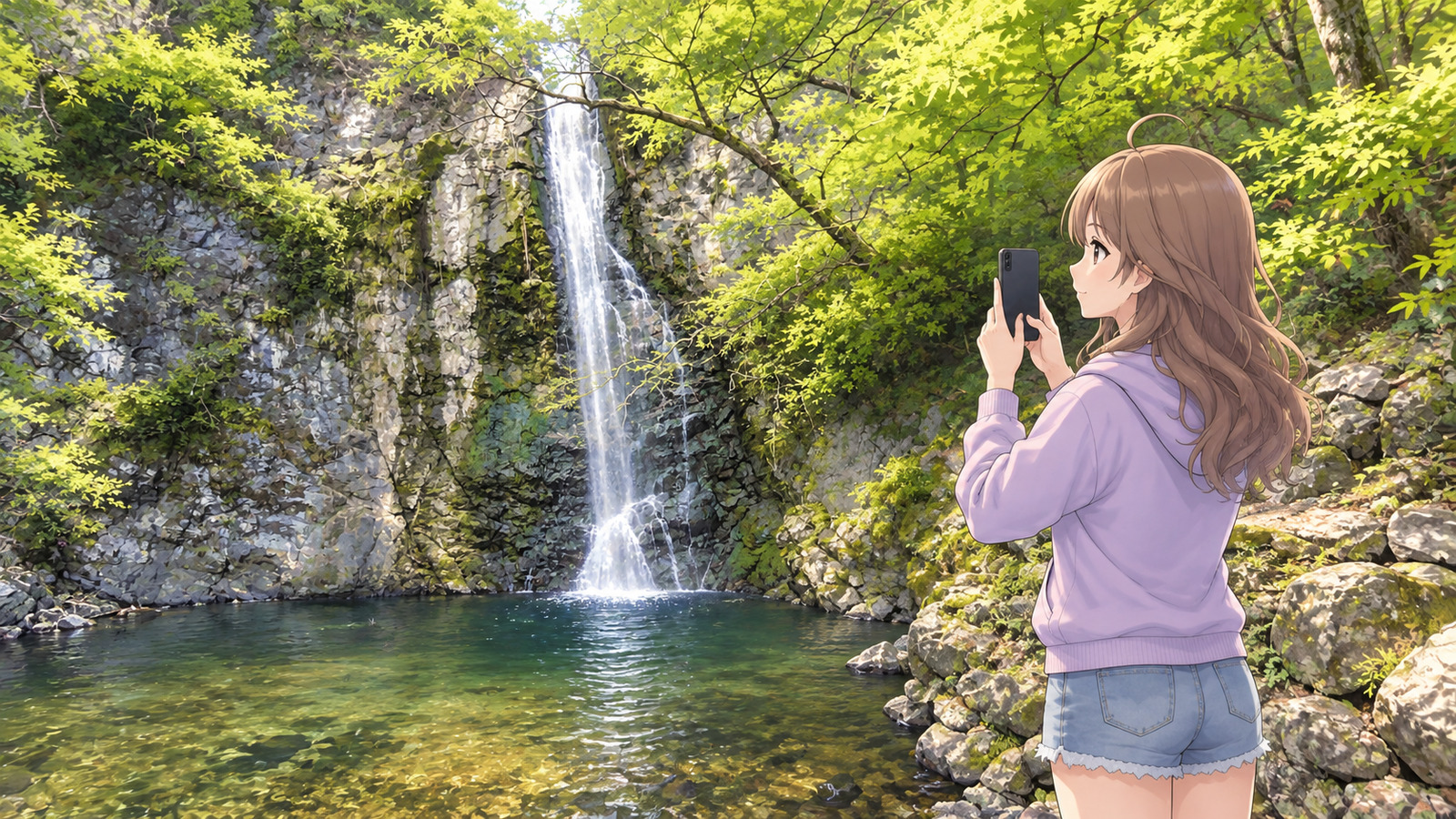
SpringApril–May, around 10 a.m. when the fresh leaves are out
I wanted to fit the greenery above the falls into the shot
I wanted to fit both the falls and the young maple leaves into a single photo. That was the main reason for my 2-night trip through Kansai in spring, when the leaves were fresh and green. The morning after driving from Ariake on the expressway in my red convertible, I parked in Car Park No. 1 in front of Minoh Station. It’s about a 10-minute walk from here to Ichinohashi at the park entrance; beyond that, the riverside waterfall trail leads to the falls.
As I walked to the sound of the river, light filtered through the layers of leaves. I pushed up the sleeves of my lavender hoodie, kept looking up, and stopped to frame the branches with my phone. I’d been picturing autumn maples, but the new leaves were lovely too. I’d already taken more photos before I even reached the falls.
The estimated walk from the car parks near the station to the falls is about 50 minutes. I stopped so often that it probably took me longer. The morning air was still cool, and the sunny patches felt just right. If I’d hurried, I might have missed the subtle differences in the leaves.
Along the trail, I looked back through the photos I’d taken so far. Sunlit leaves glowed, while those in the riverside shade looked more subdued, though they were all the same fresh green. I couldn’t decide which I liked better, so I decided to find a spot in front of the falls where I could capture both.
Around 10 a.m., I reached the falls and held my phone upright. The waterfall fit on the screen, but when I tried to include the fresh greenery above it, the plunge pool slipped out of frame. “I want to get it all in,” I murmured, then looked up from my phone at the real thing. I traced the 33m drop with my eyes from the top to the plunge pool, my head tilting farther back as I went.
Fine spray drifted over on the breeze in front of the falls. Tiny droplets landed on my phone screen, and I hurriedly wiped them away with my sleeve. They were proof of just how close I’d gotten to the falls. As I wiped the screen, I decided to try another shot from a little farther back.
Just before the falls, there’s a red bridge called Takimi Bridge. The tourism association features it as a photo spot on one of its recommended routes. I’d walked right past it on the way up because I was so busy watching the falls, so I turned back to have a look. From the bridge, the fresh greenery in the foreground made a frame, and the falls settled neatly beyond it. My earlier struggle to fit everything in from straight ahead felt like a distant memory; it all came together in one shot. I hope nobody saw my little fist pump.
On the way back along the waterfall trail, I picked up some maple-leaf tempura. Each shop apparently gives it a slightly different flavour, and there’s even a recommended route for sampling them, so I got a bag from each of 2 shops. I’ll compare them when I’m back at the inn.
Back at the car, I looked through my photos again. The straight-on shot of just the falls and the one from Takimi Bridge with the branches in the frame had such different moods. I couldn’t delete either, so I kept them both. Two bags of tempura were lined up on the passenger seat. When I try them back at the inn, I’ll also decide which photo I like better.
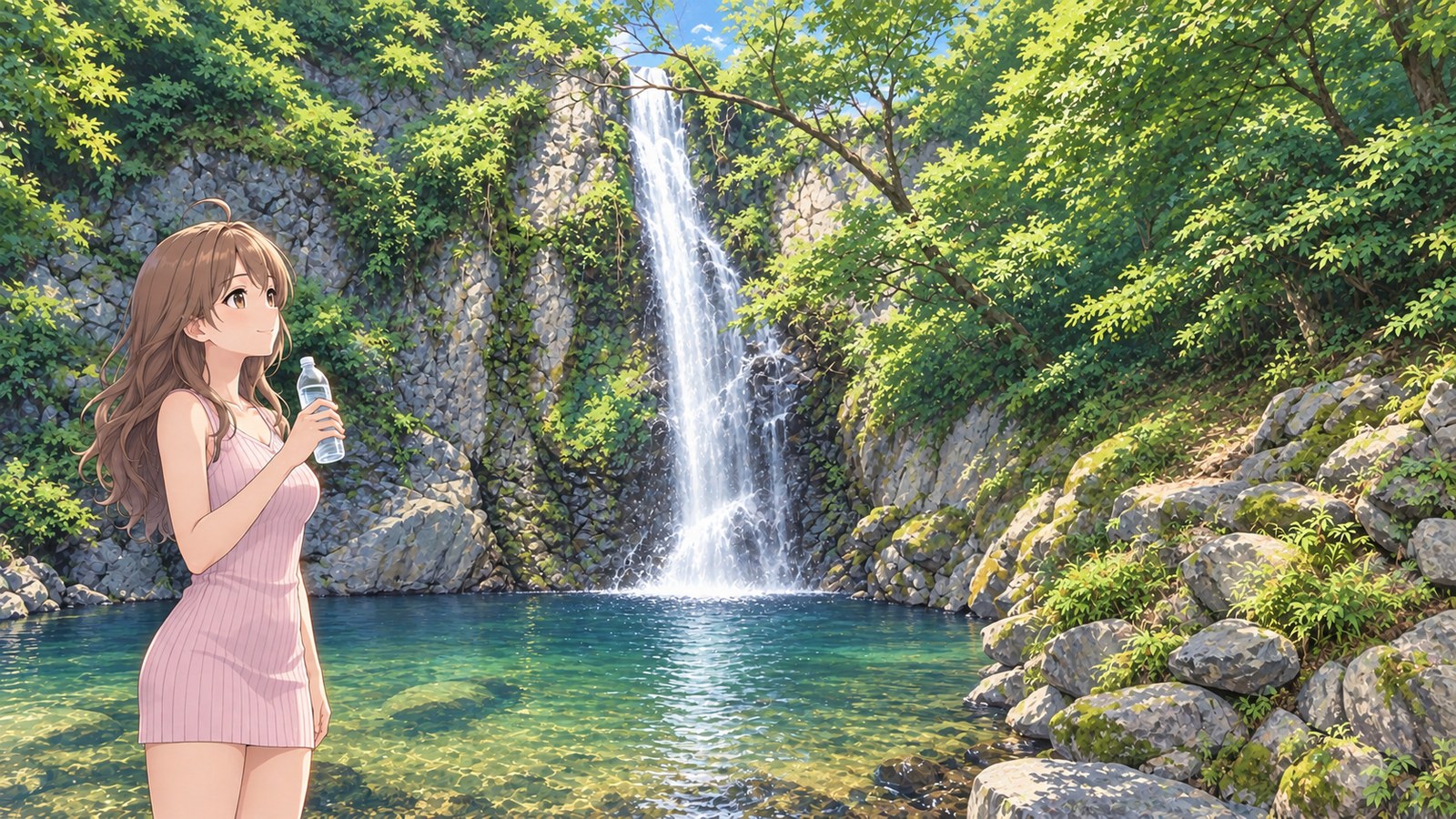
SummerJuly–August, around 1 p.m. on a sunny day
I followed the shade until the falls’ mist cooled me down
On a hot day, I wanted to walk the shaded waterfall trail and cool off in front of the falls. It was the second morning of my 3-night summer trip through Kansai, and the sky was clear. The day before, I’d driven from Ariake on the expressway in my red convertible. By the time I left the inn, I’d already settled on Minoh as the day’s destination. I parked near Minoh Station and set off along the trail.
Along the leafy trail, the branches blocked the sun and shade stretched across the path. Listening to the river, I avoided the sunny patches and walked from one patch of shade to the next. I hadn’t opened the water bottle I’d brought along even once. I’d decided to save it until I reached the falls.
I peered into the river along the way. In the shallows, the water was so clear I could see the stones on the bottom. It bubbled just a little where the current rolled over the rounded stones. I resisted the urge to step in and admired it from the edge of the path instead. That only made me more eager to cool off at the falls, so I picked up my pace a little.
When I reached the falls, the air felt much cooler than it had along the riverside trail. Fine spray hung in the air and brushed my arms; it felt lovely. I quickly cooled down, and the sweat from my walk began to dry. I felt the breeze on the shoulders of my pale-pink mini dress, took a sip of water in front of the falls at 1 p.m., then lowered the bottle from my lips.
Through the thick leaves, I could clearly see the strands of falling water. I followed the water down the rock face to the plunge pool, then noticed the ripples on the surface. The current was fast above, but below, the ripples spread slowly towards the shore in circles. Watching the fast current and the slow ripples in turn, I could hardly believe they were the same water; it moved so differently at the top and bottom.
Minoh Falls is one of Japan’s Top 100 Waterfalls. It sounds like a faraway special place, but you can park near the station and walk right up to it. Beside the railing in front of the falls, I traced the full 33m drop with my eyes over and over.
While I rested, I remembered the story behind maple-leaf tempura. It’s said to have begun about 1300 years ago, when En no Gyōja served it to travellers. I wondered whether travellers who walked these mountain paths on hot days used to pause like this, listening to the water. Thinking of them made the falls in front of me suddenly feel close and familiar.
The trail slopes downhill on the way back, so my feet felt lighter than they had on the way up. I stayed in the shade, where a cool breeze came through near the river and stirred the hem of my dress. Along the waterfall trail on the way back, I bought a bag of maple-leaf tempura. When I peered at the leaf shapes inside, I found myself smiling at the thought that travellers in that old story might have received one too.
When I got back to the car, the seats were hot from the sun. I lowered the roof to let the breeze through and set the bag of tempura on the passenger seat. The maple leaves peeking out of the bag looked much smaller than the ones I’d just looked up at in front of the falls.
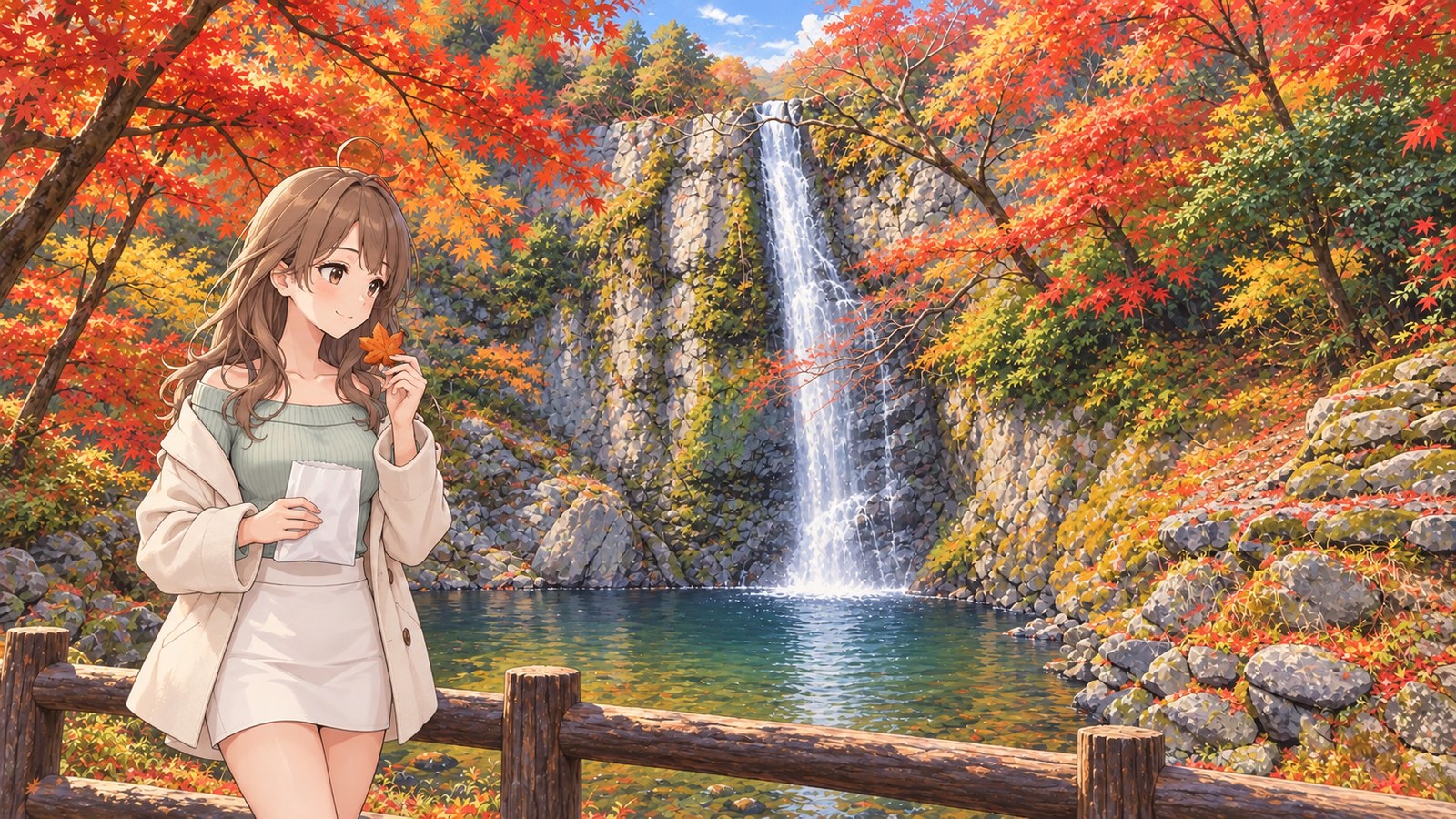
AutumnA November afternoon
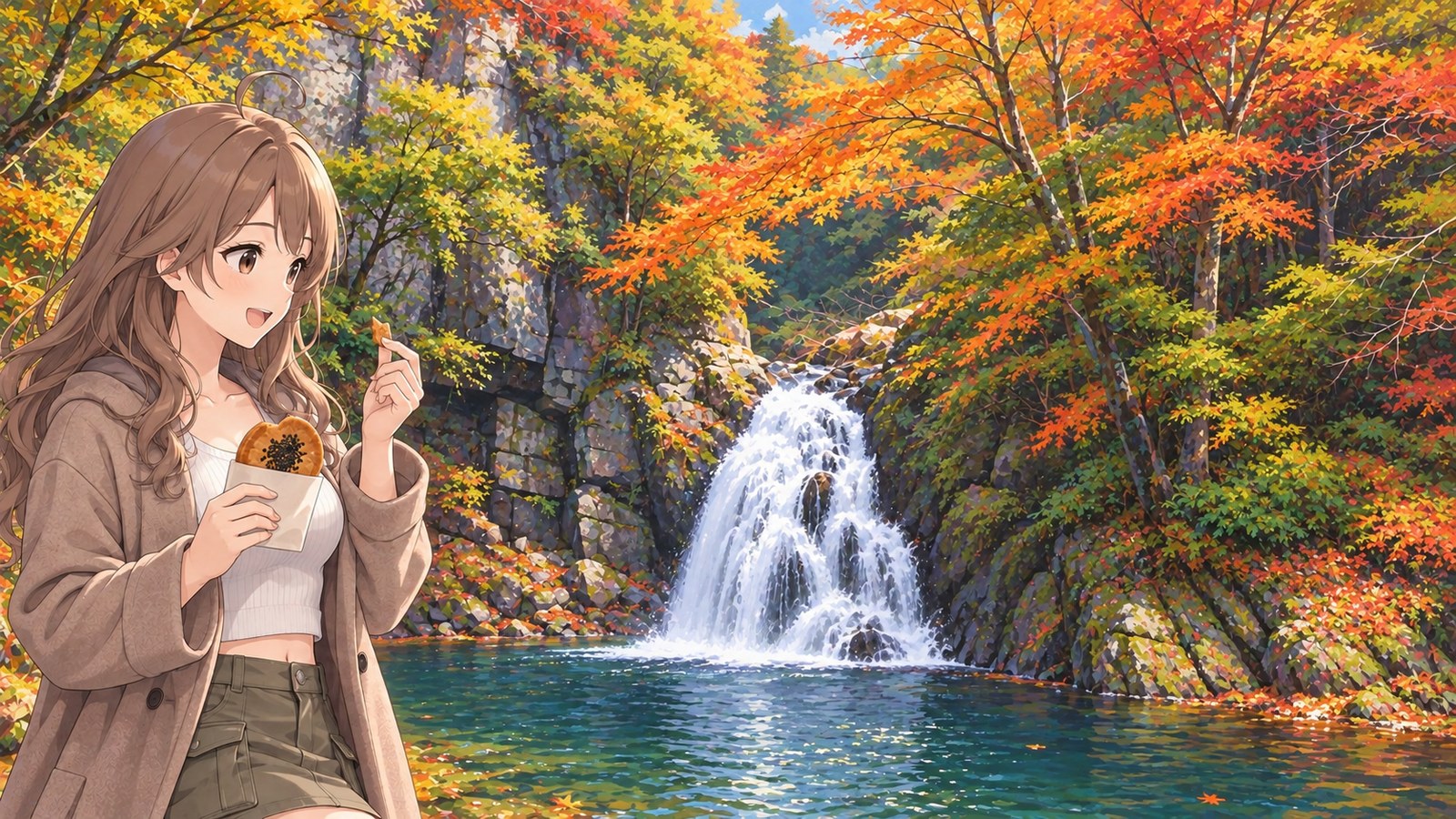
Maple-leaf tempura to the sound of the falls
My friend and I had just one plan: eat Minoh’s famous maple-leaf tempura in front of the autumn leaves. We set off for a 2-night trip through Kansai in November, travelling in 2 cars. I drove from Ariake on the expressway with my friend’s yellow coupe ahead of me. On the afternoon of day 2, we parked near Minoh Station. It’s about a 10-minute walk from there to Ichinohashi at the park entrance, then the waterfall trail follows the river to the falls. I’d picked up a bag of maple-leaf tempura from a shop along the way.
Once I opened my coat and started walking, the autumn air felt just right. I carried the paper bag in one hand and pushed up one coat sleeve with the other. Every time my friend said, “Let’s eat when we get there,” I found myself wondering what the little leaf-shaped treats in the bag looked like.
With every step, the leaves seemed a little different from one spot to the next. Sunlit branches were bright, while those near the river were only beginning to turn. My friend and I kept pointing out, “That side’s redder” and “This one has a bit of yellow,” and the roughly 50-minute walk flew by.
Before long, the water grew louder and the falls came into view, spilling over the top of the rock face. Even through the autumn branches, I could clearly see the water streaming straight down. We walked up to the wooden railing in front of the falls and stood side by side, pointing to where the water reached the plunge pool.
I took one piece from the paper bag and rested the maple-leaf-shaped piece on my fingertips. When I bit into it, the batter cracked crisply between my teeth, followed by a gentle sweetness and sesame aroma. Apparently, the batter is made with flour, white sesame and sugar. “I’m glad I brought these all the way to the falls,” I said, offering the bag to my friend.
After we’d finished eating, I looked up at the whole waterfall. I knew it dropped 33m, but its height still surprised me from below. My friend liked viewing it through the leaves; I preferred standing straight on and listening to the water. We took turns switching places to see how the same falls looked from each spot.
The falls are said to get their name from the way the water resembles a winnowing basket called a “mi.” I was seriously trying to picture one when my friend laughed and asked, “How can you tell if it looks like one when you don’t even know what it looks like?” I told her, “I’m imagining it now,” but I cracked myself up too, and we both laughed. I’ll look it up properly when we get back to the inn.
On the way back along the waterfall trail, there was a soft crackle underfoot each time I stepped on a fallen maple leaf. I’d kept looking up on the way there; on the way back, my eyes turned to the leaves on the path. My friend teased, “I bet you could make tempura out of those leaves as well.” I earnestly replied that fallen leaves aren’t the kind you eat.
I stopped in front of the shop we’d passed on the way up and picked up another bag to eat at the inn. Back at the car, I put on “ROUTE 1 - HAKONE (steam mix)”, and with the waterfall trail still on my mind, I felt ready for the next drive.
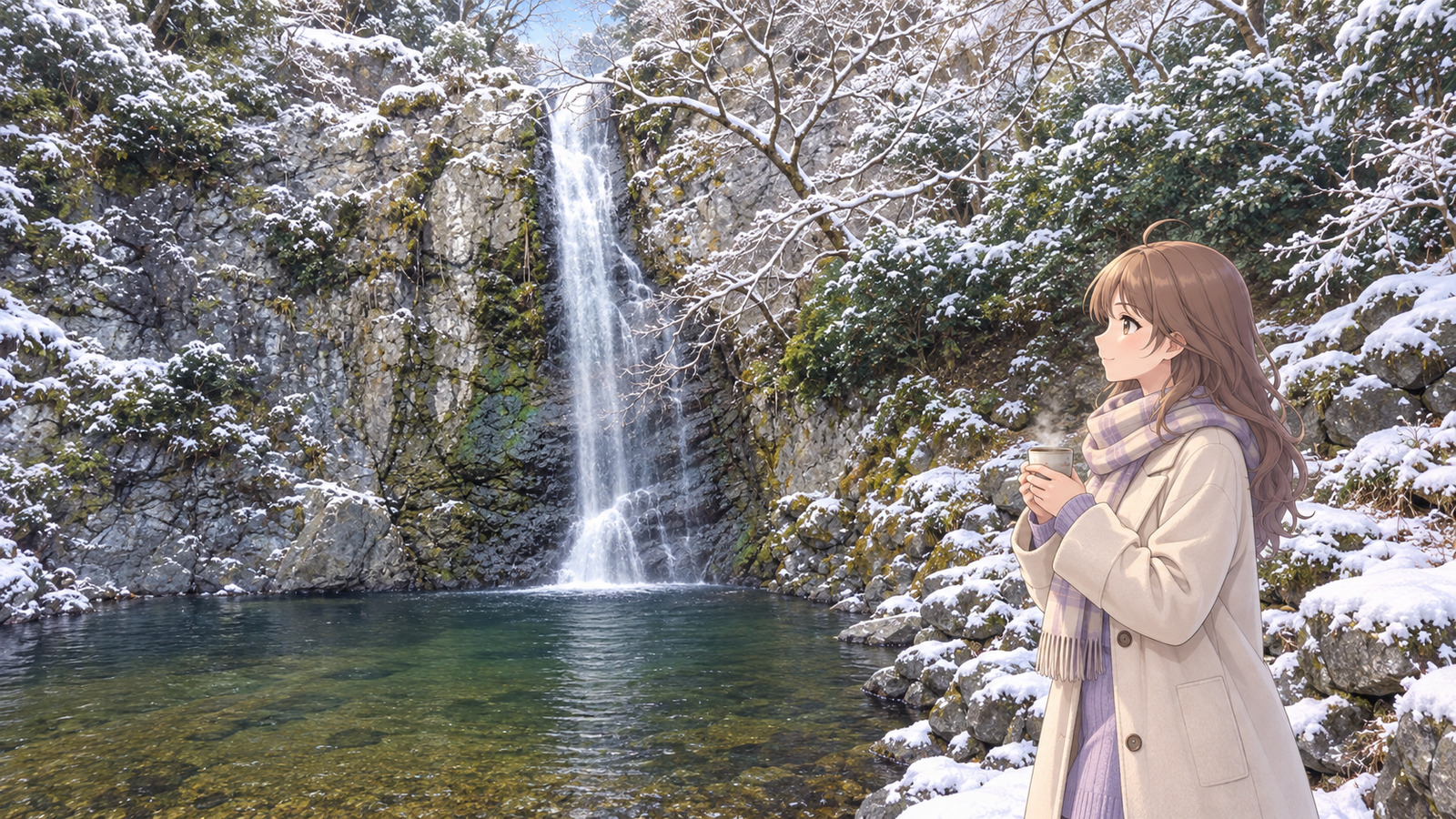
WinterJanuary–February, around midday when the area is snow-covered
The falls kept flowing beyond the snow-covered branches
The mountain outside the inn window had turned white. It was the second morning of my 3-night winter trip through Kansai. The red four-wheel-drive sedan I’d driven from Ariake could handle snowy roads, so I changed my plans and headed for Minoh, hoping to see the falls in the snow. Keeping the snow-covered mountain straight ahead, I drove to a car park near the station. I parked, buttoned up my coat and set off along the waterfall trail. I’d filled my insulated bottle with hot tea at the inn.
It’s about a 10-minute walk to Ichinohashi at the park entrance. As I headed towards the falls, I noticed snow resting on the branches. With the leaves gone, I could see exactly how the branches forked. I adjusted my scarf and kept going, listening to the river.
Where snow still covered the edge of the path, I checked my footing with every step. Each time my breath turned white, I thought about how the river kept flowing in the cold. Following someone else’s footprints, I felt like I’d joined everyone else out for a winter walk.
When I reached the falls, the water sounded louder than I’d expected. The snow made everything around me so quiet that the water was all I could hear. When the trees are in leaf, that sound might get lost in the rustling branches. The winter falls are lovely to listen to, too.
At midday in front of the falls, I poured tea into a little cup and wrapped both hands around it. Beyond the steam, the snow-covered branches and the falls behind them seemed to overlap. Holding the cup in front of my chest, I kept shifting my gaze between the snow on the branches and the flowing water.
Snow sat still on the branches and rocks, while water ran from the rock face down into the plunge pool. I liked seeing something motionless and something always moving side by side in one view, so I took just one photo with my phone. On the screen, the snow looked like dots and the water like lines. They were part of the same scene, but they came out completely differently.
I finished my tea and put the cup away. When I looked up, a little snow slipped from one of the branches I’d been watching. It disappeared almost at once, while the falls kept flowing at the same pace. Even this winter landscape, which I’d thought was still, had its own movement. I forgot the cold and kept watching to see which branch would shed snow next.
On the way back, I stopped at the red Takimi Bridge. A thin layer of snow still covered it, so I checked my footing as I made my way to the middle. When I turned around, I could see the waterfall as a narrow ribbon beyond the snowy branches. It looked smaller than when I’d viewed it straight on, but the strands of water still stood out clearly. I’d taken a photo of the fresh greenery here in spring, but it was too cold to take off my gloves today, so I simply admired the view without getting my phone out.
When I got back to the car and turned on the heater, feeling gradually returned to my fingers. I wanted to get through the mountain roads before dark, so I set off before the sun began to dip. I could feel the four-wheel-drive tyres biting into the snow as I headed down the slope and back towards the town where the inn was.
The story sections are fiction inspired by this location. For accurate information, please consult official tourism and information websites.
Photos of this place4 images
-
Minoh City, Osaka Prefecture · Spring
-
Minoh City, Osaka Prefecture · Summer
-
Minoh City, Osaka Prefecture · Autumn
-
Minoh City, Osaka Prefecture · Winter
Local specialty to try
Maple-leaf tempura
Minoh’s signature crisp, sweet treat: maple leaves coated in batter with white sesame and sugar, then fried in rapeseed oil. You can pick some up at the shops along the waterfall trail for a break after your walk.
Highlights
Minoh Falls: a 33m drop
Look up at the water spilling from the rock face to the plunge pool, framed by autumn branches. I like to listen for the moment the water starts to grow louder.
The winnowing basket behind the name
The falls are said to be named for the way the water resembles a winnowing basket called a “mi.” After seeing them, you may find yourself trying to picture one.
The route and walking trail
From the car parks near Minoh Station to the waterfall trail
- Approximate walk from the car park
- About 50 minutes to Minoh Falls
- Elevation range in the quasi-national park
- About 100–600m across the park
After parking, stroll along the Minoh River on the waterfall trail. I’d allow time for a stop at the shops on the way to the falls.
You can also approach the falls from above: it’s about a 15-minute walk from the car park above the falls on Prefectural Route 43. If I also want to stop at the snack shops, I prefer to start from the station.
More Spot Guides
If you enjoyed this story, you might like these places too. I've gone back to each of them in different seasons, again and again.
Maps & Sources
Official sources
- Minoh Park — walking access (opens in a new tab)
- Minoh City Tourism Association — Minoh Falls (opens in a new tab)
- Osaka Convention & Tourism Bureau — Meiji no Mori Minoh Quasi-National Park (opens in a new tab)
- Minoh City Tourism Association — maple-leaf tempura (opens in a new tab)
- Minoh City Tourism Association — Minoh Falls walking route (opens in a new tab)
- Minoh Park — waterfall trail guide (opens in a new tab)