Uruma City, Okinawa Prefecture
Walking Around Katsuren Castle Ruins Looking up at the curving stone walls, then out to sea from the hilltop
These World Heritage castle ruins stand on a hill on the Katsuren Peninsula in central Okinawa Island. On an April afternoon, start by looking up at the curving stone walls, then make your way to the highest point, the First Enclosure. You can see Kin Bay to the north, as well as the Chinen Peninsula and Kudaka Island to the south. I brought chinsuko to enjoy after the walk.
Read about an April afternoon spent walking among the stone walls and sea views.
SpringAn April afternoon
Follow the stone walls' curves up to the hill overlooking the sea
My long stay in Okinawa began in winter, when I brought my car over from Kagoshima by ferry. Now April was here, and the trip was beginning to wind down. Before boarding the ferry home, I decided to visit a World Heritage castle site I hadn't seen yet. That afternoon, I drove to Katsuren Castle Ruins in Uruma City.
I parked in the free car park at Amawari Park and bought an admission ticket at the reception desk in the history and culture centre. I meant to spend about 10 minutes looking around the permanent exhibition before heading to the castle ruins, but I got completely absorbed in the stories about the finds. Chinese coins and even the bones of a tropical parrot had been uncovered here. How had things from so far away made their way to this hill? I was already picturing the journey before I set off.
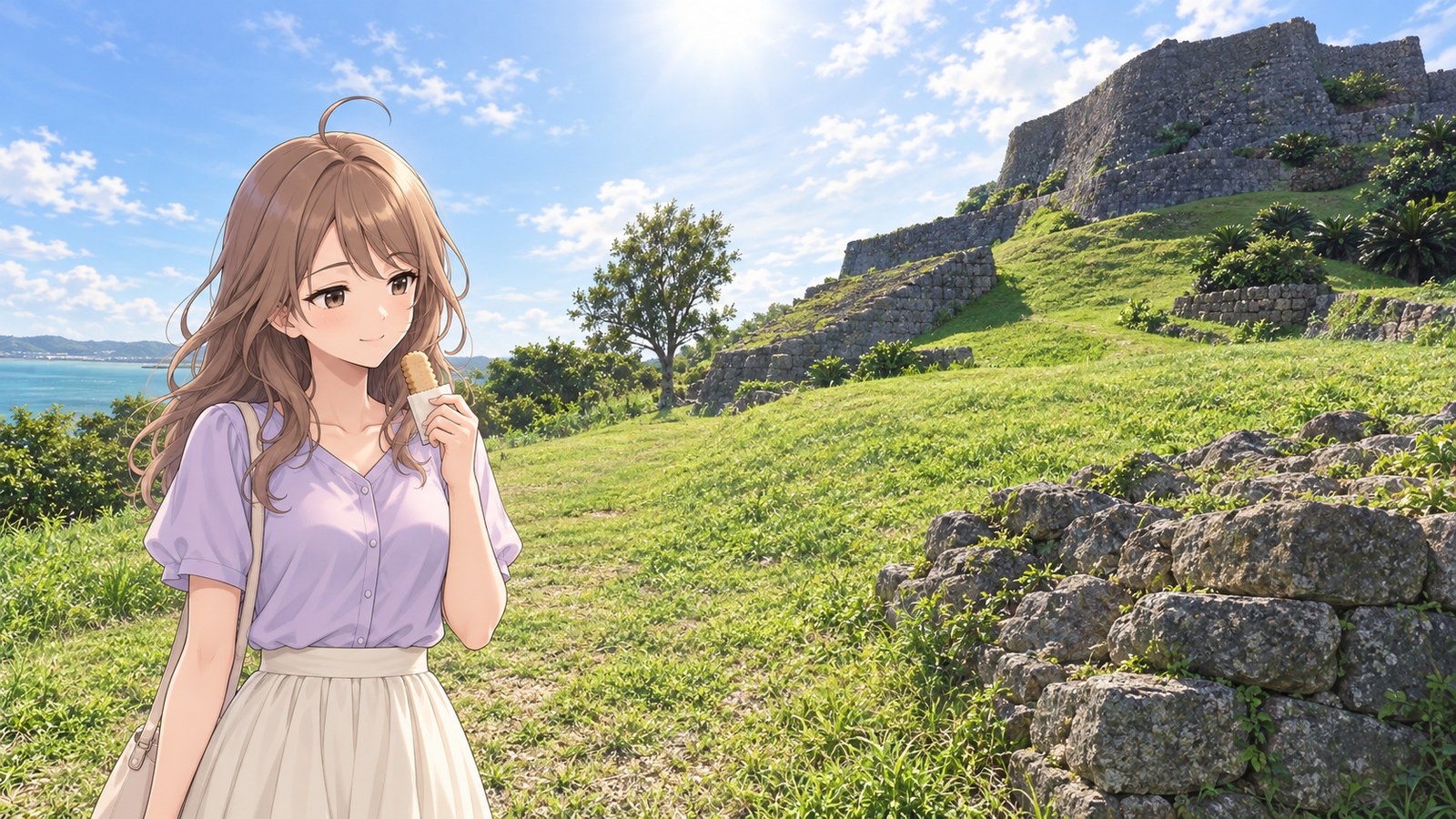
On an April afternoon, I stood at the foot of the slope at Katsuren Castle Ruins and looked up at the stone walls. They rose tier upon tier, but their corners were rounded, giving them a different outline from the castles I'd imagined. Before heading for the steps, I stopped and traced the edge of the wall with my eyes. It seemed to continue right up into the sky above the hill.
The breeze slipped through the sleeves of my pale purple blouse. The stones in front of me were covered in small ridges and hollows, and from below I could really see the thickness of each layer. The castle seems to have been built with limestone walls that follow the natural contours of the land. I'd been admiring the beautiful curves, but then I started wondering about the shape of the hill beneath them, too.
I climbed a few steps, then turned to look back. The wall that had been above my head was now slanting away below me. Even climbing one tier changed how much of the sea I could see. Above the Third Enclosure, the stone steps grew steep and the wind picked up. Holding my skirt hem down with one hand, I checked my footing and went up one step at a time.
After catching my breath, I reached the highest point, the First Enclosure, and could see all the way across Kin Bay. I stretched my arms out at my sides and faced into the wind. The rounded wall I'd been looking up at now curved along the slope below me, and by tracing its line with my finger, I could pick out where I'd stood earlier.
The First Enclosure is home to Tamano Miuji Utaki, where the castle lord's guardian deity is enshrined. A great rock there is revered as a sacred stone that protects Katsuren. I stopped a little way off and quietly put my hands together in prayer. The gate to this enclosure is thought to have once been arched, with a relief carving like a curling tendril. As I pictured the gate that's no longer there, I looked down at the steps I'd just climbed.
Amawari, who made this castle his base, is said to have helped the region prosper through overseas trade in the 15th century. The Omoro Sōshi, a collection of old Okinawan songs, includes a verse comparing Katsuren's prosperity with that of the capital in Yamato, as well as Kamakura. Looking out to sea, I remembered that story and pictured the coins and parrot bones from the exhibition travelling across these waters. The wind blew my hair across my cheek, and I gently brushed it away.
I went back down and took out the chinsuko I'd brought with me. I folded the paper wrapper down a little and raised it to my mouth, still looking up at the stone walls. It crumbled with a light crunch, and then the sweetness spread. After that walk, it tasted better than usual.
I ate the rest slowly, remembering what I'd thought on the way here. I'd imagined it as “a castle with a sea view,” but what comes to mind first now is looking up at those rounded stone walls from below. I caught every last crumb with the wrapper and folded it neatly.
The story sections are fiction inspired by this location. For accurate information, please consult official tourism and information websites.
Local specialty
Chinsuko
A much-loved Okinawan baked sweet with a crisp, crumbly texture, made with lard. I brought one along and ate it beneath the stone walls. That little sweet bite after the walk made me happy.
Highlights
Stone walls that curve with the shape of the hill
The castle was built with limestone walls that follow the natural contours of the land, and the ruins were listed as a World Heritage Site in 2000. I looked up at the rounded walls, then climbed the tiered enclosures. When the wall that had been above my head came into view below me, the sea opened up ahead. I spread my arms and let the wind wash over me.
Amawari's castle, thriving on overseas trade
In the 15th century, the castle's lord, Amawari, helped the region flourish through overseas trade. Ceramics from China and Southeast Asia have also been found here, a reminder that the castle's history is tied to the sea in view.
Exploring the castle ruins
A Walk Around Katsuren Castle Ruins
- Suggested visit time
- About 40–50 minutes
- Elevation of the castle ruins
- Approx. 60–98 m
The ruins rise in tiers along the slope, from the First Enclosure to the Fourth. I looked up at the stone walls from below before walking to the top.
The official recommended visit time is about 40–50 minutes. I'd like to take time to admire the shape of the stone walls and enjoy the sea view from above.
More Spot Guides
If you enjoyed this story, you might like these places too. I've gone back to each of them in different seasons, again and again.
Maps & Sources
Official sources
- Okinawa Travel Information Website: Okinawa Story | Katsuren Castle Ruins (opens in a new tab)
- Katsuren Castle Ruins Official Site | About Katsuren Castle Ruins (opens in a new tab)
- Katsuren Castle Ruins Official Site | Frequently Asked Questions (opens in a new tab)
- Okinawa Story | Familiar Foods (opens in a new tab)