Shiojiri, Nagano
I watched my step, then looked up to find mountains stretching on and on A June morning spent looking out over grassland and distant ridgelines at Takabocchi Highland
Beyond the stone-strewn path, a range of mountains stretches past the grassland. Whether I’m walking, stopping to take it all in, or lining up a shot, this wide-open view makes me want to stay a little longer.
Choose a story from spring, early summer, or autumn. Each one follows a day I spent taking in the highland—feeling the spring wind, walking in early summer, or capturing autumn in photos.
SpringMidday in late May
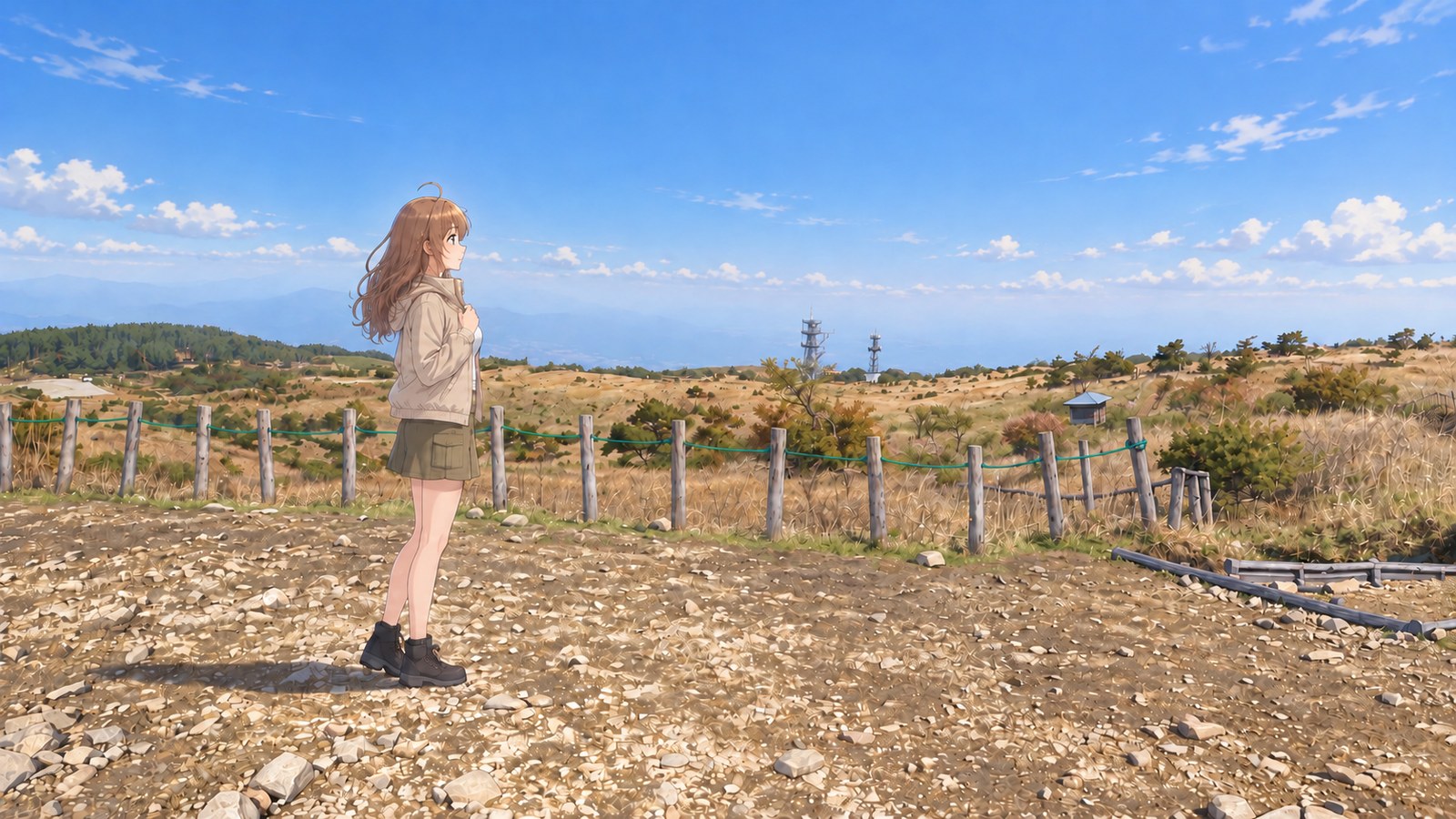
I pulled my jacket close and looked across the grassland
I drove from Ariake to Takabocchi Highland for a day trip to see spring arrive later up here than in town. I took the expressway to Shiojiri IC in my red convertible, then drove about 13km. After climbing the mountain road, I parked in the first car park beside the old grass horse-racing track.
Large stones jutted out here and there, and I picked my way along, testing each step with the toes of my boots. A few times my toes caught on a stone corner, and each time I shortened my stride. Around midday in late May, I reached the wooden posts with my eyes on the ground. When I looked up, grassland opened out gently before me. I stopped walking and caught my breath beside the posts.
The wind found its way under my jacket, so I pulled it closed with one hand. The light jacket that had been just right in town suddenly felt like a real comfort up here. Whenever my hair brushed my cheek, I could tell which way the wind was blowing, so I turned toward the mountains. When the wind picked up, all the grass tips bent the same way at once.
I started scanning the grass for flowers, then remembered that June is the best time for Japanese azaleas. Apparently, wildflowers start sprouting on the highland around Golden Week. For now, little patches of green were appearing among the dry grass. When I crouched to look, I saw thin new leaves pushing up in clusters from the bases of the dry stems. I walked a little farther along the rope and came to a patch where dead grass had fallen in layers. I picked up a strand. It felt lighter than I expected, dry and papery; when I let go, the wind carried it off.
Beyond the green rope strung between the wooden posts, low grassland gave way to overlapping mountain ridges. Several white clouds drifted across the sky, their shadows moving slowly over the grass. Wherever a shadow passed, the grass darkened, then brightened again once it had moved on. A slender tower in the distance made a useful marker; I could tell which way the shadows were drifting and found myself following the next one with my eyes.
There’s a legend behind the name Takabocchi: the giant Daidarabocchi sat here to rest. Looking out over the gently rolling highland, I can see why—it does look like a place where someone enormous might sit down for a breather. I stood by the post and took an extra-deep breath, just for a moment imagining I was the giant. I even started matching the landscape to a seated giant: maybe that low spot was a knee and the higher rise beyond it was a shoulder.
On my way back, I glanced over at the former grass racetrack beside the first car park. Horses used to race here. I found myself studying the ground and seriously wondering which way the horses used to race around the track up here. I still hadn’t figured it out by the time I reached the car park.
Back at the car, dry grass was clinging to the toes of my boots. Before getting into the driver’s seat, I picked the strands off one by one and let them fall back toward the grassland. I could still feel the papery rustle of that dry grass on my fingertips.
SummerA June morning
Step by step, the grassland opened wide
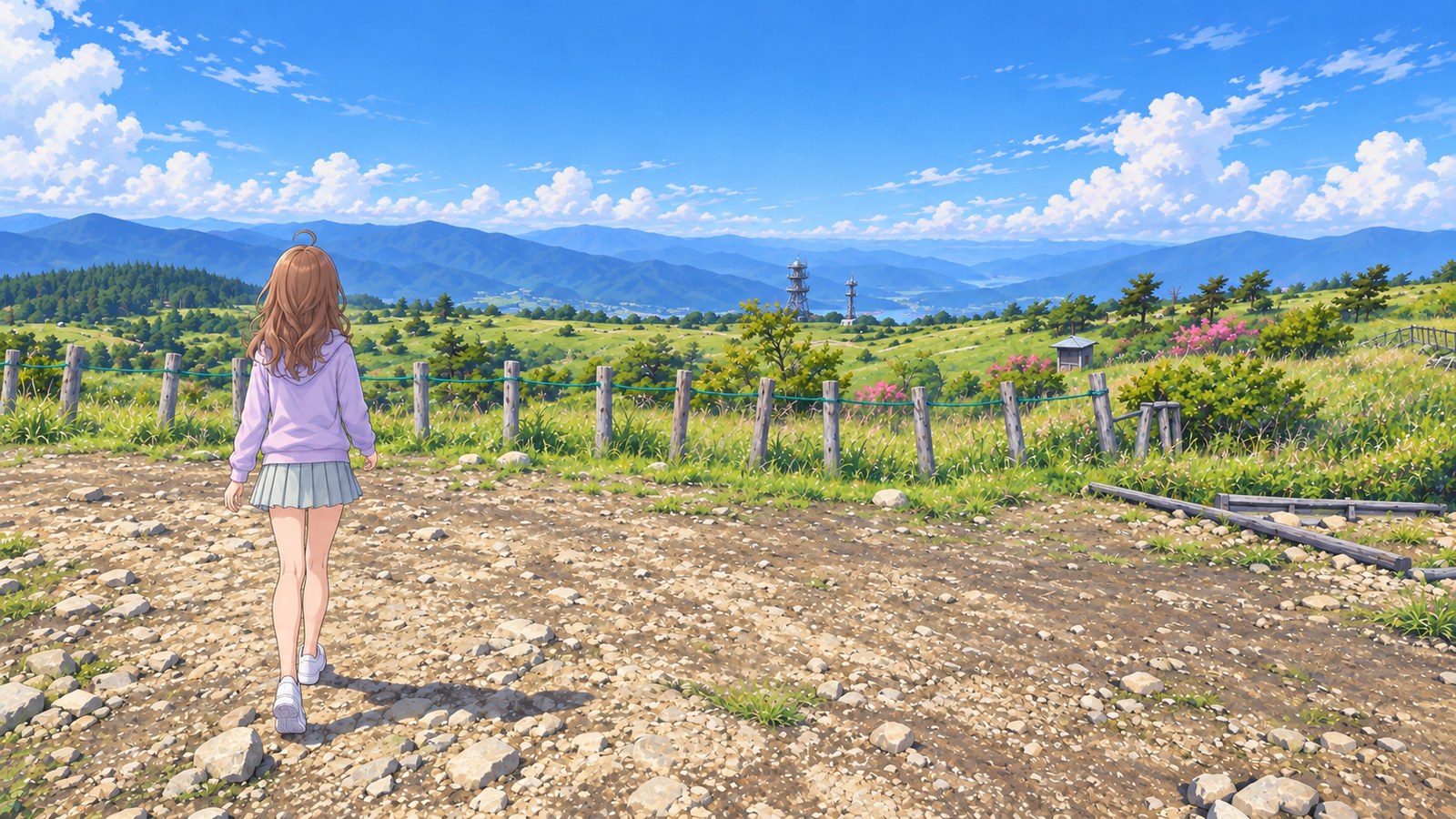
I wanted to spend a June morning walking the highland during azalea season, so I stayed in Shiojiri the night before. I drove from Ariake in my red convertible and headed up to the highland first thing that morning. I took the mountain road up to the second car park by the summit entrance and parked there. Then I set off on the path toward the summit. The morning air slipping in through my hoodie cuffs woke me up more than the drive had. With stones scattered across the path, I picked out the easiest places to put my feet.
Beyond the rope strung between wooden posts, the grassland rolled gently on. I could make out the grass nearby, but the distant ridges softened into one another. I’d been watching my shoes until just a moment ago, so when I looked up, the sheer breadth of the view stopped me for a moment.
In June, I can’t help wanting to come up and see the Japanese azaleas. From where I was walking, I spotted little clusters of flowers on the slope. I wanted to take in the whole grassland from the path rather than go closer and peer at the flowers. It felt like the wind was sweeping through the flowered patches and the rest of the grass all at once.
Tiny stones clicked against my white sneakers, and every few steps the view of the ridgelines shifted. I remember where I stopped that morning more than how far I walked. I took my drink out of my bag and had a sip and felt I didn’t have to hurry on just yet.
The path to the summit climbed gently, and each time I looked back, the path I’d walked and the car park looked a little smaller. Just as I started to breathe a little harder, the sky beyond the grassland seemed to stretch wide open.
From the summit, the view opened up all around me, a full 360 degrees. I’d heard that you can see the Northern Alps, Lake Suwa, the Southern Alps, and even Mount Fuji from here. I spotted the lake catching the light between the distant ridges and blurted out, “Oh, Lake Suwa!” I traced the landscape with a finger, trying to spot Shiojiri, where I’d stayed the night before, but the mountains hid the town from view.
From early summer through autumn, dairy cows graze here too. On my way down from the summit, I spotted cows grazing in the distance. They didn’t seem to mind whether I was walking or standing still, just keeping their heads down. Watching how unbothered they were made me slow down, too. It was lovely to feel the wind sweep across the grassland where the cows were grazing.
For lunch I headed down into Shiojiri and had sanzokuyaki at Chushin Kaikan Rindo in Daimon Ichibancho. It’s a whole chicken thigh, coated in potato starch and deep-fried. The crisp coating crackled when I bit in, and the garlic-and-ginger sauce released its aroma all at once. After walking the highland, that generous, hearty dish was exactly what I wanted.
When I left the restaurant, I looked up toward the highland I’d just left. It already felt like ages since I’d walked the grassland and watched the cows up there. Once I leave Shiojiri, it’s just the drive back to Ariake. On the mountain road home, just remembering the crackle of that sanzokuyaki coating made me feel as though I might get hungry again.
AutumnA late-October morning
I could see the wind’s path across the dry grassland
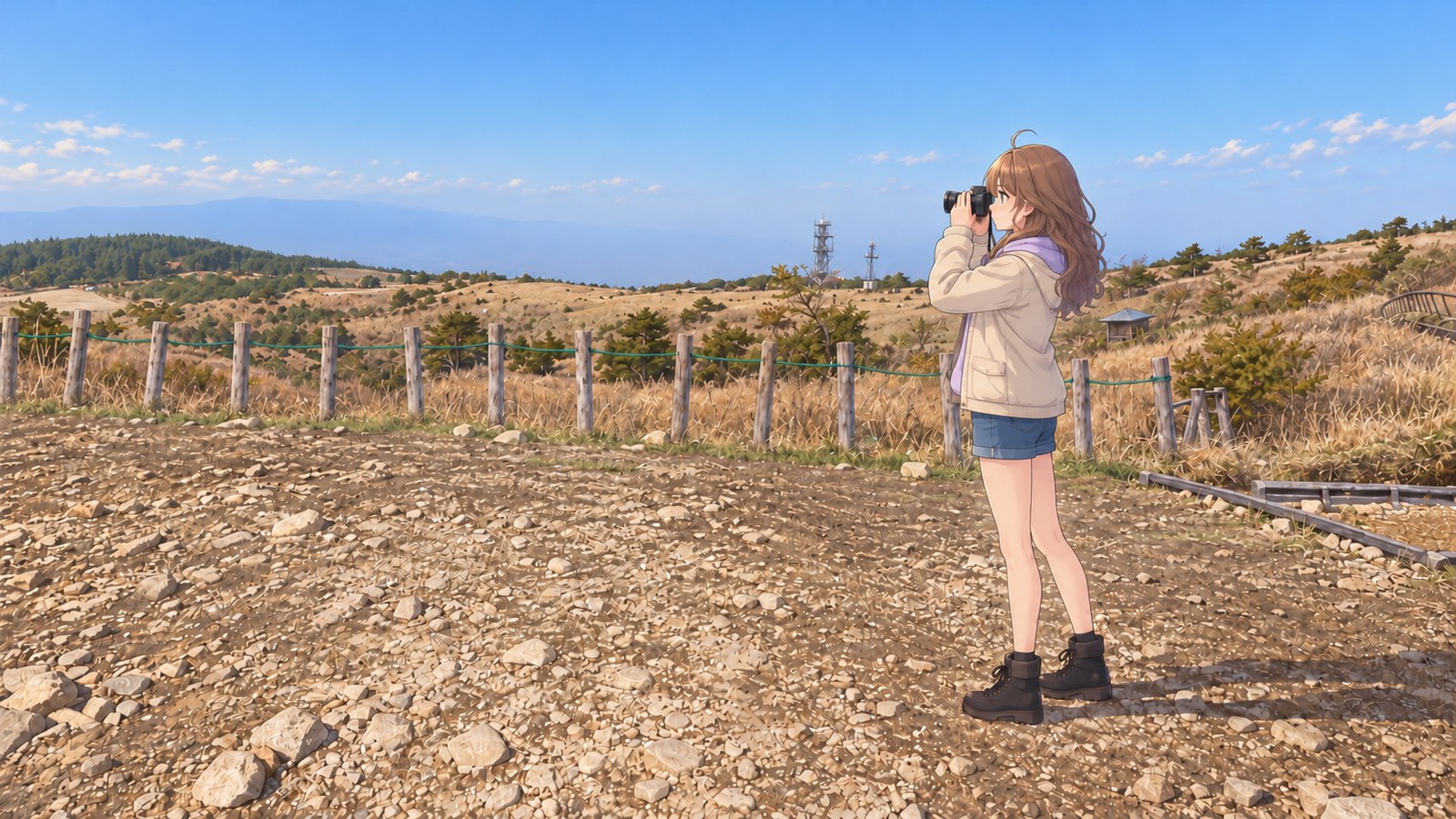
In late October, I came for a day trip from Ariake to photograph Takabocchi Highland as the grassland turned dry. I drove my red convertible to Shiojiri IC, then climbed about 13km of mountain road. I parked in the second car park by the summit entrance and headed for the stone path. I pulled out my small camera almost as soon as I started walking. Beyond the wooden posts, dry grassland stretched out, with layer upon layer of mountains beyond.
The grassland had gone from the green I remembered in early summer to the dry tones of autumn. When the wind blew, all the grass leaned in one direction at once, sending a wave-like pattern racing over the slope. I kept watching it pass again and again before I even raised my camera.
When I crouched in front of the rope, I heard the dry grass brushing in the wind with a soft, rustling sound. I hadn’t heard anything like that from the soft early-summer grass. I closed my eyes and listened as the wind picked up; the sound shifted from right to left, and it felt as if I could hear the route those waves of grass were taking. I took a shot of the wooden posts trailing off into the grassland, and the picture had more depth than I’d expected.
I had my usual lavender hoodie under my jacket. The morning air was still cold, and my fingers began to stiffen around the camera. After each shot, I tucked my hands into my hoodie sleeves until they warmed up, then raised the camera again. I worried the cuffs would stretch, so I started warming my hands in my jacket pockets instead.
At the summit, I turned my camera toward the Northern Alps. The autumn air was clear, and every overlapping ridgeline stood out sharply. The mountains looked much closer than when I’d been here in early summer. I tucked both elbows against my sides so the ridgelines wouldn’t tilt in the frame, then pressed the shutter.
Apparently, you can sometimes see a sea of clouds here from mid-October until the road closes for winter. A clear, cold day with little wind before dawn is your best bet. The best time seems to be from about 30 minutes before sunrise until about 30 minutes after. I arrived in the morning today, so instead of clouds I decided to photograph the dry grassland and clear ridgelines.
On the way back to the car park, I noticed my shadow stretching a long way across the stone path. The late-October sun was already low, and even the length of my shadow was different from when I’d walked here in early summer—not just the color of the grass. On a whim, I aimed the camera at it, too. The shadow of me with the camera raised stretched long and thin across the stones. I took that photo, then set off along the stone path again.
Back by the car, I flipped through the photos on my camera. There was just one shot of the grass rippling like waves. It was the same pattern I’d watched pass so many times before raising the camera. I hadn’t meant to catch it, but it turned out to be the most autumnal shot I’d taken that day. I decided that would be the first picture I’d show my friend.
The story sections are fiction inspired by this location. For accurate information, please consult official tourism and information websites.
Photos of this place3 images
-
Shiojiri, Nagano · Spring
-
Shiojiri, Nagano · Early summer
-
Shiojiri, Nagano · Autumn
Local specialty
Shiojiri Sanzokuyaki
A whole chicken thigh marinated in garlic-and-ginger sauce, coated in potato starch, and deep-fried. After a walk on the highland, it makes me want to head back into Shiojiri for a plate.
Highlights
Grassland stretching to distant ridgelines
I followed the stone path, then looked up to see ridgelines stretching beyond the grassland. I’d been watching my feet, so the sudden sweep of the view took me by surprise.
Japanese azaleas in June
If you want to see the highland flowers, June is the time to come. From the path I walked in early summer, I spotted small clusters of blooms on the slope and lingered to take in the whole grassland around them.
Road details
From Shiojiri IC to Takabocchi Highland
- Distance from Shiojiri IC to the highland
- 13km
- Elevation of Mount Takabocchi
- 1665m
A drive from town up to the highland, followed by a walk to the summit after parking.
The tourism association lists the route from Shiojiri IC as 13km. Mount Takabocchi is 1665m high. I want the walk after parking to be part of the trip, too.
More Spot Guides
If you enjoyed this story, you might like these places too. I've gone back to each of them in different seasons, again and again.

Maps & Sources
Official information consulted
- Nagano Prefecture Official Tourism Site: Takabocchi Highland (opens in a new tab)
- Shiojiri City Tourism Association: Takabocchi Highland (opens in a new tab)
- Shiojiri City Tourism Association: Takabocchi Highland in Early Summer (published in 2025) (opens in a new tab)
- Shiojiri City Tourism Association: Sanzokuyaki restaurants (opens in a new tab)