Omihachiman City, Shiga Prefecture
Exploring Hachiman-bori Spring along the canal, seen from Hakuun Bridge, with detchi yōkan
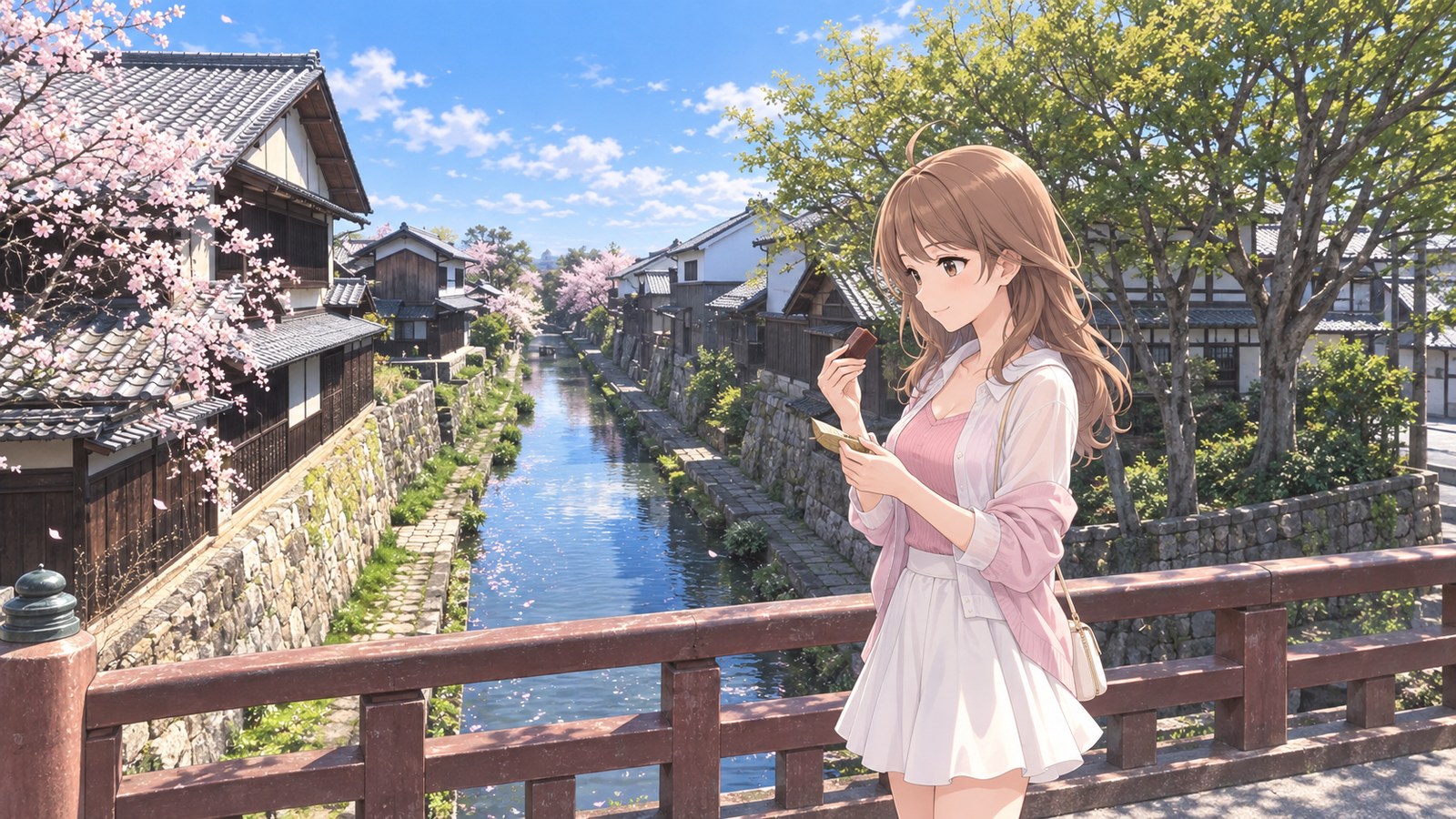
On an early April afternoon, I gazed at the cherry-blossom-lined canal from Hakuun Bridge, then wandered through the historic streets. My snack was Omihachiman’s famous detchi yōkan. As I unwrapped it from its bamboo sheath and took a bite, the unhurried view and the sweet, simple taste stayed with me.
Even my hands slowed as I opened the bamboo sheath. Here’s the view from that day and the story of my trip.
SpringAn early April afternoon
Even my hands slowed as I opened the bamboo sheath
From Hakuun Bridge, I watched the water of Hachiman-bori thread between the townhouses and disappear into the distance. It was an early April afternoon. My eyes moved from the cherry blossoms in the foreground to the stone embankments, then the rooftops above them, and more rooftops beyond. I’d come to see the canal, but I found myself wondering how the town was laid out, too. I stopped for a while around the middle of the bridge.
With my pale-pink cardigan over my white shirt, I pulled out the snack I’d brought along. Detchi yōkan comes wrapped in a bamboo sheath. I thought hurrying might squash its shape, so I watched my hands and eased the sheath back a little at a time. Maybe it was the still water in front of me, but even reaching for a bite had started to feel unhurried.
I pinched off a bite-sized piece and paused to look at it. It’s made from smooth red-bean paste and wheat flour, wrapped in a bamboo sheath, then steamed. I wondered how it would compare with the yōkan I knew even before I tasted it. The bamboo’s aroma lingered, and it had a gentle, uncomplicated sweetness. I was glad I’d picked it for a snack with that view.
Hachiman-bori is a moat associated with Hachimanyama Castle, built by Toyotomi Hidetsugu. It recalls the town’s history as an important hub for shipping on Lake Biwa. It looks quiet now, but long ago this was a vital route for moving goods. As I followed the stone embankment into the distance with my eyes, I started wondering about the lives of the people who used it. I stopped eating for a moment and took another look.
I’d heard the stretch from Hakuun Bridge to the area around Meiji Bridge is often used as a location for period dramas and films. Once I knew that, the view started to seem oddly familiar. But today I wasn’t seeing it on a screen; I was standing there in the spring breeze. Watching the cherry branches overlap the rooftops, I felt like I’d discovered a view I loved, not just recognized a familiar place.
I wrapped up the remaining detchi yōkan and walked off the bridge toward town. Stone-paved paths and white-walled townhouses line the canal. I’d like to walk beside the stone embankment I’d admired from a distance. I thought I’d just enjoy the snack and cherry blossoms, then be on my way, but something I noticed on the bridge gave me a new reason to explore on foot.
The story sections are fiction inspired by this location. For accurate information, please consult official tourism and information websites.
Local specialty
Detchi Yōkan
Detchi yōkan is a local specialty of Omihachiman. Seijuya describes it as smooth red-bean paste and wheat flour, wrapped in a bamboo sheath and steamed. I took my time opening the wrapper, enjoying the scent of bamboo and its gentle sweetness as I looked out at the canal.
Highlights
A Canal That Recalls Lake Biwa’s Shipping Trade
Hachiman-bori is a moat associated with Hachimanyama Castle, built by Toyotomi Hidetsugu. It recalls the town’s past as a key hub for shipping on Lake Biwa. I learned that history after seeing the quiet water as it is today, and even the stone embankments seemed different.
A Townscape Seen on Screen
The area around Hakuun Bridge and Meiji Bridge is often used as a location for period dramas and films. It was lovely to stand in the spring breeze and discover a view I liked for myself, instead of thinking of what I’d seen on screen.
Road Details
Along Hachiman-bori, from Hakuun Bridge to the Meiji Bridge area
A pleasant walk along the canal, with views of the townhouses. After admiring the scene from the bridge, I wanted to stroll along the stone-paved path, too.
Leave a little time in your plans to take in the scenery.
More Spot Guides
If you enjoyed this story, you might like these places too. I've gone back to each of them in different seasons, again and again.