Tanohata Village, Iwate Prefecture
Kitayamazaki Cliffs stretching beyond the railings
Kitayamazaki sits along the Sanriku coast. From the railings at the First Lookout, cliffs about 200 m high seem to stretch on and on into the distance. In spring I took photos; in summer I held onto my hat and watched the waves; in autumn I brought binoculars; in winter I followed the snow on the rocks. Here’s how I took in the same view in different ways, on trips of a few nights around Sanriku and a summer drive north to Hokkaido.
Read my stories from spring, summer, autumn and winter, with a few highlights from each. I took photos, peered through binoculars and traced the snow on the rocks. Start with whichever moment catches your eye.
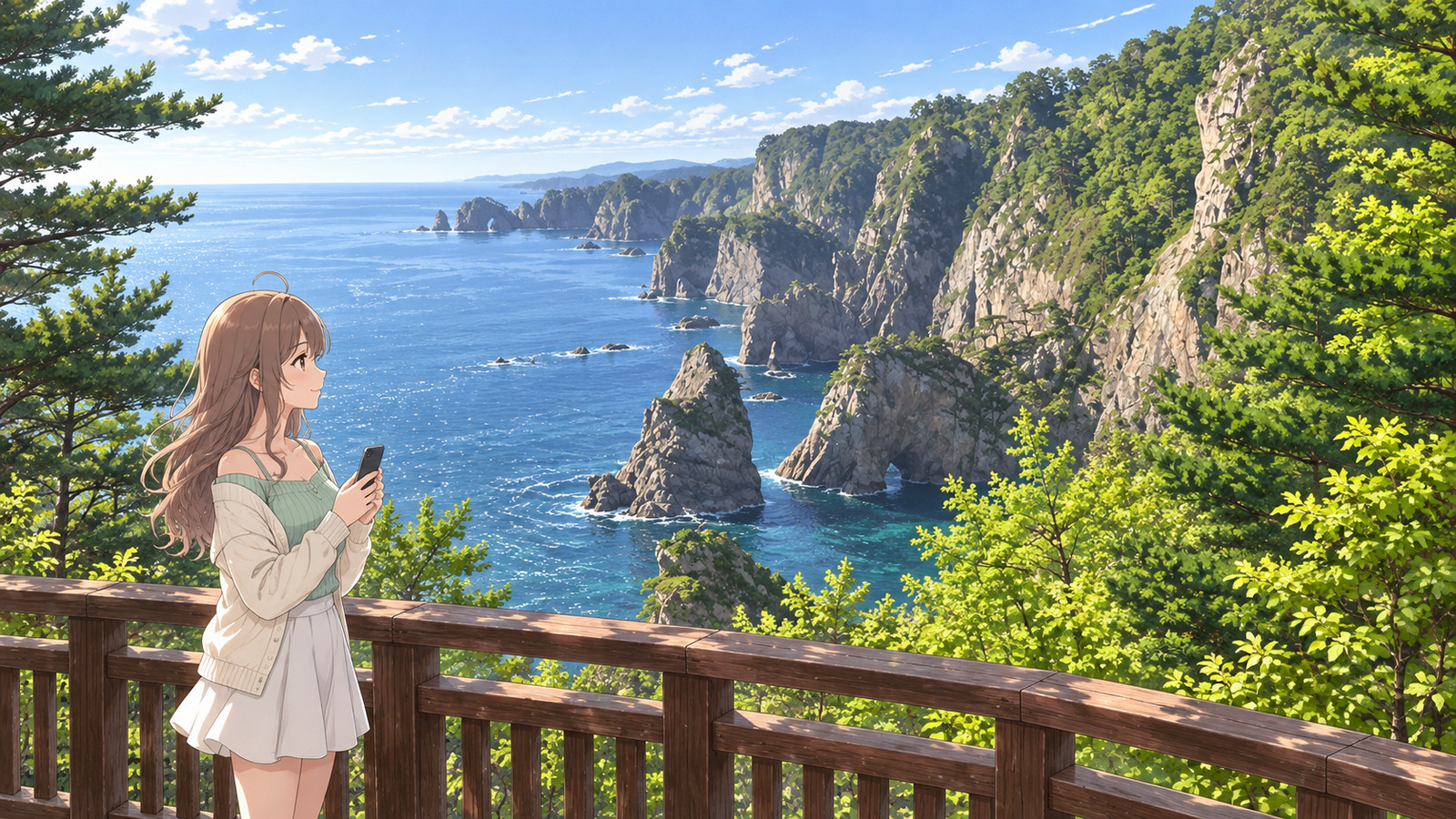
SpringA clear morning in May
The cliffs kept going beyond the edge of my photo
I wanted to see how the Sanriku coast changed from season to season, so I set off for a 2-night stay in Tanohata in May. I left Ariake before dawn and headed north on expressways and coastal roads. The morning after I arrived, the sky was clear. I parked at Kitayamazaki and headed for the First Lookout. The new leaves were catching the light, and I felt my pace quicken before I’d even caught a glimpse of the sea.
The path to the lookout was step-free and easy to walk, even with my phone in hand. I pushed my cardigan sleeves up a little; I wanted to get the cliffs in a photo. At the railings, the sea opened up between the trees. A pointed rock stood in the foreground, with cliffs stretching far beyond it. In the photos I’d seen, the view stopped at that first rock. I hadn’t realized so many more cliffs lay beyond it. What should I include to capture this view?
I started by filling the frame with the rock in front of me. When I checked the shot, I could see the rock’s shape clearly, but the cliffs stretching into the distance had fallen outside the frame. Wait, the part I most wanted to show wasn’t even in the picture. I’d been so busy getting the rock right that I’d forgotten how vast the view was.
I held my phone in both hands at my chest and looked back out to sea. The nearby pine branches were crisp, while the cliffs farther off softened into the distance. When I spotted fresh leaves swaying between the branches, the view felt so much deeper than it had in my first photo. This time, I’d make room for more sea: just the tip of the foreground rock along the bottom edge, with the sea and headlands filling the upper 2/3.
With a slightly wider shot, I managed to fit the whole view—from the foreground rock to the distant headland—into one frame. I kept the close-up of the rock too and set the 2 photos side by side. I think having both photos will help me remember today’s view of Kitayamazaki.
I got so caught up taking photos that I didn’t notice someone was waiting behind me. I quickly said, “Sorry,” and moved along the railing to make room. From the end of the railings, the foreground rock and the cliffs behind it overlapped a little differently. Even at the same lookout, shifting your position just a little gives you a completely different shot. Letting someone have their turn gave me a new angle too: one more photo from the far end.
When I enlarged the 2 photos, I noticed a pine growing right on top of the pointed rock. There was greenery not only on the cliffs but even on rocks jutting out into the sea. I wanted to see for myself what I’d spotted in the photo, so I looked up from my phone toward the railings. Sure enough, a pine was swaying in the sea breeze up on that rock.
There are 2 more lookouts here: the Second Lookout and the Third, where you can enjoy a walk through the forest. I was staying another night, so I decided to visit the Third Lookout tomorrow morning and follow the trail through the fresh green forest. I wonder how the sea between the trees will look compared with today’s photos.
On my way back through the park, I started thinking about a seafood rice bowl at Matsunoya Shokudo. I’d heard it came with scallops and salmon roe, and before I knew it, I was heading toward the restaurant. I’d look back through my 2 photos while waiting for lunch.
SummerA clear morning in July
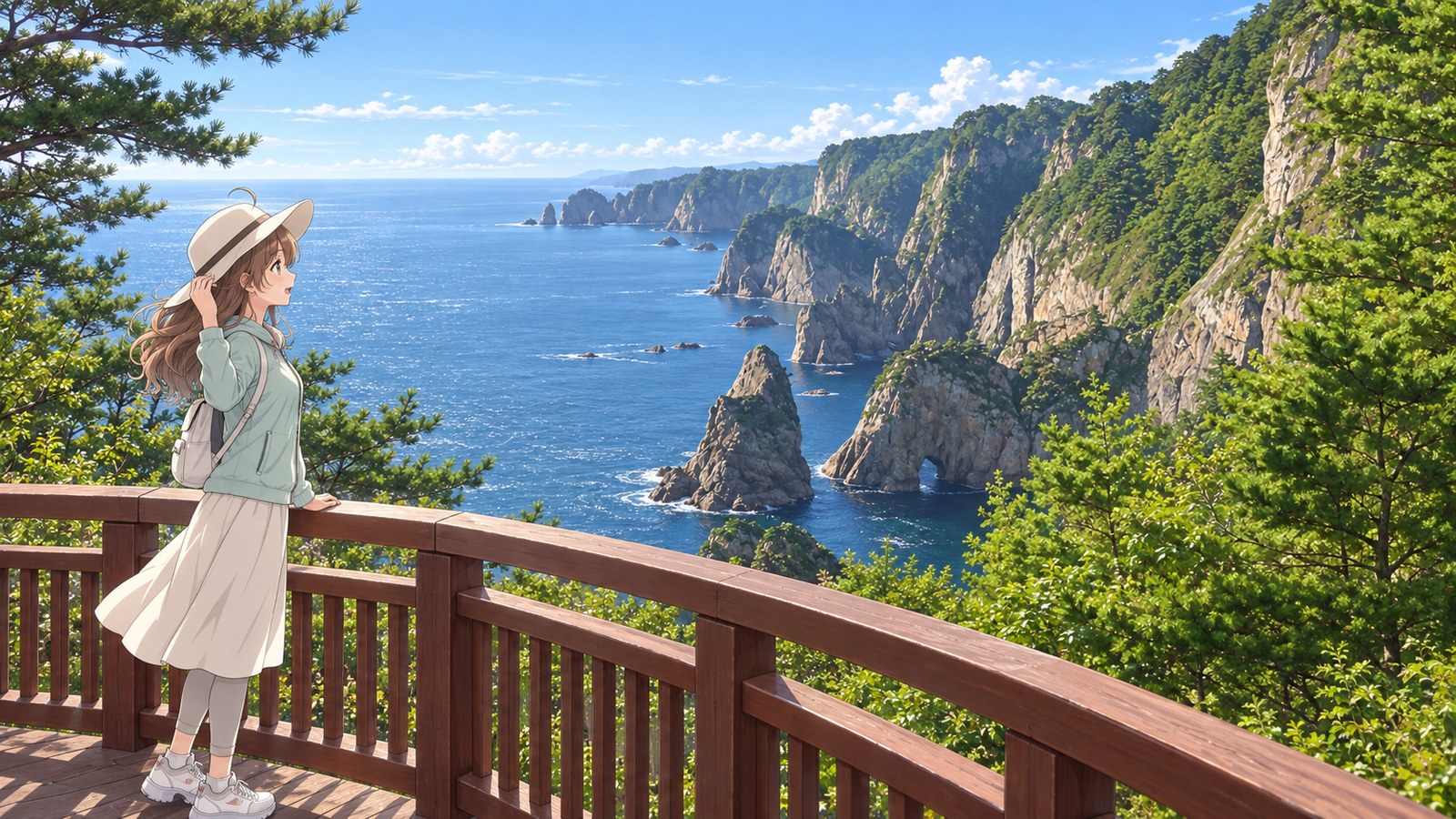
Cliffs stretching beyond the railings
I stopped at Kitayamazaki on my way to Hokkaido in summer. I was heading north from Ariake along the Tohoku coast, planning to cross to Hakodate from Oma on the Shimokita Peninsula. As I drove the coast road with my eyes on the road and my hands on the wheel, each glimpse of sea around a bend made me want to see more. I saved the view for the lookout. On a clear July morning, I parked and adjusted my hat.
The path from the car park to the First Lookout was step-free. I unbuttoned my light jacket as I set off, and the sea gradually appeared through the trees. At the railings, a huge rock filled the foreground; beyond it, and beyond that, the cliffs just kept going. I’d come to see one headland, but the view was so expansive that it took a while just to trace the cliffs with my eyes. Several other people at the railings were holding onto their hats too. Every gust made us all reach up in exactly the same way, which made me smile.
The wind nearly lifted the brim of my hat, so I held it down with one hand and rested the other on the railing. Below the rocks, I watched the sea. Even from a distance, I could pick out the white water where the waves hit. Looking from the massive rocks to the small waves rolling in and out, I began to grasp just how tall those cliffs were: about 200 m.
Apparently, the rocks in these cliffs formed during volcanic activity about 120 million years ago. Once I heard that, it felt as if the pointed rocks in front of me had been meeting waves here for longer than I could imagine. Each time the surf broke white at their base, I gripped my hat a little tighter. I was looking down from so high up, yet the sound of waves drifted faintly up on the wind.
The yamase, a damp northeasterly wind, is said to blow here from early summer through summer. Today the sky was clear, and I could see all the way along the cliffs. Each gust lifted my hat brim, and the air coming off the sea felt cool. I was glad I’d brought a light jacket, even in July.
There’s also a staircase from the First Lookout that descends all the way to sea level—736 steps, I hear. I’d love to see the cliffs from below, but this was a long trip north, so I stayed at the top and peered down the stairs. They disappeared into the trees, and I couldn’t see what lay below. Once I’d confirmed that, I headed back through the park.
On the walk back through the park, I started thinking about what to eat. Matsunoya Shokudo serves fresh sea urchin rice bowls in summer, and I was already tempted. Apparently, there’s also soft serve made with Tanohata milk, and it comes with a spoon made from black kelp. I caught myself wondering if the spoon was edible too, then laughed at myself for taking the question so seriously.
After getting back into the car, I checked the rest of today’s route on the map. I still had a long way to go north to the Shimokita Peninsula. I cracked the window open a little, let in the sea breeze I’d just felt, and headed for the next town.
AutumnA mild afternoon in October
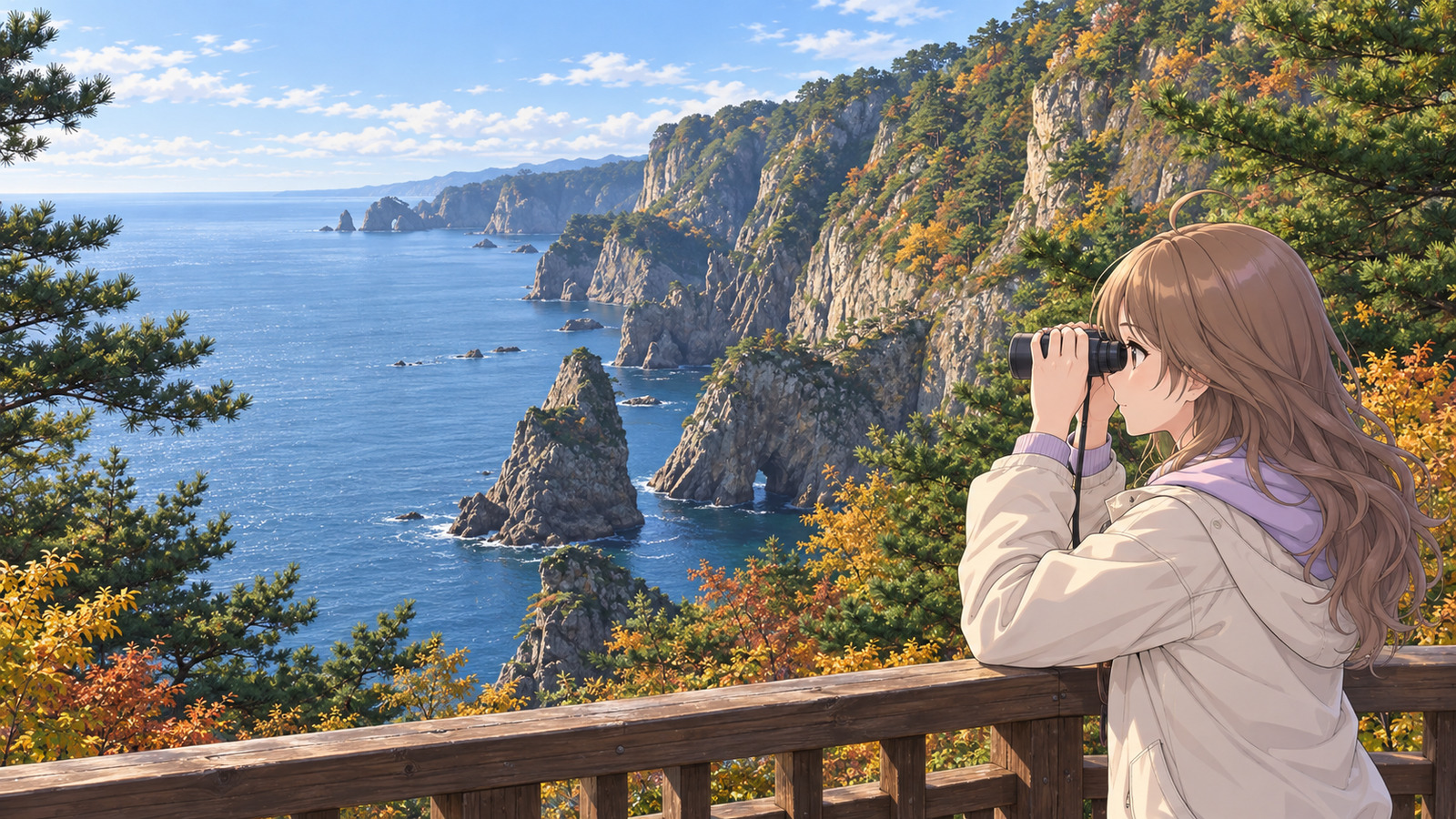
Tracing a distant headland through binoculars
In October, I set out on a trip to spend 3 nights in Sanriku and see Kitayamazaki in autumn. I drove north from Ariake and reached the First Lookout on the afternoon of day 2, binoculars in hand. On the walk from the car park to the lookout, I saw autumn leaves between the pines. I’d come for the sea, but kept stopping to look up at the trees on the cliffs before I even reached the railings.
When I turned back toward the sea, I could see from the huge rock in front all the way to a distant headland. The pines were still green, with autumn leaves layered between them. As I took in the scale of the cliffs, my eyes wandered to the line where trees met rock. Autumn gives you so many places to look.
I raised the binoculars to eye level with both hands and focused on a distant headland. To the naked eye, the rocks seemed to form one continuous outline; through the lenses, I could see which ridges were near and which were farther away. I could make out where the headland jutted over the sea and where it dipped inward. I found myself gripping the binoculars tighter.
I slowly swept my gaze across the rocks and trees. The headland looked so close that when I lowered the binoculars, it surprised me to see how far away it really was. Wait, was it really that far away? I looked again, and the outline I’d spotted before came straight back into focus. That made me smile.
The October afternoon sun was already low, lighting only one side of the rock. Through the binoculars, every ridge and hollow stood out where the sun hit, while the other side fell into shadow. If I’d come at midday in summer, I might never have noticed the shape of that shadow. I think this was the first time I realised that the direction of the light is part of the scenery, too.
After picking out the distant headland, I took in the wider sweep of sea right in front of me. Maybe because I’d been studying every detail in the rock, the open expanse to the horizon felt especially good. I wanted to remember both—the details through my binoculars and the broad view in front of me. I tugged my jacket sleeves back into place and slung the binoculars around my neck. As I started walking, they swung against my chest, bumping lightly with every step.
On the way back from the lookout, I stopped by the visitor centre too. There’s a theatre showing Kitayamazaki through the seasons, from fresh spring foliage to snow-covered cliffs in winter. When the distant headland I’d just followed through my binoculars appeared on screen under a blanket of snow, I wanted to come back in another season.
There were exhibits on local wildlife and plants, and even a dialect quiz. The quiz was much harder than I expected; every time I checked an answer, I found myself nodding, “Ah, I see.” I’d studied the headland’s shape through my binoculars; now I wanted to take at least one new word home, too. I quietly practised the answer to the hardest question right there in front of the exhibit.
When I get back to the park, I’d like to try Matsunoya Shokudo’s ramen, loaded with seaweed. Hearing about all that seaweed gave me something else to look forward to after taking in the scenery.
On the way back to the inn, the afternoon sun was already low. My binoculars on the passenger seat gave a little clack now and then, and every time I heard it, I pictured that distant headland again. Once I get to the inn, I’m going to spread out the map and choose which lookout to visit for a view of the sea tomorrow morning.
WinterA sunny midday in January, with snow on the cliffs
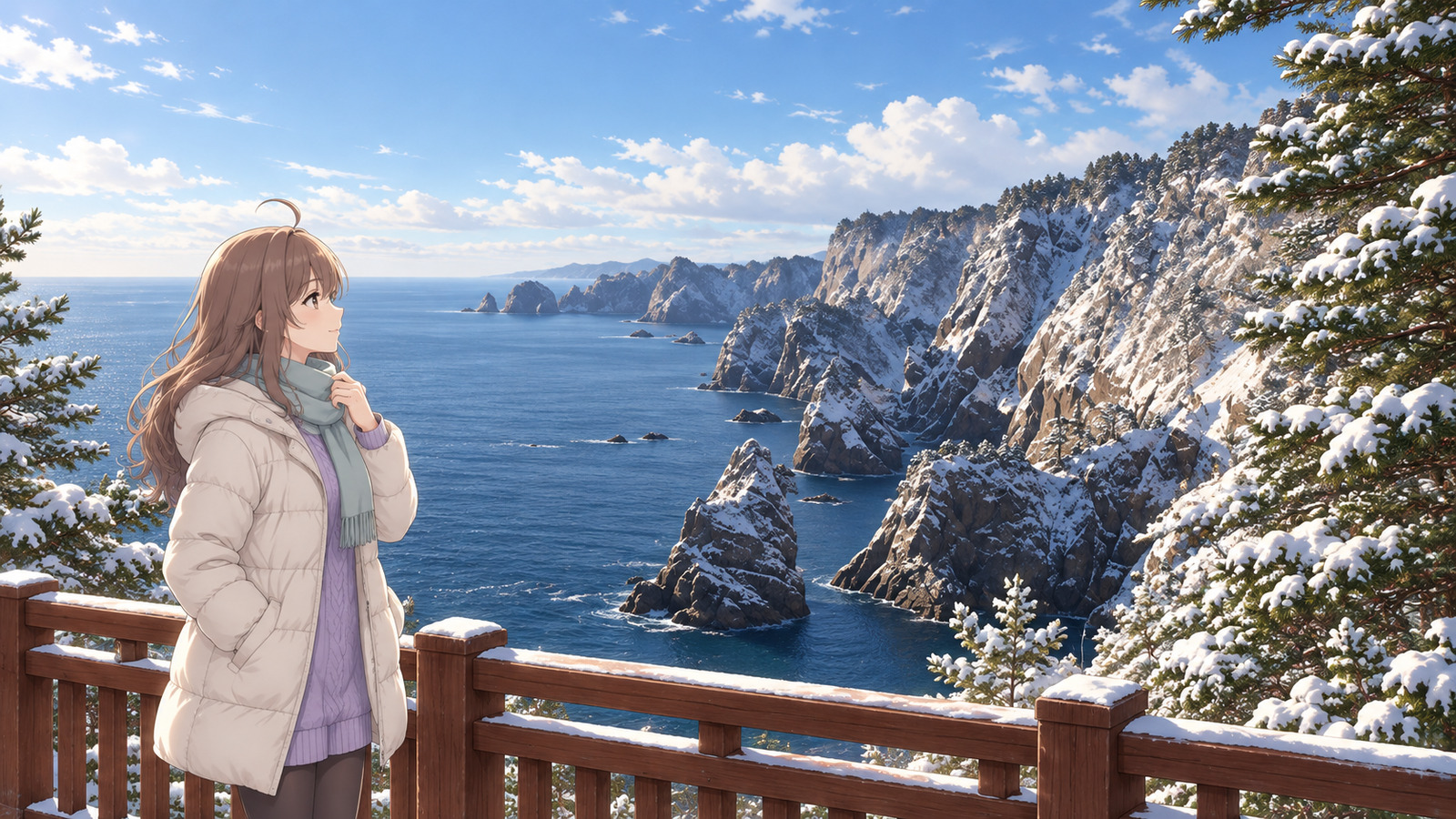
Follow the lines of snow to see the shape of the rocks
In January, with snow on the ground, I drove north from Ariake in my red four-wheel-drive sedan for a 2-night winter trip to Sanriku. On day 1, I reached the inn and turned in early, listening to the sea in the darkness outside my window. At midday on day 2, I set out and drove the snow-lined roads to the Kitayamazaki car park. At the First Lookout, I faced the sea. Snow still clung to the cliffs and pine branches. With one hand in my down-coat pocket, I traced the snow-covered rocks from the nearest one onward. It was the same coastline, yet the outlines of the rocks looked sharper than usual.
I’d pictured the cliffs buried in snow, but patches of bare rock showed through. Snow lingered in the hollows, bringing the jagged lines of the rocks into focus. Below, the sea was still free of ice, its waves changing shape each time they struck the rocks. It was a winter scene, but the sea kept moving.
The wind slipped down the back of my neck, so I used my free hand to fix my scarf. Some nearby pine branches were heavy with snow, while needles showed through on others; the view felt different from when I’d been focused only on the rocks.
Looking through the pines, I brought my gaze back to the rock in front. Following the streaks of snow with my eyes, I could trace its shape from the pointed tip to the base. Then the cliffs behind it, and the distant headland beyond. One by one, the shapes came into focus, and I could see this was so much more than a landscape turned white. Snow lay deepest on the flat ground atop the cliffs.
Apparently, the bedrock here lay beneath the sea until about 1 million years ago. It was later uplifted to form a terrace facing the sea. So the flat ground on top of the cliffs, where the snow lay deepest, was the surface of that terrace. Could the ground beneath this lookout have been underwater too, long ago? I looked down at my boots pressing into the snow.
The air was clear today, and I could make out the shape of the farthest headland. In autumn, I’d struggled to pick it out even through binoculars; today I could see it with the naked eye. The cold wind was making the tip of my nose ache, but this was the kind of view I could only get in winter. I put my gloves back on inside my pockets, then traced the coastline again, this time in reverse, from the distant headland to the rocks in front.
I wanted to take in the sea too, so I lowered my gaze a little. Waves hit the foot of the rocks, receded, then rolled in again. Watching the snow on the cliffs and the restless sea at once, I forgot all about the photo I’d meant to take.
As I adjusted my scarf and headed back through the park, the snow gave a little squeak underfoot with every step. I climbed into the car and warmed my hands by the heater. Since I’d missed the shot I wanted, I decided to sketch the snow-streaked rock in the notepad at the inn instead. Tomorrow morning, before heading home, I’d stop by the lookout and see if my drawing matched the real thing.
The story sections are fiction inspired by this location. For accurate information, please consult official tourism and information websites.
Photos of this place4 images
-
Tanohata Village, Iwate Prefecture · Spring
-
Tanohata Village, Iwate Prefecture · Summer
-
Tanohata Village, Iwate Prefecture · Autumn
-
Tanohata Village, Iwate Prefecture · Winter
Local specialities to look forward to on this trip
Fresh sea urchin rice bowl
A summer dish at Matsunoya Shokudo in Kitayamazaki Park. After taking in the sea, I’d love to go for a bowl topped with Sanriku sea urchin.
Highlights
A coastline that keeps unfolding
This is a scenic stretch, with cliffs about 200 m high. I’d like to keep taking in the view, tracing it with my eyes from the nearby rocks to the distant coast.
Sea and rock in one sweeping view
The coastline stretches for about 8 km. Even after following it with my eyes, the cliffs kept going; in spring, I was so focused on the rock in front that I framed it up close and left the rest out.
Road and location data
Kitayamazaki coast and lookouts
- Length of the cliff-lined coast
- About 8 km
- Height of the cliffs
- About 200 m
These figures describe the coastline itself and the height of its cliffs. I’d love to take in the full line of cliffs from a lookout.
These figures give a sense of the coastline’s scale. I’d like to walk from the car park to a lookout and take in the cliffs.
More Spot Guides
If you enjoyed this story, you might like these places too. I've gone back to each of them in different seasons, again and again.