Kanozan, Kimitsu City, Chiba
The valley mist brought the hills into focus At dawn in December, take in the Kazusa Hills at your own pace
On an early winter morning after rain, look out over the Kazusa Hills from Kujukutani Observatory Park. When mist lingers in the valleys, the outline of each hill comes into view.
Read the story of a winter morning in the mist at Kujukutani.
WinterDecember dawn through just after sunrise
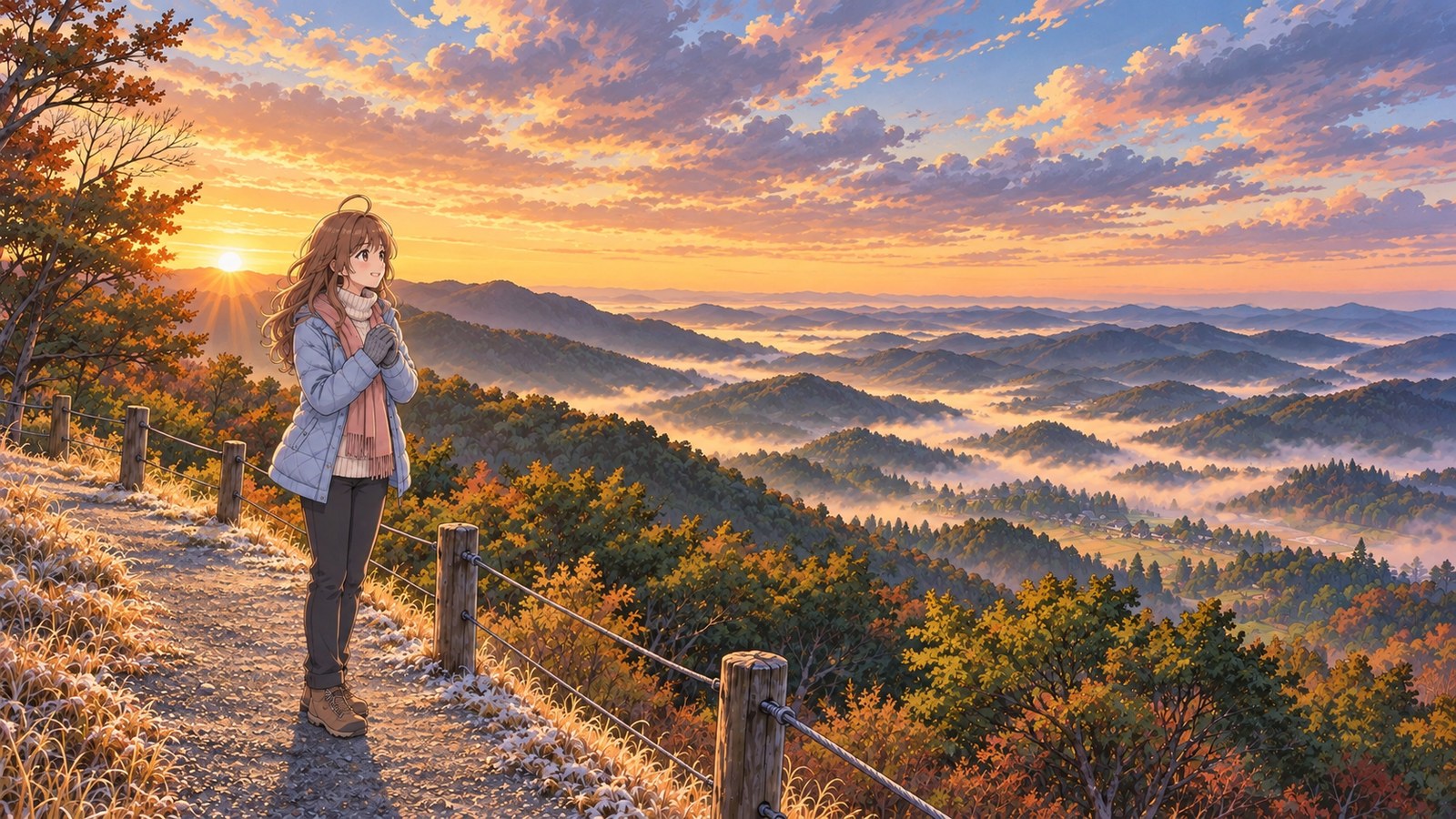
Rubbing my gloved hands as I wait for the hills to appear
On a still-dark December morning, I headed for Kanozan with my friend. We’d made plans to see the morning view at Kujukutani, so I’d brought my coat, scarf, and gloves. After parking, we walked to a spot with a more open view. The air was colder than it had been when we left town. Rubbing my hands together, I turned to face the hills.
Mist still lingered in the valley. At first, I watched the mountains in the distance, but as I slowly brought my gaze back toward the nearer hills, I began to make out their rounded outlines, layer upon layer. With mist between them, it was easy to pick out the valleys. I started counting on my fingers, then spotted still more hills beyond.
As the sun rose, the upper edge of the mist brightened. The nearby trees were still in shadow, and the hills beyond them had a completely different look. The view kept changing while my friend and I talked, so I stopped rubbing my gloved hands and got completely absorbed in it. I hadn’t forgotten the cold, but I wanted to stay with that light a little longer.
I walked a little way along the inside of the low fence, then moved to a different spot. Through the gaps between the overlapping hills, a different valley came into view. A broad view like this is hard to take in all at once, even from one spot in Kujukutani. I used the shape of a nearby tree as a marker and slowly followed the ridgeline to the mountains in the distance.
Back in the car, my friend and I talked about the morning until my hands warmed up. She showed me a photo, and I caught myself searching for more hills in the distance on the screen. I was looking forward to a detour to pick up some soybean sweets in Kimitsu, but right then I wanted to keep talking about the view a little longer. I knew I’d remember that early morning for the shape of every hill.
The story sections are fiction inspired by this location. For accurate information, please consult official tourism and information websites.
Food to try on your trip
Sweets made with Koito Zairai soybean flour
Koito Zairai is a soybean variety grown in the Koito River basin in Kimitsu. There are also bouchée cakes and other baked sweets made with kinako (roasted soybean flour). I’d love to pick up one of these local sweets as a souvenir on my way back from the mountains.
Highlights
A mountain view that inspired a painting
Higashiyama Kaii’s painting “Afterglow” was based on this view. I saw the mountains in the morning light, but I wonder what they look like in the evening. I’d love to compare the painting with the real view.
Finding the layers in the Kazusa Hills
This isn’t a view of towering, snow-covered peaks; it’s a succession of forested hills. When mist drifts into the valleys, you can pick out the outline of each one. I got so absorbed looking for the hills in the distance that I stood there, rooted to the spot.
Getting to the park
Getting to Kujukutani Observatory Park
- Driving time
- About 25 minutes (from Kimitsu Interchange)
- Walk from the bus stop
- About 15 minutes on foot (from the last stop on the bus bound for Jin'yaji Temple)
By car, follow the Kimitsu–Kamogawa road toward Kanozan. I drove up into the hills, parked, then walked to an open viewpoint for the morning panorama.
Here I’ve included the driving and walking times given by the official sources. After taking in the mountains at dawn, I also look forward to deciding what local food to try and choosing a souvenir in Kimitsu.
More Spot Guides
If you enjoyed this story, you might like these places too. I've gone back to each of them in different seasons, again and again.