Nara City, Nara Prefecture
Waiting above Nara for the city lights A short September evening drive up Wakakusayama
When I spend time in Nara, I always find myself wondering what the city looks like from up on the mountain. At Wakakusayama, I take the Shin-Wakakusayama Course to the summit car park, then walk 300m along the path to the viewpoint. Each time I’ve come, something different has caught my eye: rooftops in daylight, the sunset, or the city lights. I love deciding which hour to visit before the trip even begins.
After a cherry-blossom drive, take in Nara by day; in summer, watch the sun sink behind the mountains; in early autumn, wait for the city lights; in winter, look out to distant mountains. Choose the season that catches your eye and visit Wakakusayama with me.
SpringApril · around 2 p.m. during cherry blossom season
After the cherry-blossom drive, take in Nara by day
I left Ariake before dawn and headed west along the expressway in my red convertible. On day 1 of my 2-night trip through Kansai in April, I was looking forward to driving the cherry-lined Shin-Wakakusayama Course and seeing Nara from above. I’d heard there weren’t any shops at the summit, so I’d already picked up some Kenjo Mikasa at Tsuruya Tokuman in Shimomikado-cho, Nara City.
The cherry trees appeared along both sides of the road as soon as I turned onto the Shin-Wakakusayama Course. With the roof down, the air beneath the blossoms rushed into the car. I wanted to look up, but kept my hands on the wheel and my eyes on the road as I followed the curves. After 3.7km one way, I reached the summit car park, with space for around 50 cars. From there, it was on foot.
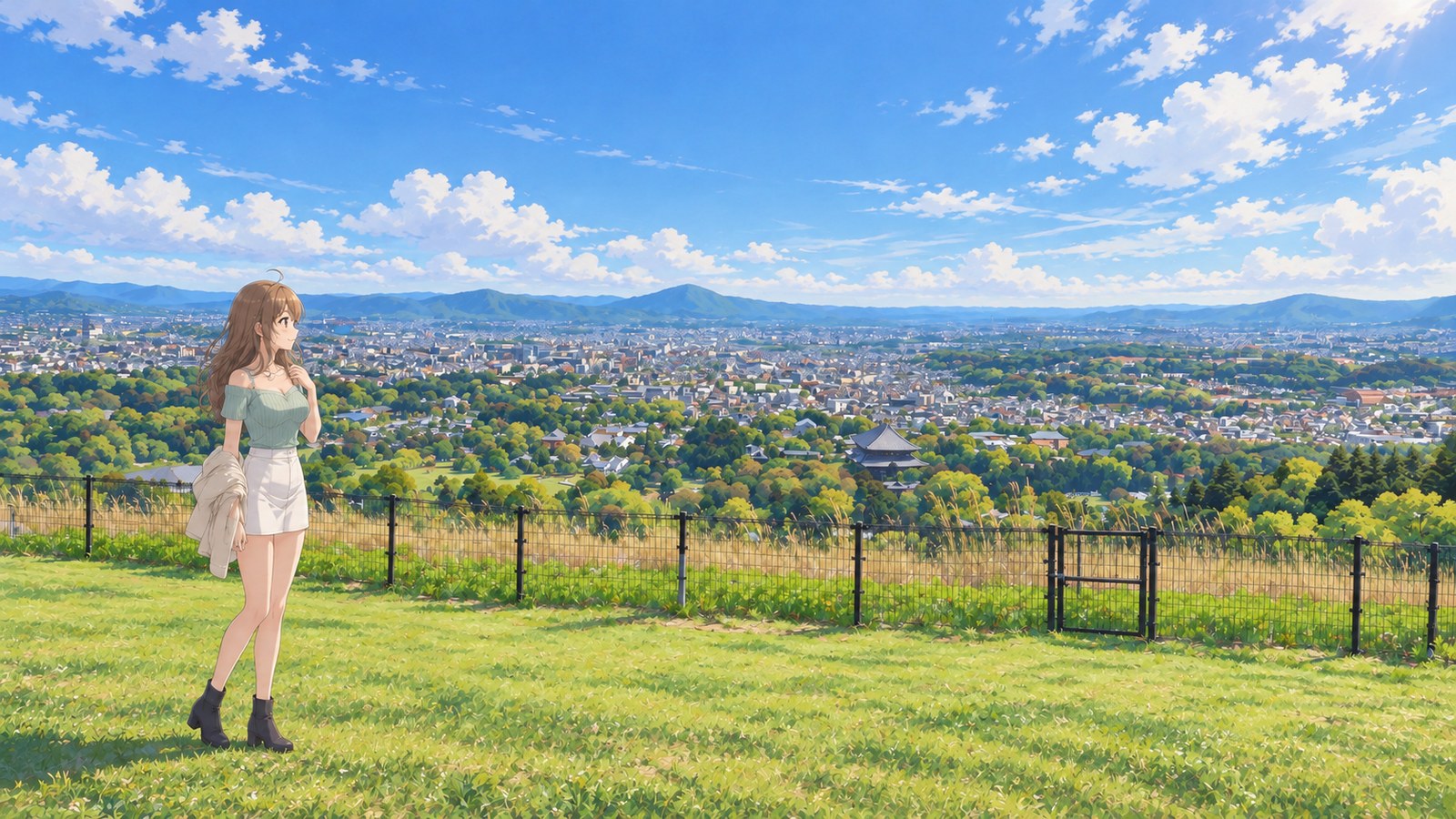
The 300m footpath brought me to a spot overlooking the city. I stopped with one foot slightly forward, my light jacket draped over my arm. The breeze brushed the shoulders of my mint knit top, and I rested my free hand over my chest. Nara stretched out before me, beyond the trees. In daylight, you can make out the rooftops and roads, so my eyes kept tracing them one by one.
My gaze moved from the nearby trees to the city, then on to the distant mountains. Even the large rooftops I could see from here seemed like part of the city. Down below, I’d been looking up at buildings; now I was looking beyond them to the mountains. “I hadn’t realised Nara stretched out this far,” I found myself murmuring.
The grass at the viewpoint was warm in the spring sunshine. Each time the breeze came through, the hem of the jacket over my arm fluttered. It wasn’t cold enough to put it on, but it was just the kind of spring afternoon that made me glad I’d brought it.
I’d heard that Wakakusayama is also called Mount Mikasa because its shape resembles three hats stacked on top of one another. The Mikasa I’d left in the car was a sweet inspired by the mountain. I had no idea the sweet and the mountain were connected. I started searching the slope at my feet for the shape of the three stacked hats, then it hit me: I was standing on the mountain itself. Of course I couldn’t see its full shape from up here.
As I looked out, I tried to work out where the cherry-blossom road I’d just driven ran along the mountainside. The trees hid the road itself, but I could still remember how I’d felt when blossoms appeared around a bend. I’d seen the cherry blossoms from below and Nara from above—all in a single afternoon.
The spring sky was a little hazy, softening the outlines of the distant mountains. A crisp, sharp view is lovely too, but this gentler scenery feels just right for spring. I took 1 photo by the railing and sent it to my driving friend with the message, “All this space after the cherry-blossom road.”
On the way back to the car park, my friend messaged, “Have you had your Mikasa on Mount Mikasa yet?” “Not yet,” I replied, and left the package unopened on the passenger seat. I was saving it to have with tea at my hotel that night. Looking forward to it, I took the wheel again and started down the cherry-lined road.
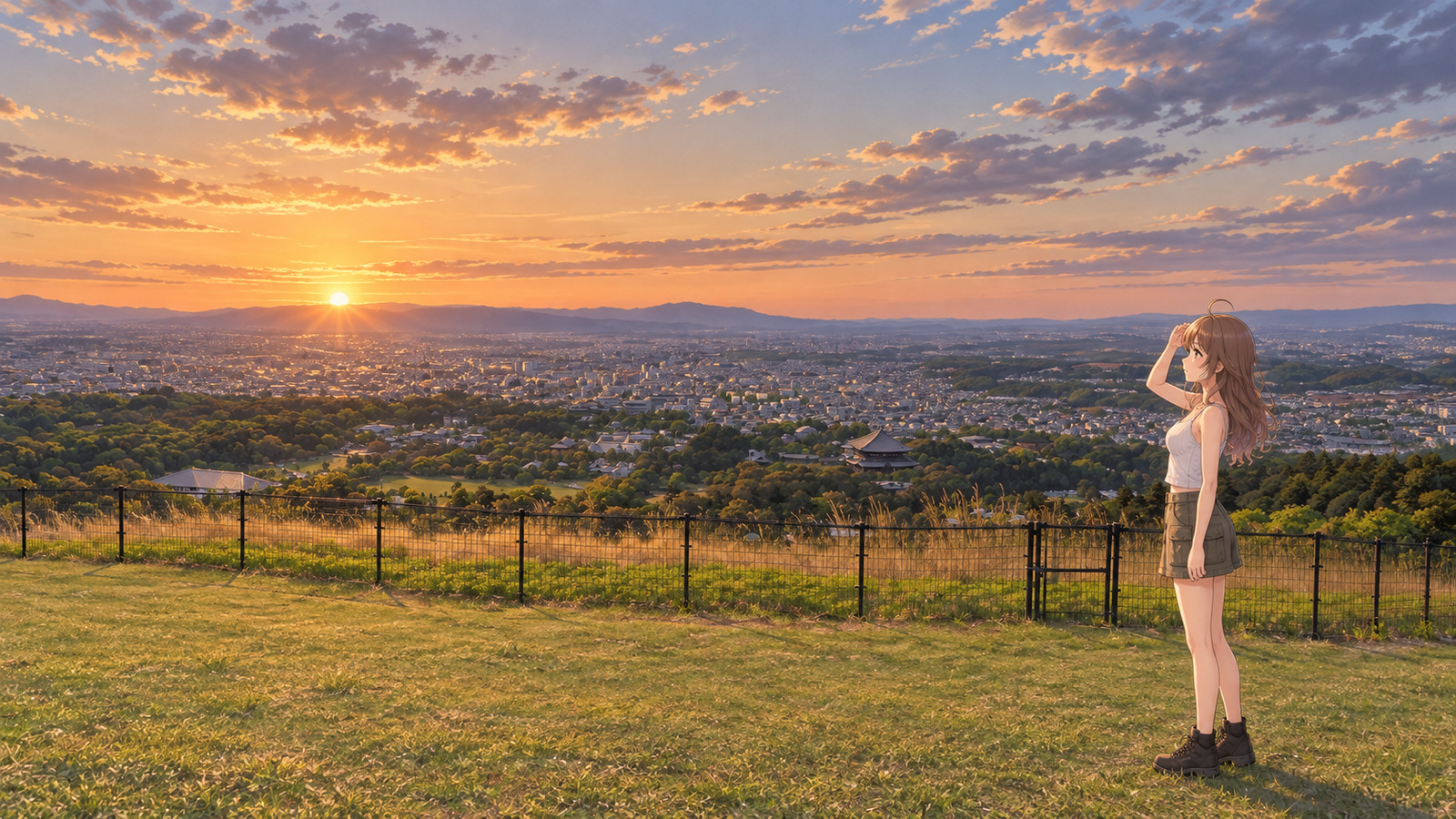
SummerJuly–August · late afternoon before sunset
Watch the sun sink toward the ridge, with the city below
Wakakusayama is famous for its night views, but I wanted to visit before dark. On day 3 of my 3-night summer trip through Kansai, I’d come to watch the sun set over Mount Ikoma straight ahead. I’d read that it was best to be on the mountain about 30 minutes before sunset to see the evening glow, so I timed my drive up the Shin-Wakakusayama Course accordingly. I reached the summit car park at the end of the course before the sun had sunk too low.
I stepped out of the car and walked 300m along the path to the viewpoint. It was still light enough to make out the rooftops and streets. The rooftops and roads still gave Nara its shape; a night view would be all lights. I’d come to watch the sunset, but before long I was looking for the streets I’d walked earlier that day. When I looked back up, the sun was edging toward the mountain range.
There aren’t any shops at the summit, but you can get drinks from a vending machine. I was thirsty after the walk, so I bought a cold drink, took a sip, and headed for the railing.
The low sun was dazzling, so I held one hand above my brow. My other hand rested lightly against the side of my cargo miniskirt as I watched the sun just above the mountain. The summit grass was under my black sneakers; beyond the railing were trees and the city. It’s lovely to pause here and watch the view change.
After looking at the ridge, I lowered my gaze to the city again. The buildings I’d seen so clearly a moment ago were gradually disappearing into the evening shadows. I followed the shadows from the trees nearest me, trying to see where they began, and noticed the rooftops closest to the mountains darkening first.
As the sun sank to just above the ridge, its light softened and Mount Ikoma’s outline came into sharp relief. The moment the sun touched the ridge, I dropped my hand from my brow and took 1 photo on my phone. It disappeared much faster than I expected: from the moment it touched the ridge, it sank quickly until only a sliver of light about as wide as my finger remained, then it slipped behind the mountain. The breeze on the back of my damp neck felt wonderful.
The sky above the mountain stayed bright for a while after the sun disappeared. Below, the first city lights began to flicker on here and there. I thought about staying for the night view, but I’d decided I was here for the sunset today, so I headed back.
While there was still some light in the sky, I walked the 300m path back to the car park. Before getting in, I sent the photo to my driving friend with just a few words: “I watched it disappear behind Mount Ikoma.”
Just as I started the engine, my friend replied, “Next time, stay for the night view.” I’ll save that for another trip. Before I switched on the headlights, I saw a few more of the first city lights appear beyond the trees.
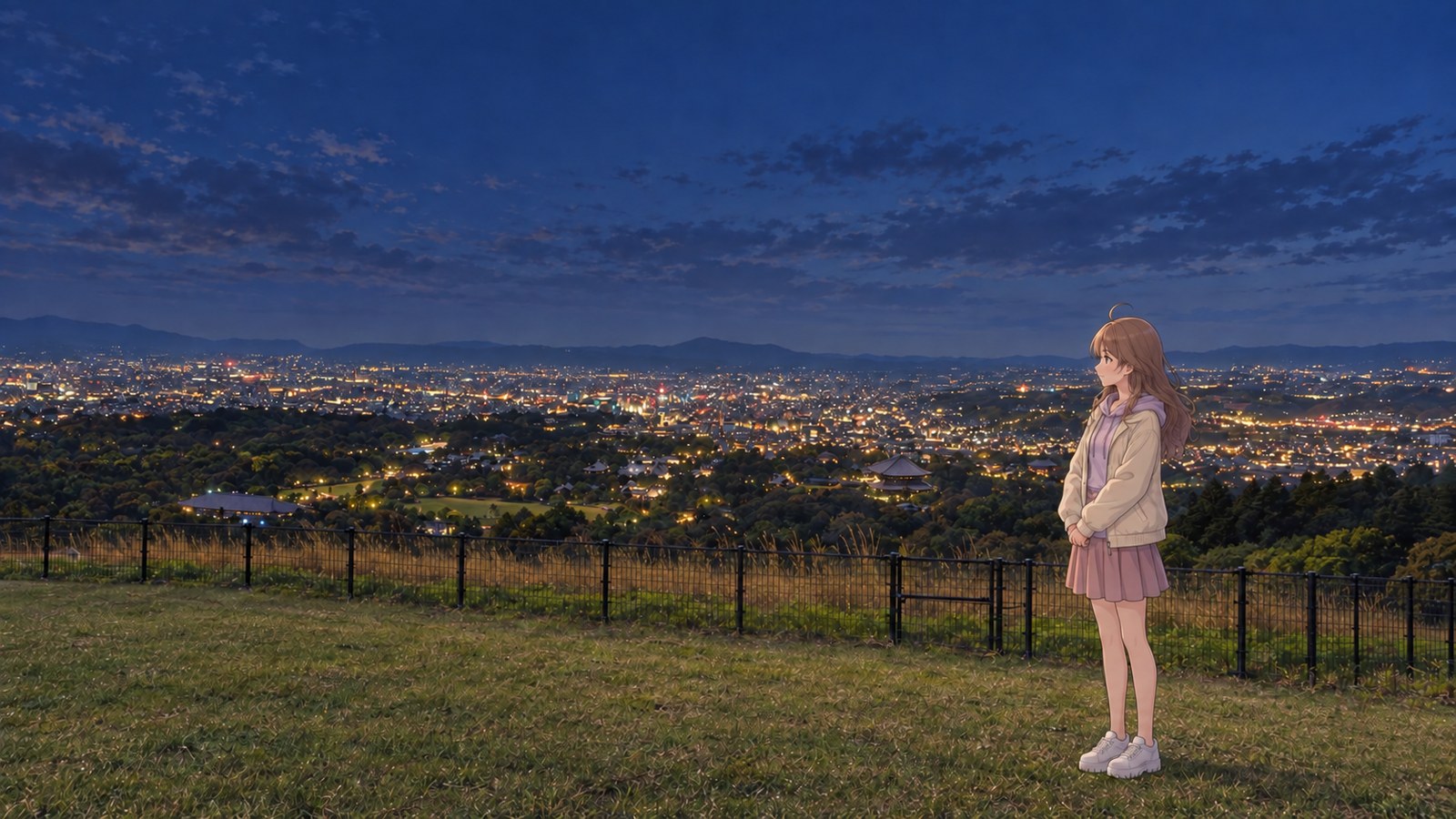
AutumnSeptember · from before sunset through nightfall
Pause by the railing as the city lights come on
On day 1 of my 2-night September trip around Kansai, I drove from Ariake to Nara in a red convertible. Just as I’d planned, I spent the day walking around town, then headed to Wakakusayama in the evening to watch the lights come on. I loaded the Mikasa sweets I’d bought in town into the car and set off on the Shin-Wakakusayama Course. The road kept curving as I climbed, and suddenly I was turning the wheel much more often. Along the one-way 3.7km drive, the bustle of the city gradually faded as the trees closed in.
Once I reached the summit car park, I got out and set off for the viewpoint. The path is a 300m ramp, so I started while the sky was still bright. I could feel the path through the soles of my sneakers and smell the grass close by. It would be dark on the way back, but I’d heard that little lights come on along the path at night.
At the railing, the Nara Basin opened out before me. As the distant mountains darkened, I began to pick out the city lights one by one. With my hands clasped in front of my cream-coloured jacket, I fixed my eyes on the first light that came on. I was going to use it as a marker and watch the other lights come on around it.
Just after sunset, only the sky above the mountain range was still bright. The city beneath it was already in shadow. It was a brief moment between day and night, and I was glad I’d arrived in time to see it.
The Shin-Wakakusayama Driveway guide said the best time for night views is about 30 minutes to 1 hour after sunset. I’d also read that Wakakusayama’s night view had been selected as one of Japan’s New Three Great Night Views. Two lights, then three, appeared around the one I’d picked as my marker. By the time I gave up trying to keep count, I’d lost track of which one had been my marker.
Among the lights of the city at night, I could see several straight lines of light stretching into the distance. Maybe they were car headlights moving along the roads. Thinking that one of those roads might connect to a street I’d walked that day suddenly made the city below feel close.
When I lowered my gaze, I could see a broad roof among the trees. From Wakakusayama, you can look out over the part of the city where Todaiji and Kofukuji stand, so I liked looking for the streets I’d walked during the day. I kept trying to spot where I’d turned at that corner earlier, and before I knew it, the sky had gone completely dark.
I compared the photos I’d taken, trying to choose 1 to send to my driving friend: one taken before many lights had come on, and another from after night had fully fallen. After some thought, I sent the earlier one, while I could still make out the first light I’d picked as my marker.
Small lights along the path lit the way for my 300m walk back. Each time I turned around, there were more lights in the city than before. I kept stopping to look, so the car park seemed a long way off.
Back at the car park, I opened the Mikasa sweets I’d bought earlier. I finished the fluffy cake and sweet bean filling in the cool night air on the mountain, then folded the wrapper into a small square. I picked a song for the drive back, switched on the headlights, gripped the wheel with both hands and headed down the winding road toward the city.
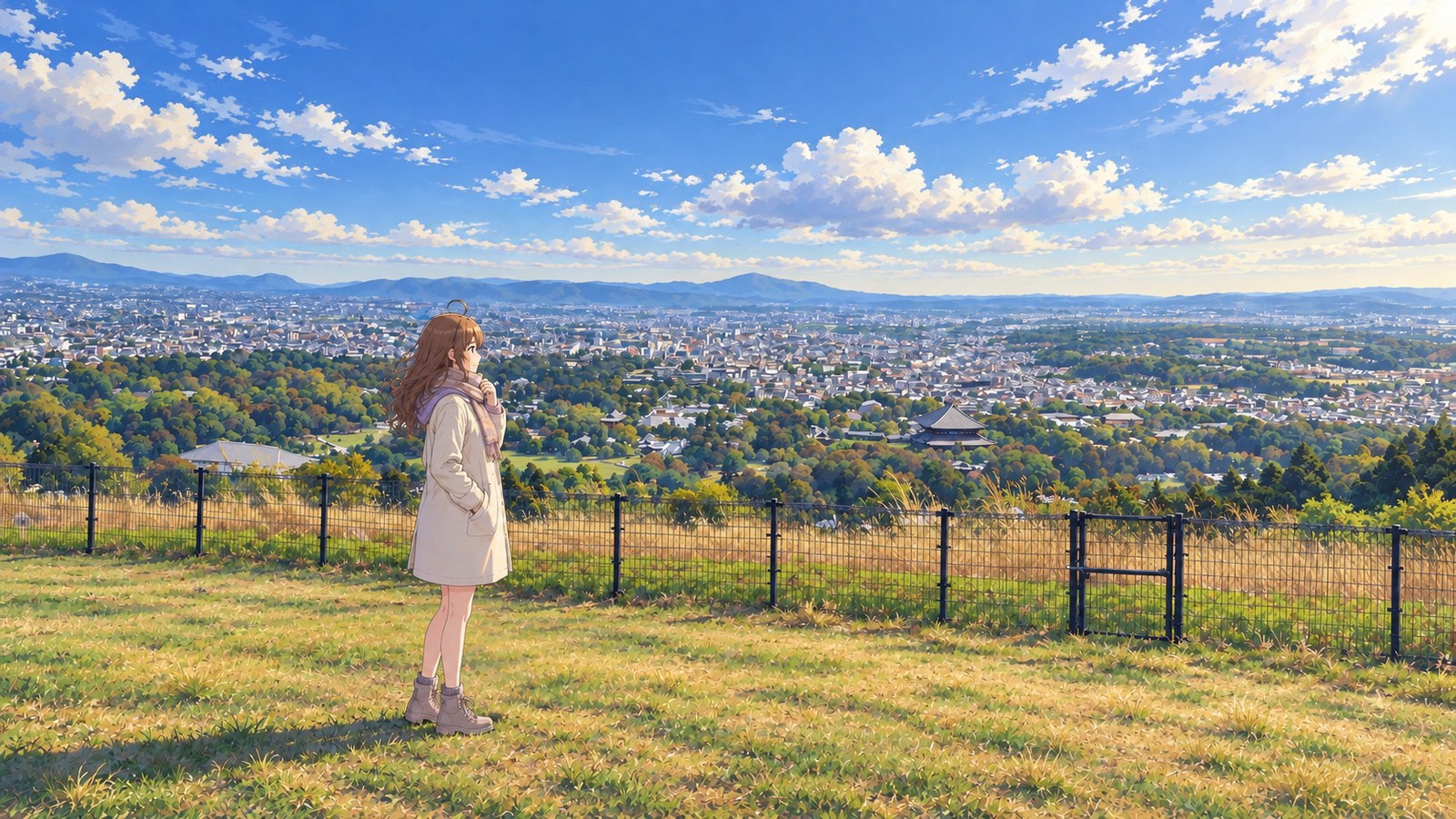
WinterJanuary–February · around 1 p.m. on a clear, snow-free day
Pull my scarf close and look out to the distant mountains
Day 3 of my 3-night winter trip through Kansai brought clear skies, no snow and the sort of chill you get in January or February. This time, I’d driven from Ariake in a red four-wheel-drive sedan. Hoping the crisp winter air would let me see the mountains beyond the city, I headed to Wakakusayama. I drove the Shin-Wakakusayama Course to the summit car park. Each time I entered a shaded bend, cold air rushed in, so I turned the heater up a notch.
I’d heard it was a little cooler at the summit than in town, but the moment I stepped out of the car, the cold pinched my cheeks and I understood. I hurried to button my coat all the way to the top.
I walked the 300m path with my coat still on. At the viewpoint, the grass spread out before a low railing, with Nara beyond. I was so glad I’d picked a clear, snow-free afternoon.
The winter grass was short and crackled under my shoes as I walked. It felt completely different from the soft grass I’d stepped on at summer dusk, so I walked toward the railing, deliberately making the grass crackle with each step.
I felt the wind and drew one end of my scarf up toward my chin. My other hand stayed in my coat pocket as I faced the city and mountains. Unlike when I’d waited for the night view, my gaze kept travelling farther and farther into the distance.
First I looked at the wooded slope, then the city rooftops, then the mountains beyond. I like to take in a clear winter view from near to far, in that order. I tried to count the layers of mountain ridges, but after the third one their outlines grew faint, and I couldn’t decide where one ended and the next began.
I took a deep breath by the railing, and the cold air stung the inside of my nose. I don’t think I could see this far when I came on a summer evening. The clear winter air lets you make out even the distant mountain outlines so sharply.
At the summit stands Uguisuzuka Kofun, a keyhole-shaped burial mound measuring 103m long. It’s also said to be the “Warbler’s Tomb” mentioned in The Pillow Book. I was standing right there, at a place that may have appeared in a book written over a thousand years ago. At the thought, I found myself treading more softly across the grass.
Back at the car park, I turned on the heater and took a break inside the car. As feeling returned to my cold fingertips, I looked at the mountain photo again. On the screen, the mountains beyond the third ridge were almost impossible to tell apart from the sky. I still wanted to send it, so I messaged it to my driving friend with the note, “Winter afternoons are lovely too.”
On the way down, I gripped the wheel again and followed the curves one at a time. Once I reached town, it felt a little strange to be driving between the rooftops I’d just seen from above. At the hotel, I looked through the photos again and marked a favourite: the one where I could still make out the third mountain ridge.
The story sections are fiction inspired by this location. For accurate information, please consult official tourism and information websites.
Photos of this place4 images
-
Nara City, Nara Prefecture · Spring afternoon
-
Nara City, Nara Prefecture · Summer dusk
-
Nara City, Nara Prefecture · Early autumn night
-
Nara City, Nara Prefecture · Clear winter afternoon
Local treats to enjoy on your trip
Mikasa sweets shaped like Wakakusayama
At Tsuruya Tokuman in Shimomikado-cho, Nara City, you’ll find Kenjo Mikasa, a sweet inspired by Wakakusayama. Pick some up in town beforehand for a little treat after your time on the mountain.
Highlights
The Nara Basin from the summit
From Wakakusayama, at an elevation of 342m, you can look out over the old capital’s cityscape and the distant mountains. Its night view has been selected as one of Japan’s New Three Great Night Views. Before taking a photo, I traced the view with my eyes from the nearby trees to the far-off mountains.
Road and walking route
Shin-Wakakusayama tollgate to the summit car park
- Shin-Wakakusayama Course (one way)
- 3.7km
- Wakakusayama’s elevation
- 342m
Drive 3.7km one way to the summit car park, then walk 300m to the viewpoint.
342m is the elevation of Wakakusayama. The driveway is 7.4km round trip, returning to the same tollgate.
More Spot Guides
If you enjoyed this story, you might like these places too. I've gone back to each of them in different seasons, again and again.