Katsuyama City, Fukui Prefecture
At Heisenji Hakusan Shrine I stopped on the approach and noticed the light on the moss
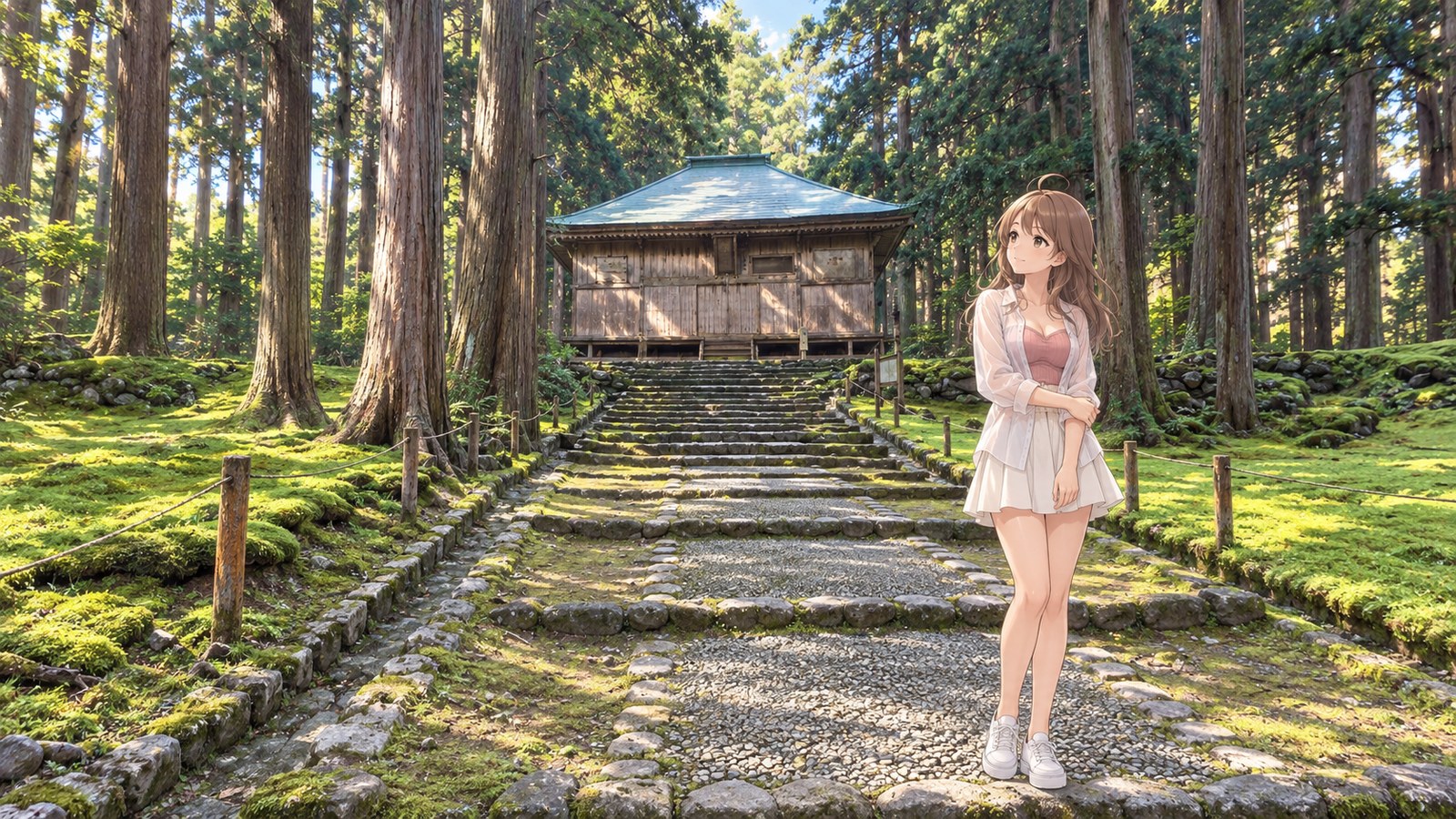
I stopped on the approach, holding the cuff of my white shirt in one hand. Sunlight filtered through the cedars onto the moss; before I looked at the building ahead, I was already gazing at the light underfoot.
Read the story of a June walk along the approach, with highlights on the moss and the shrine’s history.
SummerJune
I stopped on the approach and noticed the light on the moss
I hadn’t realized moss could cover so much ground. The moment I stepped onto the approach at Heisenji Hakusan Shrine in early summer, my pace slowed. I could see the worship hall through the trees, but my eyes went first to the moss on either side of the path.
I held the cuff of my white shirt in one hand and stopped on the stone approach. Sunlight slipped between the cedar trunks, brightening just one patch of moss. As I compared the sunlit patch with the shaded areas, the moss seemed soft and thick in one spot, even though it was all the same ground.
It’s said that Taichō Daishi founded this place in 717. I’d heard it was an important center for Hakusan worship on the Echizen side. I’d come for a quiet walk in the woods, but imagining how many people had passed along this approach made even the stones before me look different.
After taking a few more steps, I stopped again; the cedar trunks now overlapped in a different pattern. A roof appeared between them, and the stones of the approach continued toward it. I wanted to take a photo, but first I wanted to take in the depth of the view with my own eyes.
I’d assumed it was a temple because it’s called Heisenji. Then I learned that its temple designation was abolished during the Meiji-era separation of Shinto and Buddhism, and it became Hakusan Shrine. I nodded. “Ah, that makes sense.” Even the name holds a bit of history. There was more to this place than the moss and cedars I’d come to see.
After walking the grounds, I was curious about the nearby Mahoroba history center, and I wanted a bowl of Katsuyama oroshi soba, too. My time here had been so quiet, yet by the time I left, my list of places to see had grown. I have a feeling I’ll stop again on that approach the next time I come, to watch the light fall on the moss.
The story sections are fiction inspired by this location. For accurate information, please consult official tourism and information websites.
Local specialty
Katsuyama Oroshi Soba
In Katsuyama, you can find restaurants serving oroshi soba, buckwheat noodles topped with grated daikon. At Hachisuke, locally grown Katsuyama buckwheat is milled and the noodles are made by hand. After walking the grounds, I’d love to try this local specialty, too.
Highlights
An approach surrounded by moss and cedars
The grounds are blanketed in moss, and the shrine is also known as “Moss Shrine” and “Moss Temple.” I stopped, holding my cuff in one hand, and was captivated by the interplay of sunlight and shade across the moss.
Discover Hakusan’s history at Mahoroba
Nearby is Mahoroba, the Hakusan Heisenji history center. If walking the grounds leaves me wanting to learn more about Heisenji’s past and Hakusan’s natural landscape, I’d like to stop in, too.
Road information
Road to Heisenji Hakusan Shrine
Head to Heisenji in Katsuyama City. You can explore the shrine grounds on foot.
Once you arrive, take your time looking at the moss on either side of the path. I ended up spending more time standing still than walking.
More Spot Guides
If you enjoyed this story, you might like these places too. I've gone back to each of them in different seasons, again and again.